Quick Summary
- Start from one revenue goal and the single funnel stage that limits it, not from a list of channels.
- Rank experiments by impact, confidence and effort so your first month goes to the likeliest wins.
- Run a fixed weekly cadence with two or three live tests, and write down every result, including failures.
- Scale a channel only after it pays back at a volume that still holds when you double the spend.
A growth marketing strategy is a ranked set of bets on the parts of your funnel that hold back revenue. If you want help turning that into a working plan, growth marketing consulting starts with exactly this kind of diagnosis, and the six phases below follow the same order I use with clients.
I wrote this for owners and marketing leads who already spend money on marketing and suspect it is spread too thin. Each phase is short on purpose. You can finish the first three in a week and be running your first test the week after.
The Six Phases at a Glance
| Phase | What you decide | Typical time | Output |
|---|---|---|---|
| 1. Goal | One revenue target and a deadline | 1 day | A one-line goal with a number |
| 2. Diagnosis | Which funnel stage limits growth | 2 to 4 days | A funnel table with conversion rates |
| 3. Channel bets | Where the next customers come from | 2 days | Two primary channels, one wildcard |
| 4. Backlog | Which experiments run first | 1 day | A ranked list of 15 to 25 ideas |
| 5. Cadence | How you run and review tests | Weekly | An experiment log and a decision rule |
| 6. Scaling | When a win gets more budget | Monthly | Spend rules and a payback limit |
Phase 1: Pin the Goal to One Number
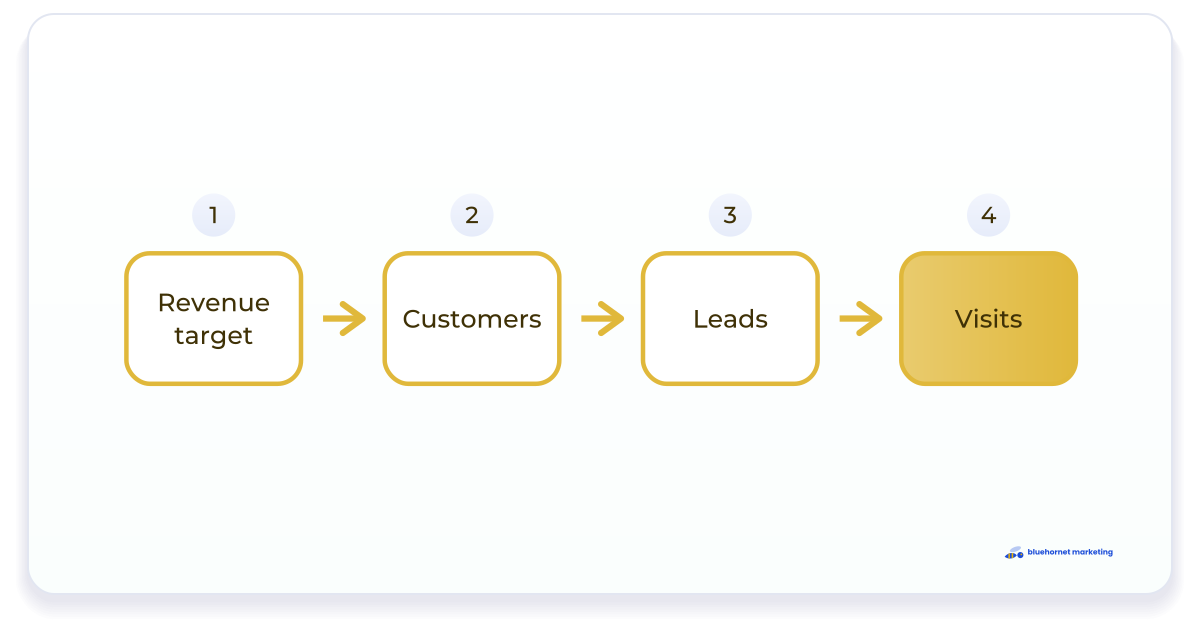
Most weak strategies fail in the first sentence. "Grow awareness" and "get more leads" cannot be tested. A usable goal looks like "add 40 new paying accounts per month by the end of June at a blended acquisition cost under $900." It has a number, a date and a cost limit, so every later choice can be checked against it.
Work backwards from revenue. If an average customer is worth $6,000 over their lifetime and you want $240,000 of new lifetime value per quarter, you need 40 customers. Then divide by your close rate to get the lead volume you need. I do this on one page with the client before anything else, and it often shows that the goal and the budget cannot both be true.
Phase 2: Find the Stage That Limits Growth
Draw your funnel as five stages: visit, lead, qualified opportunity, customer and retained customer. Fill in the real conversion rate between each pair. The stage with the biggest gap against a sensible benchmark is where your first experiments belong. A leaky top of funnel and a leaky onboarding call for completely different work, and I regularly meet teams that pour budget into traffic while half of their new customers leave within ninety days.
Good tracking comes before the diagnosis. If your analytics cannot tell you which source produced a customer, spend the first fortnight on that. The same applies to your CRM: lead status fields that nobody fills in make every conversion rate a guess. A short marketing technology audit is the fastest way I know to check whether your data can be trusted.
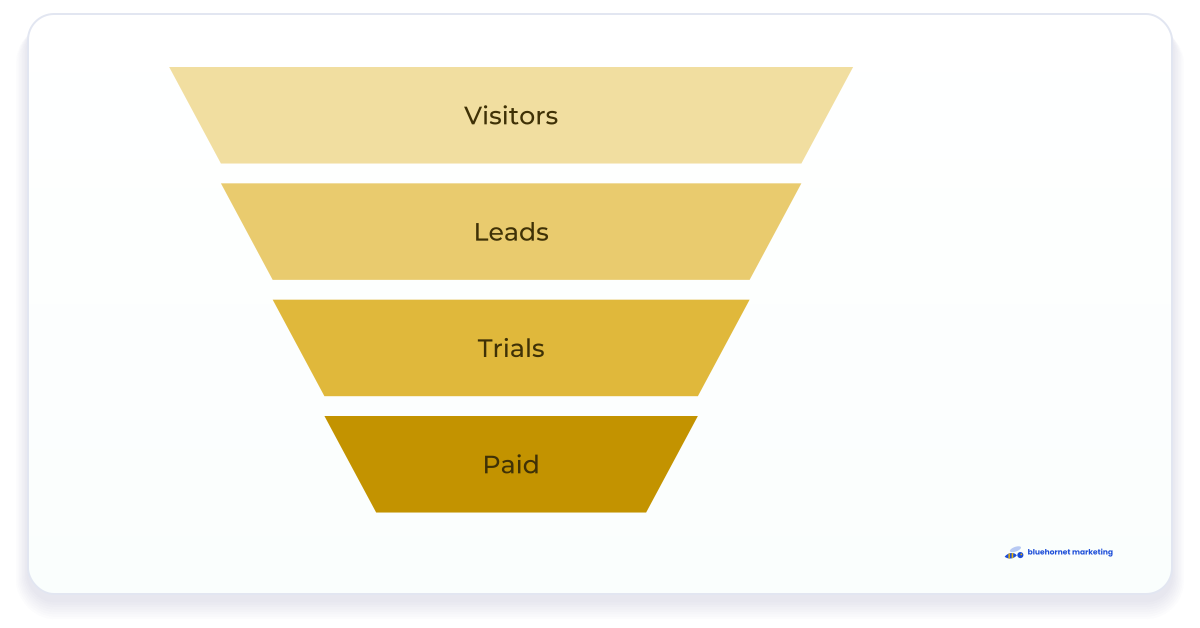
Write the diagnosis as a table with three columns: stage, current rate and what a healthy rate would look like for your model. Keep the benchmark honest. Use your own best month or a published figure for your sector, and name the source next to it.
Phase 3: Place Bets on Two Channels and One Wildcard
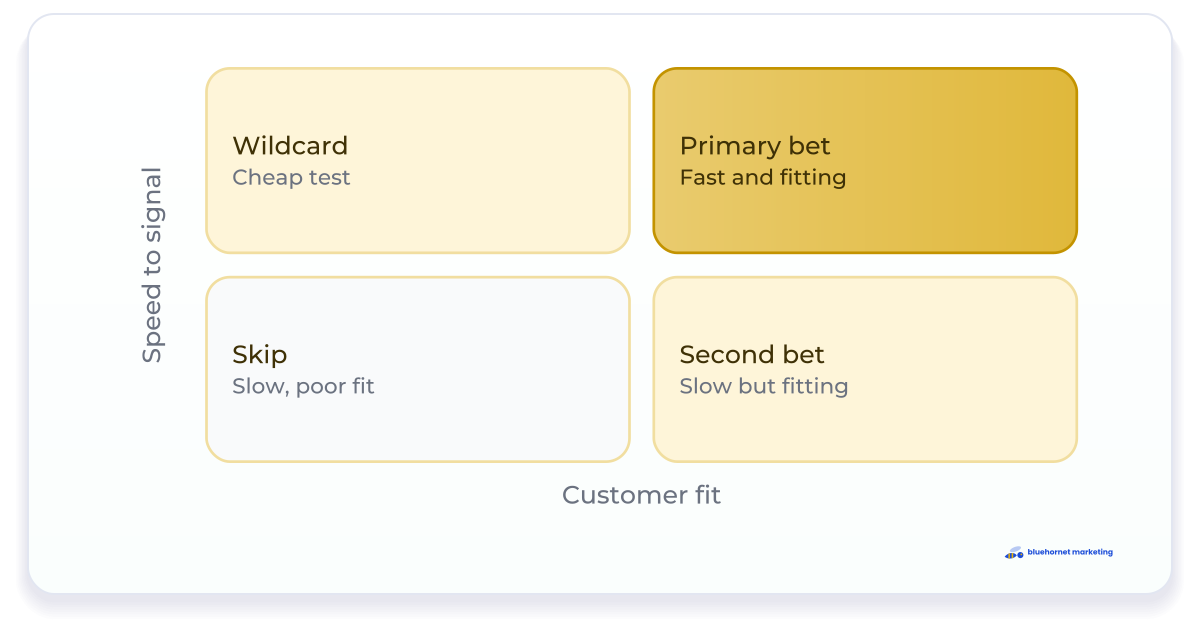
Spreading effort across seven channels guarantees none of them gets enough attention to work. I ask clients to pick two primary channels where their buyers already spend time, and one wildcard that gets about ten percent of the effort. The primary channels are where you build depth: search content, outbound, partnerships, paid social or lifecycle email. The wildcard is where you look for the next primary channel.
Choose with three questions. Where do your best existing customers say they found you? Where can you reach a buyer for less than your cost limit from phase one? And which channel can you test in two weeks, not two quarters? A founder-led B2B company will often land on outbound and one content format. A subscription ecommerce brand will land on paid social and lifecycle email. If you are early, growth marketing for startups covers how to choose when you have almost no data.
Phase 4: Build and Rank the Experiment Backlog
Collect every idea in one sheet: landing page headline changes, a new lead magnet, a pricing page layout, a referral offer, a reactivation email, a partnership outreach batch. Aim for 15 to 25 ideas. For each one write the hypothesis in one line: "If we change X for audience Y, metric Z will rise by about N because of reason R." The reason is the part people skip, and it is the part that teaches you something when a test loses.
Then score each idea from 1 to 5 on impact, confidence and ease, and rank by the average. The scores are rough on purpose. Their job is to stop the loudest voice in the room from picking the first test. You can see worked examples of tests that came out of this kind of backlog in these growth marketing examples.
| Idea | Impact | Confidence | Ease | Score |
|---|---|---|---|---|
| Rewrite pricing page headline and first screen | 4 | 3 | 5 | 4.0 |
| Add a three-email onboarding sequence | 4 | 4 | 3 | 3.7 |
| Launch a customer referral offer | 5 | 2 | 2 | 3.0 |
| Test a new paid social audience | 3 | 2 | 4 | 3.0 |
Phase 5: Run a Weekly Cadence That You Keep
The cadence is the engine of the strategy. Every week, hold a 30-minute review. Close any test that reached its planned sample or end date, record the result and the decision (ship, drop or retest), and start the next test from the top of the backlog. Cap live tests at two or three. Keep a single experiment log with the hypothesis, dates, sample size, result and what you learned.
Decide the stopping rule before the test starts. Peeking at results every day and stopping when they look good is the most common way I see teams fool themselves. If your traffic is too low for a clean A/B test, run before-and-after comparisons over a longer window and treat the result as a directional signal, not proof.
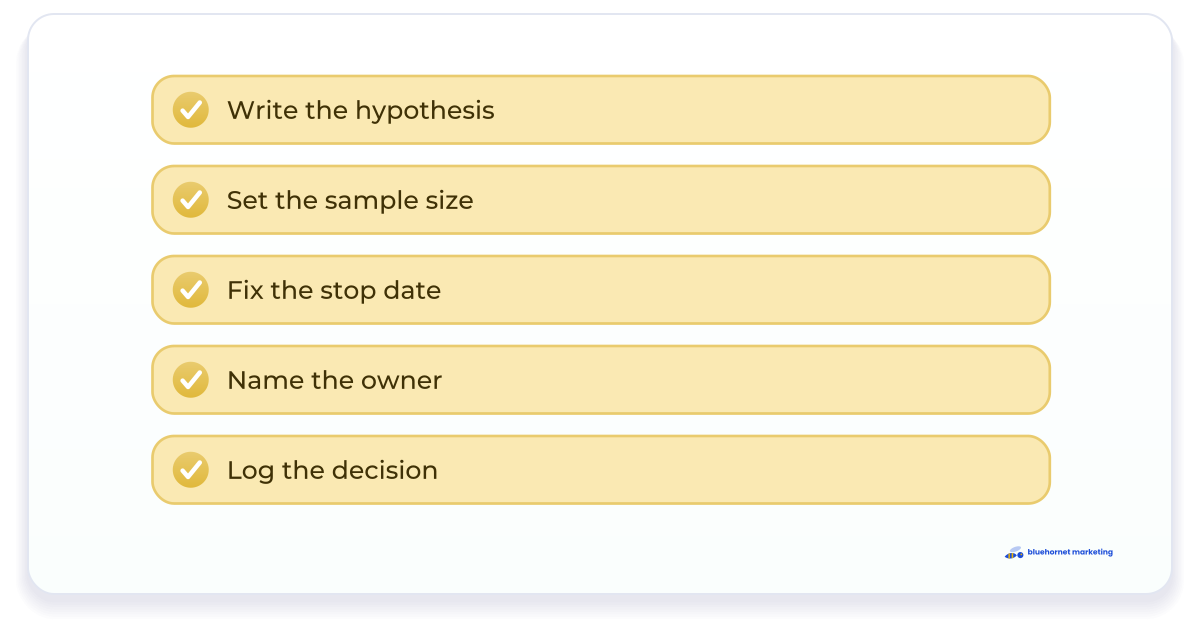
A cadence also needs an owner. One person is accountable for the log, even when several people run tests. Without that, the log stops after a month and the strategy quietly turns back into a list of campaigns. If you are choosing a structure for the whole loop, the stages in this growth marketing framework map neatly onto the weekly review.
The Tools the Cadence Needs
You do not need a large stack. You need analytics that follow a visitor to revenue, a CRM or billing tool that records the outcome, a way to build landing pages and emails without a developer, and a sheet for the log. Add session recordings or an experimentation tool once you have the traffic to use them. My shortlist of growth marketing tools compares the main options by price and by the team size they suit.
Phase 6: Decide When to Scale a Win
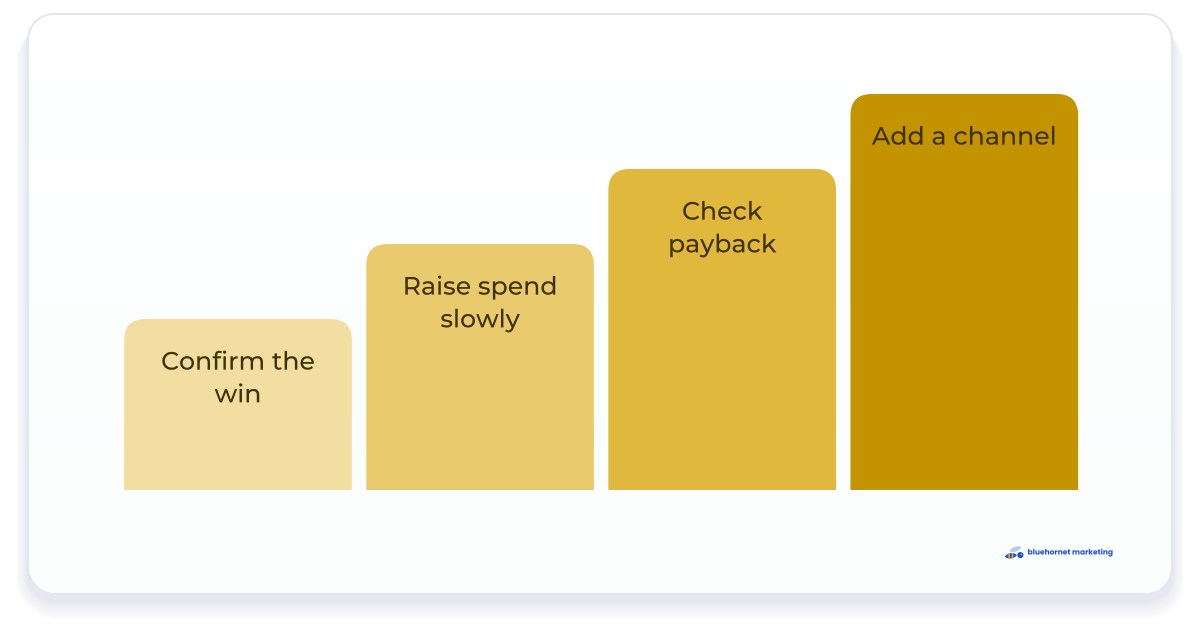
A winning test is not a green light by itself. Before you raise the budget, check three things: the result held for at least two cycles, the payback period is shorter than your cash can stand, and the channel does not collapse when you double spend. Paid channels usually show rising costs as you scale, so raise spend in steps of 20 to 30 percent and watch cost per acquisition for a full week before the next step.
For lifecycle and referral gains, scaling means rolling the change out to every segment and then checking retention after ninety days. A gain in signups that disappears from the retention curve is a cost, not a win. Write the scaling rule next to each channel in plain words: "Raise spend 25% weekly while payback stays under 5 months. Stop at 7 months."
How to Divide Your Time and Budget
A first-year split that I see work for small teams is roughly 40 percent on measurement and conversion work, 35 percent on the two main channels, 15 percent on retention and 10 percent on the wildcard. It changes as the funnel changes. When acquisition is healthy and churn is the problem, flip the retention and channel shares.
| Area | Share of effort | Typical work |
|---|---|---|
| Measurement and conversion | About 40% | Tracking fixes, landing pages, pricing page, form flow |
| Two main channels | About 35% | Content, outbound, paid or partner programs |
| Retention and referral | About 15% | Onboarding emails, check-ins, review requests |
| Wildcard channel | About 10% | One cheap test every few weeks |
Where Strategies Break in the First Quarter
Three failures show up again and again. The first is a goal that nobody owns, so priorities drift to whoever shouts. The second is testing small cosmetic changes because they are easy, while the funnel stage that limits growth stays untouched. The third is a missing decision rule, so each result triggers another meeting instead of a decision.
There is a fourth, quieter one: the strategy lives in a slide deck. Put the goal, the funnel table, the ranked backlog and the log in one shared workbook that the team opens every week. If your team relies on several disconnected tools to keep that log, the plan for marketing technology rollout shows how to tidy the stack before it slows you down.
How to Pick Your First Priority
If you are unsure where to begin, use this order. First, fix measurement if you cannot trace customers to sources. Second, fix the stage with the biggest drop. Third, add the channel that your best customers already point to. Run this checklist before you commit your first month:
- You have one goal with a number, a date and a cost limit.
- You know the conversion rate at each funnel stage.
- You have named two primary channels and one wildcard.
- Your backlog is ranked and the top two tests have an owner and an end date.
- Someone is accountable for the weekly review and the log.
If three or more of these are missing, a short outside review saves weeks. I have seen a half-day workshop turn a vague plan into a ranked backlog that a small team could start on Monday.
Questions About Building a Growth Marketing Strategy
What Is a Growth Marketing Strategy?
It is a written plan that ties your revenue goal to the funnel stages that limit it, then lists the experiments you will run to move each stage. Unlike a classic marketing plan, it expects most ideas to fail and builds in a weekly review so you learn quickly which ones work.
How Is Growth Marketing Different from Digital Marketing?
Digital marketing describes the channels you use. Growth marketing describes how you decide what to do with them: you measure the whole funnel from first visit to retained customer and run small tests where the numbers say the biggest gap is. The same channels can serve either approach.
How Many Experiments Should I Run at Once?
For a team of one to three people, two or three at a time is plenty. In my client work, teams that run more than that rarely finish the analysis, and unread results are the same as no test at all. Raise the number only when you consistently close tests on schedule.
How Long Before a Growth Strategy Shows Results?
A first winning test usually shows up within four to eight weeks if you have enough traffic or leads to read a result. Compounding gains from retention and referral work take a quarter or more. If you have very little traffic, start with channels where you can talk to buyers directly.
What Budget Do I Need?
Time matters more than media spend early on. Many first-year plans I see put two thirds of the effort into tracking, landing pages and lifecycle email, and only a third into paid media. Set a test budget you can afford to lose entirely, then scale only what pays back.
Which Metrics Belong on My Growth Dashboard?
Pick one north star metric tied to customer value, then four or five stage metrics such as visitor-to-lead rate, activation rate, payback period and month-three retention. Keep the dashboard to one screen. If a number never triggers a decision, remove it.
Should I Hire an Agency or a Growth Consultant?
Hire help when you lack tracking skills, test design experience or the hours to run a weekly cadence. A good partner sets up measurement, picks the first tests with you and hands the process over. Ask for the experiment log and the decision rules, not just a monthly report.
Disclaimer: This article is for general information only and isn’t legal, financial or tax advice. Treat figures as estimates from typical work and confirm details with your providers before you act.
Was this guide helpful?
Thanks for your feedback.
Warren Albright
Warren leads the Blue Hornet editorial team and works with the consultants to turn real client projects into practical guides on content, paid media, marketing automation, CRM and analytics. He comes from content and demand generation work, edits every article before a working marketing consultant reviews it, and draws on strategies, channel plans and audits from client projects to keep the advice grounded in real numbers.