Quick Summary
- A good roadmap has five phases: baseline, pilot, integrate, roll out and govern, each ending in a go or no-go decision.
- Start with a pilot of 6 to 8 weeks on one workflow, one team and one metric before you buy anything at scale.
- Integration and training take more time than the purchase itself, so plan for them in the schedule and the budget.
- Review the roadmap every quarter and retire a tool for every new one you add.
Most marketing technology plans fail in the middle. The purchase goes fine, the first demo impresses everyone, and then the tool sits half-configured while campaigns run on spreadsheets. A roadmap prevents that by putting order, owners and decision points between the idea and a working stack. If you want help building one from your own numbers, my team does that as part of marketing technology consulting.
Below is the five-phase roadmap I use with clients, from a first look at what you own to a rollout that sticks. Each phase is short on purpose. You can run all five in about 12 months, or stop after phase two if the pilot shows you do not need more.
Five Phases in Brief
Read the table first, then jump to the phase you are in. Durations are what I see most often in mid-sized teams, not a promise for yours.
| Phase | Typical length | Main output | Decision at the end |
|---|---|---|---|
| 1. Baseline | 2 to 4 weeks | Tool inventory, owner list, one-page goals | Which workflow to fix first |
| 2. Pilot | 6 to 8 weeks | One working workflow with measured results | Scale, adjust or stop |
| 3. Integrate | 4 to 8 weeks | Connected CRM, email, ads and reporting | Is data trusted by sales and marketing? |
| 4. Roll Out | 8 to 12 weeks | Every team on the new workflow, training done | Retire the old tools |
| 5. Govern | Ongoing, quarterly | Review rhythm, ownership, tool budget | Add, keep or cut each tool |
Phase 1: Baseline Before You Buy
Start with what you already have. List every tool that touches a lead, a customer or a report, including the free ones and the ones a single person set up years ago. For each, write down the owner, the monthly cost, the main use and the last time someone logged in. If you want a proper scoring method, my marketing technology audit framework goes through it line by line.
Then write one page of goals. Pick two or three numbers that matter, such as cost per qualified lead, time from form fill to first sales contact, or the share of revenue you can trace to a channel. Without those numbers, you cannot tell later whether the roadmap worked.
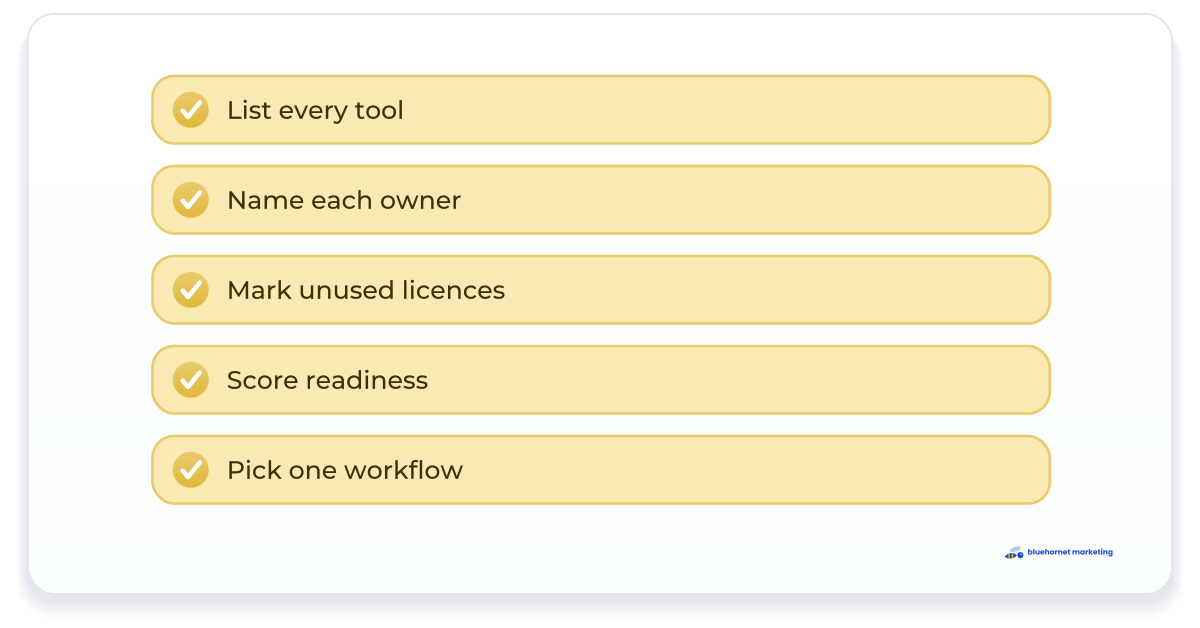
This phase also needs an honest read on your team. Ask whether people have the time and skill to run a new tool. The marketing technology assessment I use scores readiness across data, people and process, and it often shows that training matters more than another license.
Phase 2: A Pilot You Can Switch Off
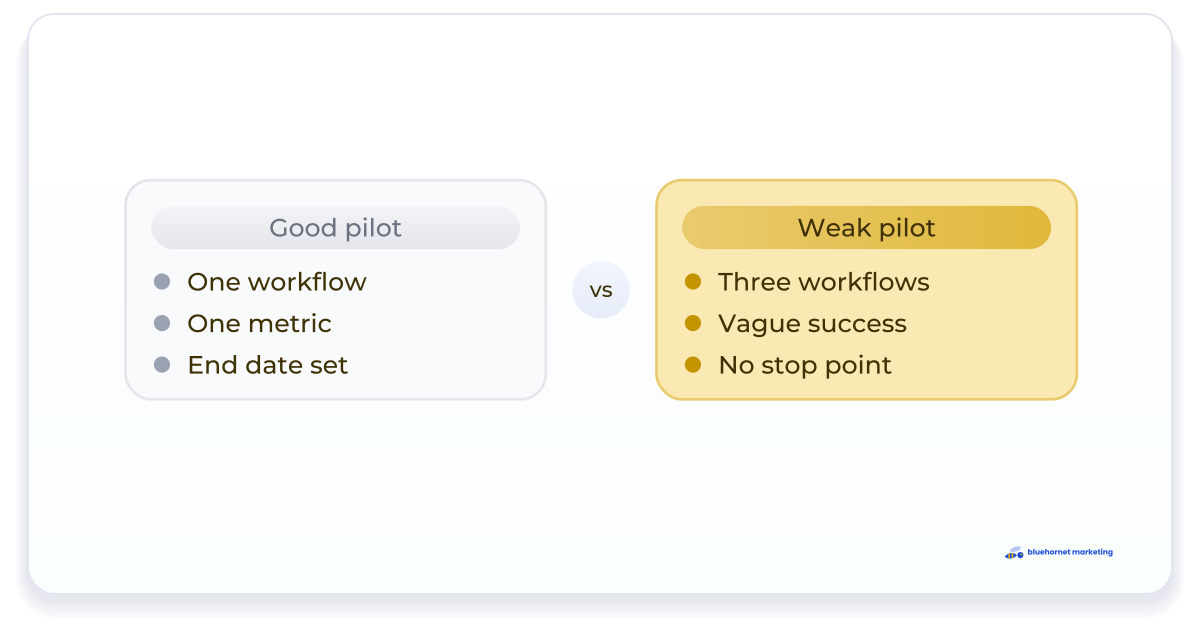
Choose one workflow where the pain is clear and the risk is small. Good candidates are lead routing for one product line, a welcome email series, or a single dashboard that replaces a weekly manual report. Set a start date, an end date and one success metric before you touch the tool.
Keep the pilot team small: the person who will own the tool, one user from sales or service, and someone from IT or operations for access and data. Meet for 20 minutes each week. At the end, compare the result to the baseline and decide in the room. Scale, adjust or stop are all valid answers, and a stopped pilot that cost six weeks is far cheaper than a failed rollout that cost six months.
A pilot also tells you things a vendor demo never will: how long the import really takes, which fields do not map and how much cleanup your data needs. Write those down, because they become your estimates for phase four.
Phase 3: Integrate Your Core Systems
Once the pilot works, connect it to the systems around it. For most teams that means the CRM, the email platform, the website forms, ad accounts and one reporting layer. The goal is a single path for a lead from first click to closed deal, with the same IDs in every system.
Agree on definitions before you build connections. What counts as a marketing qualified lead? Which source field wins when two systems disagree? In my client work, these arguments take longer than the technical setup, and skipping them produces dashboards that nobody trusts. Document the answers in one shared page.
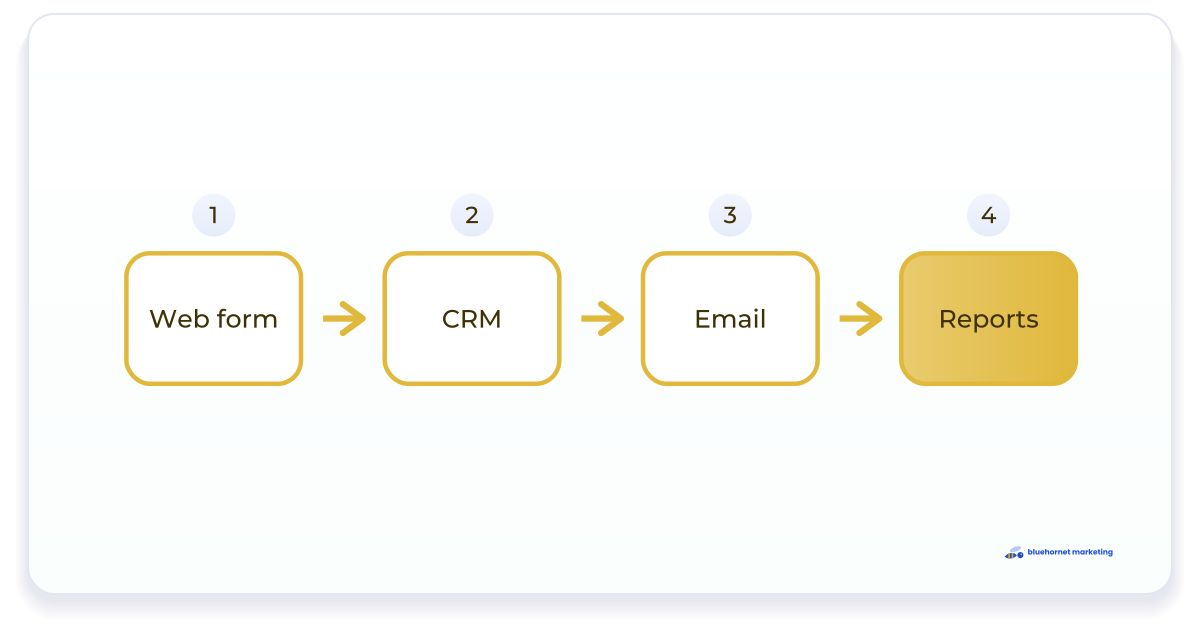
For ideas on how other companies connect their stacks, look at these marketing technology examples, then test your own flow with real records: submit a form, follow it through every system and check that nothing is duplicated or lost.
Phase 4: Roll Out to Every Team
Roll out in waves. Move one team or one region at a time, give each a short training session and keep the old tool read-only for 30 days so nobody loses history. Appoint a champion in each team who answers questions in the first month.
Training deserves its own line in the plan. A 45-minute session with your own data beats a vendor webinar every time. Record it, add a one-page cheat sheet and put both where new hires will find them.
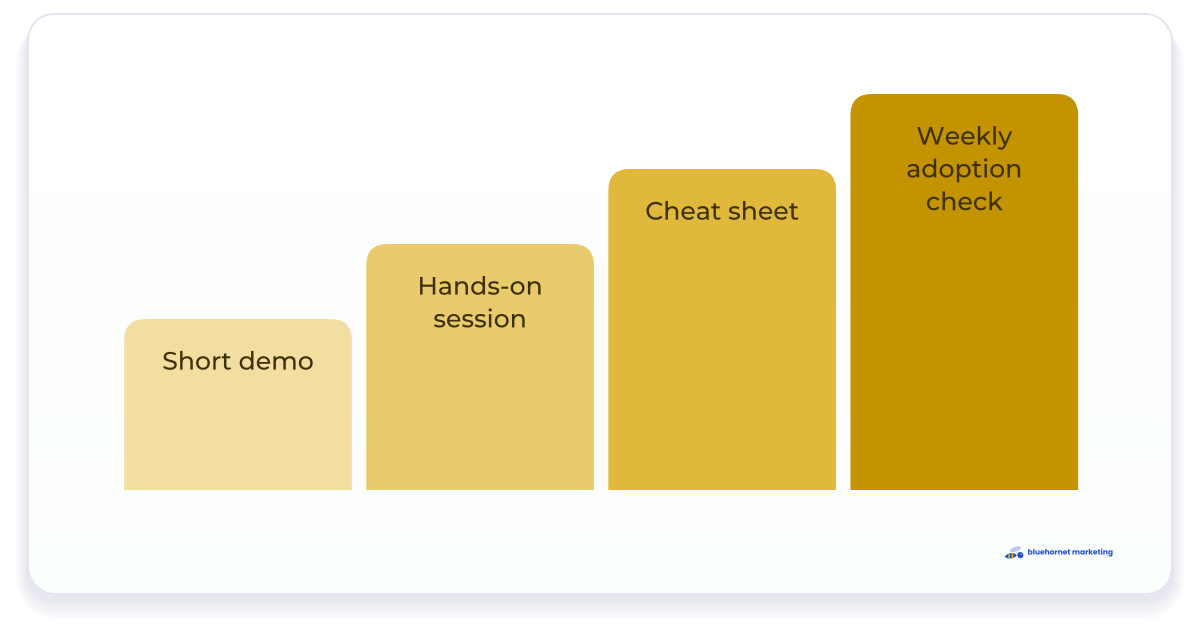
Track adoption weekly during this phase: logins, records created, campaigns launched in the new tool. If a team is below target after two weeks, visit them and ask what is in the way before you add reminders.
Phase 5: Govern the Stack You Built
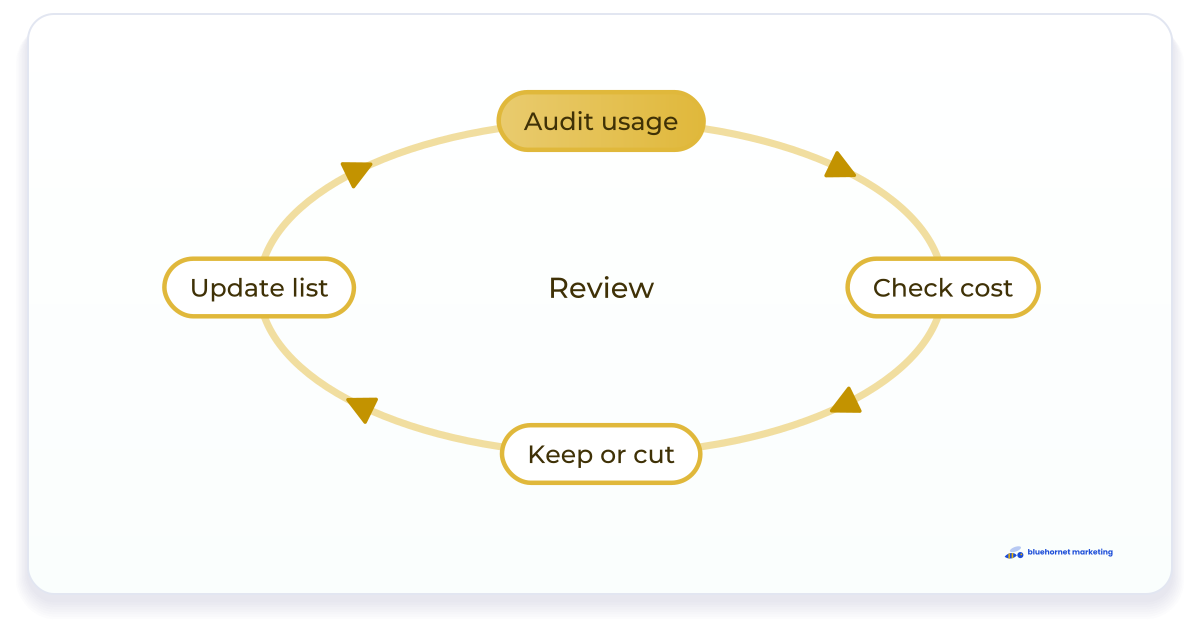
A roadmap ends in a rhythm, not a finish line. Hold a 60-minute review every quarter. Look at cost per tool, usage, results against the goals from phase one and the list of requests for new tools. Use one rule: every new tool needs a named owner, a success metric and an older tool it replaces or justifies.
When you need the market view for that conversation, my martech tools ranking compares current options. It helps to keep a short list of approved tools by category, so teams stop buying overlapping software on department cards.
The numbers behind this problem are large. The Martech landscape counted 15,384 solutions in 2025, according to Chiefmartec, so the supply of shiny options will not slow down. My marketing technology statistics collection has more figures you can use in your budget case.
A Twelve-Month View of the Roadmap
Here is how the phases usually sit on a calendar for a team of ten to thirty people. Months one and two go to the baseline and the pilot kickoff. Months three and four hold the pilot itself and its review. Months five to seven cover integration, because connections need testing with live data before anyone trusts the reports. Months eight to eleven are the rollout in waves, and month twelve is the first governance review with a budget decision for the next year.
Delays are normal. Procurement, security reviews and key people on vacation add weeks. In my client work, a roadmap that fits twelve months on paper often needs fourteen in practice, so leave slack between phases and do not promise the whole plan to leadership as a fixed date. Promise the decision gates instead: a pilot result by a named month, an integration test by another and a rollout decision after that.
Keep the plan visible. A one-page timeline on a shared board, updated every two weeks, does more for alignment than a long document. Show the current phase, the next gate, the owner and any blocker, and nothing else.
What the Roadmap Costs and Where Teams Slip
Budget the roadmap in four lines: licenses, implementation help, training and a buffer of 15 to 20 percent for integrations that turn out harder than expected. That buffer is my own rule of thumb from client plans, not an industry standard, so adjust it to your risk.
| Where it slips | In practice | Fix |
|---|---|---|
| No owner | Tool is bought, nobody configures it | Name the owner in phase one |
| Dirty data | Imports fail, duplicates multiply | Clean 10 to 20 percent of records first as a test |
| Scope creep | Pilot adds a second and third workflow | One workflow, one metric, one end date |
| Weak training | Spreadsheets return within a month | Short session on real data plus cheat sheet |
| No retirement | Old and new tools both stay on the invoice | Set a shutdown date at rollout start |
How to Choose Your Starting Phase
You do not have to begin at phase one. Use these checks to find your entry point:
- You cannot list your tools, owners and costs: start at phase one.
- You know your stack but have a clear pain point: start at phase two with a pilot.
- Tools work alone but reports disagree: start at phase three.
- One team is happy and the others are not: start at phase four.
If the answers are mixed, begin with the baseline anyway. Two weeks of inventory often saves two months of rework later.
Questions About Marketing Technology Roadmaps
How Long Should a Marketing Technology Roadmap Cover?
I plan in 12-month roadmaps with a detailed first 90 days and a looser second half. Tools, vendors and your own priorities change too fast for a three-year plan to stay accurate. Review the roadmap every quarter and move items between phases as results come in.
Who Should Own the Roadmap?
One person in marketing should own it, usually the head of marketing or marketing operations. IT, sales and finance contribute, but a roadmap with five owners gets no decisions made. The owner runs the quarterly review and holds the budget line for the whole plan.
Should We Replace Our Whole Stack at Once?
Rarely. Big-bang replacements break reporting, stall campaigns and tire out your team. Pick one workflow, such as lead capture to CRM handoff, fix it end to end and move on. Most teams I work with replace two or three tools a year, not twelve.
How Much Budget Should I Set Aside?
Plan for licenses, implementation help, training and a buffer for integrations. Implementation and training often cost as much as the first year of the license, so a tool that looks cheap on the pricing page can still be expensive to adopt. Ask vendors for a written estimate of setup effort before you commit.
What Should I Pilot First?
Pick a pilot where one team, one channel and one metric are involved, such as lead routing for a single product line. A good pilot lasts 6 to 8 weeks, has a clear baseline and can be switched off without hurting revenue if it fails.
How Do I Get Sales to Adopt New Marketing Tools?
Involve one or two sales reps in the pilot and let them shape the fields, alerts and handoff rules. Adoption follows when the tool saves them time in their first week. Show them the before-and-after in lead response time, not a feature tour.
Do I Need a Consultant to Build the Roadmap?
No, but an outside view helps when your team is too close to the tools or when politics blocks decisions. A short assessment and audit give you the inputs, and a consultant can pressure-test the sequence and cost before you present it internally.
Disclaimer: This article is for general information only and isn’t legal, financial or tax advice. Treat figures as estimates from typical work and confirm details with your providers before you act.
Was this guide helpful?
Thanks for your feedback.
Warren Albright
Warren leads the Blue Hornet editorial team and works with the consultants to turn real client projects into practical guides on content, paid media, marketing automation, CRM and analytics. He comes from content and demand generation work, edits every article before a working marketing consultant reviews it, and draws on strategies, channel plans and audits from client projects to keep the advice grounded in real numbers.