Quick Summary
- A content marketing checklist covers ten areas: strategy, production, distribution, tools, tracking and budget.
- Score each point only if you can show a document or report as proof.
- Fix the lowest-numbered gap first, because later points depend on it.
- Review the checklist every quarter and keep the action list short.
A checklist earns its place when it catches the things you stop noticing. The ten points below come from the content marketing consulting audits I run, and they cover strategy, production, distribution and measurement. Use it before you start a program, and again each quarter, because most gaps appear after the first burst of enthusiasm fades.
Do not worry if the first score is low. Most programs I review start between four and six.
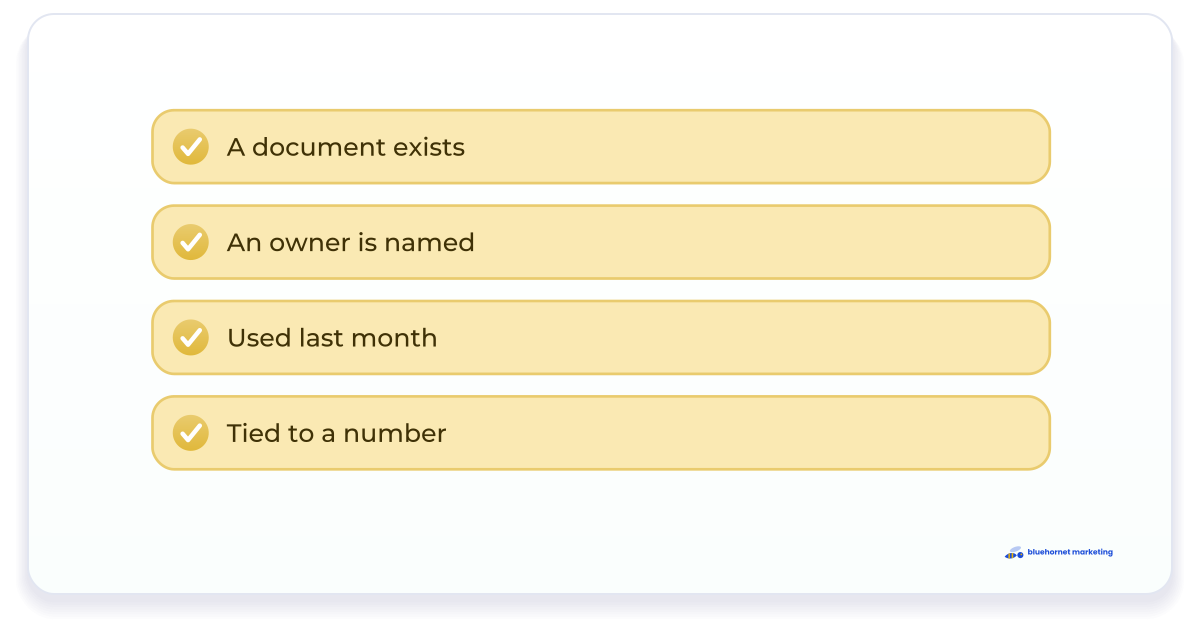
Score yourself honestly: one point for each item you can show with a document or a report, and zero for anything you only think is true. A total below seven means a reset will help more than additional publishing.
The 10 Checks at a Glance
| Area | Check | Proof you have it |
|---|---|---|
| Strategy | 1. Goal and reader | A one-page plan with a number |
| Strategy | 2. Buyer questions | A question list from real calls |
| Strategy | 3. Funnel stage and next step | Topic map with stages |
| Production | 4. Briefs and owners | Brief template and calendar |
| Production | 5. Style guide | A short written guide |
| Production | 6. On-page basics | A page checklist applied to each post |
| Reach | 7. Distribution plan | Two channels per piece |
| Operations | 8. Tools | A list of tools with owners |
| Measurement | 9. Tracking | A tested lead report |
| Operations | 10. Budget and ownership | Funded plan with a named owner |
The 10-Point Content Marketing Checklist
1. Goal and Reader Are Written Down
Open your plan and look for one business goal with a number and one primary reader. If you find a list of goals or a vague audience such as small businesses, the rest of the checklist will not help much until this is fixed. A clear goal tells you which topics to drop, and a clear reader tells you what language to use. I explain the full model in my content marketing framework.
- One goal with a number and a review date
- One primary reader described in two sentences
- Secondary goals parked until the first one works
2. Buyer Questions Come From Real Conversations
Read ten recent sales calls, demo notes or support tickets and list every question a buyer asked before deciding. Those questions are the safest topics you have, because real buyers asked them with money on the line. Teams that skip this step usually fill the calendar with topics that only interest the team.
- Ten sales or support conversations reviewed
- Questions grouped by funnel stage
- Questions matched to search demand
3. Every Topic Has a Funnel Stage and a Next Step
A post with no next step is a dead end. For each planned piece, decide whether it builds awareness, helps a buyer compare options or removes a last doubt, and then choose what the reader should do next, such as a related guide, a pricing page or a call. Decision pages deserve the first slots in your calendar.
- Funnel stage noted for every topic
- One clear next step on every page
- Decision and comparison pages published first
4. Each Piece Has a Brief, an Owner and a Deadline
The brief is the cheapest quality control you can buy. It names the reader, the question, the search term, the points to cover, the sources and the next step. Without it, writers guess and editors rewrite. With it, even a first-time freelancer can produce something close to your standard.
- Brief template used for every piece
- Named owner for writing, review and approval
- Deadlines that include review time
5. Style Guide and Quality Bar Exist
A short style guide of one or two pages is enough. Include five to ten examples of your voice at its best, a list of words to avoid, rules for sources and statistics and the way you handle claims. It keeps several writers sounding like one company and gives editors something to point to.
- Voice examples and words to avoid
- Rules for sources and statistics
- A fact-check step before publishing
6. On-Page Basics Are Covered
Every page should have one clear search target, a title and description written for a human, a heading structure that follows the question, descriptive image text and links to related pages. None of this is complicated, but it is often skipped when the team is in a hurry.
- Title, description and headings reviewed
- Internal links to related guides and service pages
- Image text added and page speed checked
7. Distribution Is Planned Before You Write
Decide where each piece will be seen before you begin. Pick two channels from search, email, social, sales follow-up and partners. Set a date to check how each channel performed and plan how the piece will be reused in other formats.
- Two channels chosen per piece
- Sales team has the new link and when to use it
- Repurposing plan written down
8. Tools Support the Workflow and Do Not Replace It
A spreadsheet, a shared document, your analytics and a search tool are enough for most teams. Add editing, design or scheduling software when you see a step that slows you down. Before you buy, compare options in my ranking of content marketing tools and check what you already pay for.
- List of tools with a named owner for each
- Overlapping subscriptions cancelled
- One tool per job until a gap appears
9. Tracking Connects Content to Leads
Check that forms, calls and sign-ups are tracked and attributed to the page where they started. Without that, you cannot tell which posts bring leads. Test it yourself by filling in a form and following the record through to your CRM or your analytics.
- Form and call tracking tested end to end
- Leads tagged with the first content page
- Monthly report with leads, opportunities and cost per lead
10. Budget and Ownership Match the Plan
Content takes months to pay back, so the budget has to cover that period. Confirm that you can fund the plan for at least two quarters and that someone owns it, including updates. If you are unsure what a realistic budget looks like, my breakdown of content marketing cost gives typical ranges, and an outsourced setup is covered in my guide to content marketing outsourcing.
- Budget covers at least six months
- One person owns the plan and the report
- Update time reserved in the calendar
A Scored Example From a Real-Style Audit
To show how this works, here is a typical result from a mid-sized software company I might meet. The team published three posts a week for a year and felt busy, but pipeline from content stayed flat. Here is how the checklist scored them.
| Check | Score | What I found |
|---|---|---|
| 1. Goal and reader | 0 | Three goals, no numbers |
| 2. Buyer questions | 0 | Topics came from a brainstorm |
| 4. Briefs and owners | 1 | Briefs existed but nobody used them |
| 7. Distribution | 0 | One social post per article |
| 9. Tracking | 0 | Forms not tied to the source page |
Their total was four out of ten. The first month of work was not about writing: it was about picking one goal, collecting buyer questions from sales and fixing form tracking. Only after that did the calendar change. Within two quarters they published fewer posts, sent each one to the sales team and could finally see which articles produced demo requests.
How to Read Your Score
Add up your points and look at where the zeros sit. Zeros in points one to three mean strategy work, and no amount of production will fix that. Zeros in four to six point to a process problem that usually shows up as slow approvals and uneven quality. Zeros in seven to ten explain why good content stays invisible or why nobody can say what it earned.
Common patterns follow a rhythm. Teams new to content usually score low on points one, two and nine. Established teams typically score well on production and badly on distribution and tracking. Both groups benefit from fixing the lowest-numbered gap first, because the later points depend on it. If you want to know what typically goes wrong when gaps stay open, my list of content marketing mistakes describes each one with its fix.
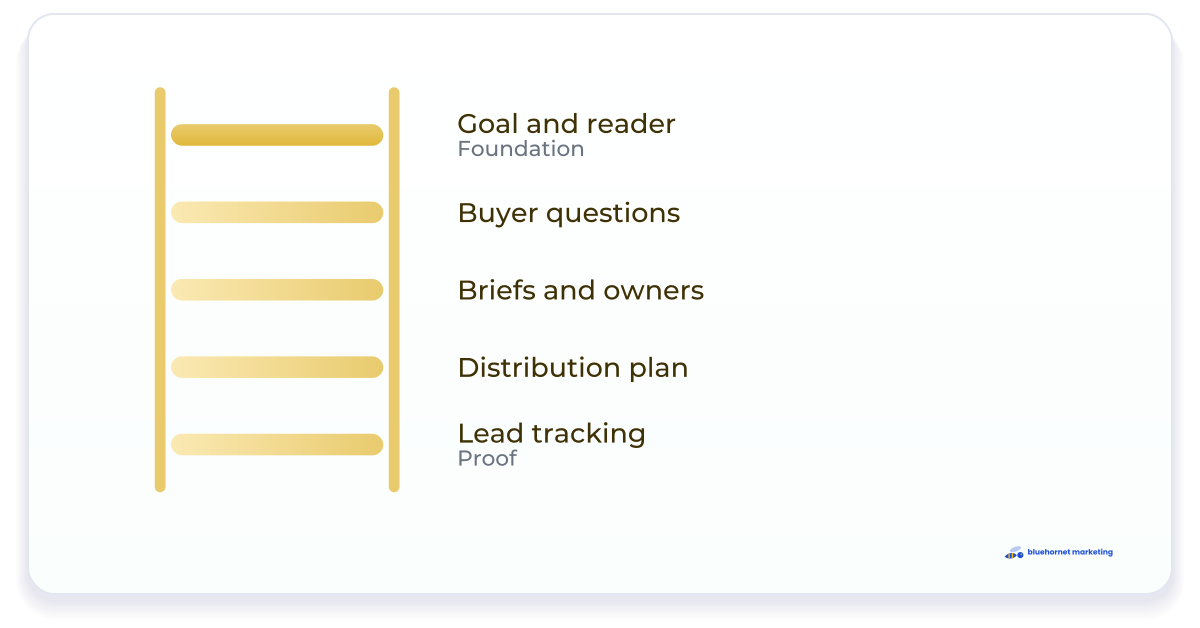
If you want help turning this into a plan, the approach is the same each time: start with the weakest check, assign an owner and set a date. Progress on one check at a time is more reliable than an ambitious overhaul.
Who Should Own Each Check
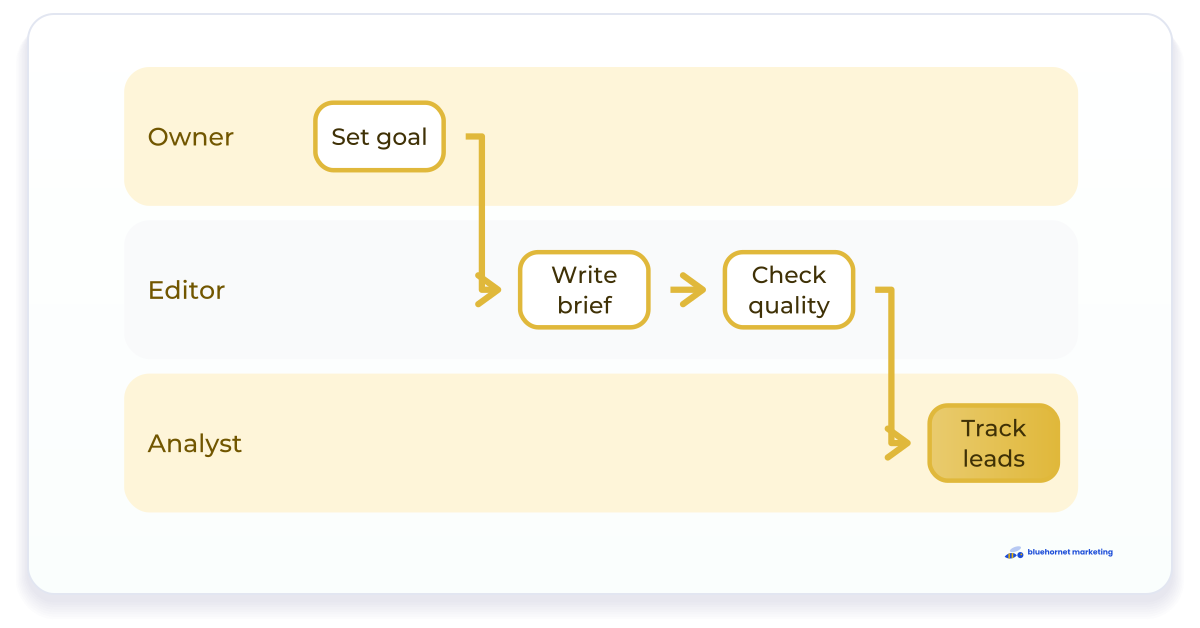
A checklist without owners becomes a document nobody opens. Give every point a named person: the content lead owns points one to three and ten, the editor owns four to six, the channel owner takes seven and your analytics owner takes nine. Tools in point eight can sit with whoever pays the bills, as long as one person reviews the list of subscriptions each quarter.
Small teams often have one person in all of these roles. That is fine, but write the roles down anyway. When that person goes on leave or leaves the company, the list tells the next owner what the job actually involves, and nothing drops silently.
How to Use the Checklist Each Quarter
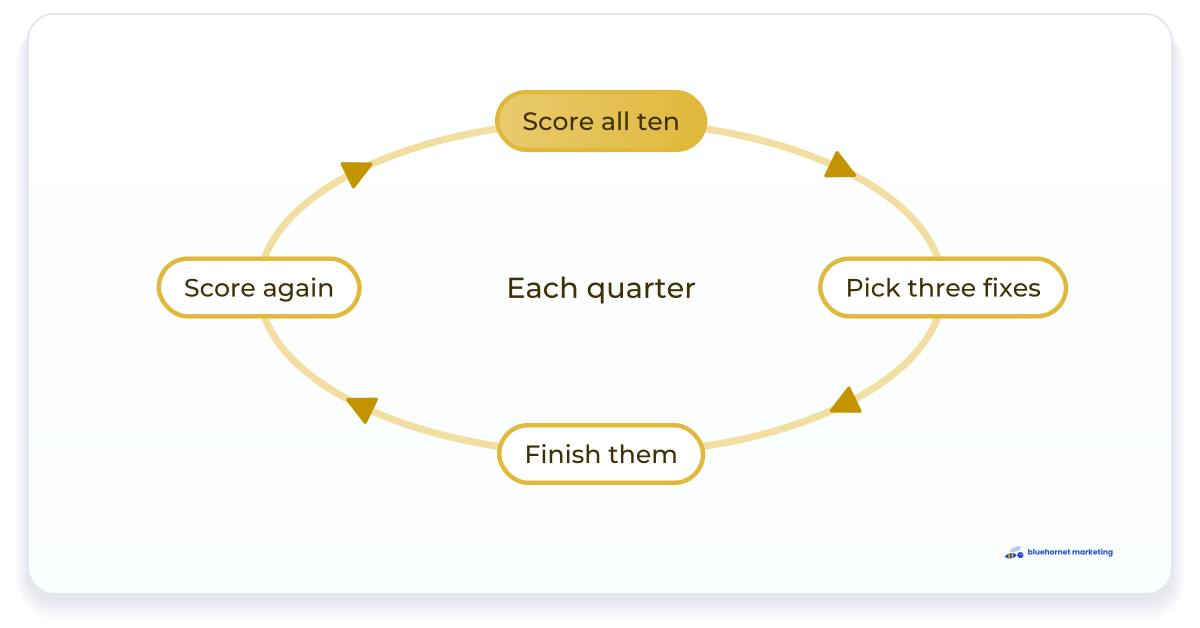
Block an hour at the start of every quarter and go through the ten points with the people who touch content: the lead, the main writer, someone from sales and whoever owns your analytics. Bring evidence for each point and write down one action for every item you cannot prove.
- Review the score and the three weakest points.
- Assign one owner and one date to each fix.
- Check last quarter’s fixes before adding new ones.
Keep the actions few. Three finished fixes beat ten started ones, and a short, honest list is more likely to survive the next busy month.
Questions About the Content Marketing Checklist
What Should Be on a Content Marketing Checklist?
A good checklist covers strategy, production, distribution and measurement: a written goal and reader, buyer questions, briefs and owners, a style guide, on-page basics, a distribution plan, tools, tracking and budget. The ten points in this article cover each area.
How Often Should I Review My Content Marketing Checklist?
Once a quarter works for most teams. Go through all ten points with the people who work on content and write one action for every point you cannot prove.
What Is a Good Score on This Checklist?
Eight or more means your program is in good shape. Between five and seven means specific fixes will help. Below five, a reset of strategy and tracking will pay back faster than publishing more.
Which Point Should I Fix First?
Start with the lowest-numbered gap. Goals and reader come first because every other point depends on them, and tracking is next because it shows what works.
Do Small Teams Need All Ten Checks?
Yes, but each one can be light. A solo owner can keep the style guide to half a page and the brief to a few lines. What matters is that the point exists and you can show it.
Can I Use the Checklist Before Hiring an Agency?
Yes. It shows which gaps you need help with and gives you questions to ask an agency, such as how they handle briefs, distribution and reporting.
How Is a Checklist Different from a Content Strategy?
A strategy is the plan for what you publish and why. A checklist checks that the strategy and the process around it are complete, so it works as a quality gate and not as a plan.
Disclaimer: This article is for general information only and isn’t legal, financial or tax advice. Treat figures as estimates from typical work and confirm details with your providers before you act.
Was this guide helpful?
Thanks for your feedback.
Warren Albright
Warren leads the Blue Hornet editorial team and works with the consultants to turn real client projects into practical guides on content, paid media, marketing automation, CRM and analytics. He comes from content and demand generation work, edits every article before a working marketing consultant reviews it, and draws on strategies, channel plans and audits from client projects to keep the advice grounded in real numbers.