Quick Summary
- ROI equals marketing revenue minus marketing cost, divided by cost, and first-year production is the revenue figure to use.
- Cost per new patient varies by channel: one agency benchmark puts SEO at $50 to $150, Google Ads at $150 to $350 and paid social at $200 to $500.
- Referrals, reviews and recall of existing patients usually pay back faster than paid ads, because the patient already knows you.
- You can only calculate ROI if every new patient is traced to a source, so build that tracking before you raise the budget.
Most practice owners know what they spend on marketing and have only a feeling about what it returns. That gap is where budgets get wasted, and it is the first thing I look at in any dental marketing consulting engagement. A practice that can say what one new patient costs and what that patient produces can make every other decision faster.
The math is simpler than most agencies make it sound. Below you will find the formula, a worked example with real numbers, benchmarks for what each channel tends to cost, and a calculator to run your own figures. Treat the benchmarks as a starting point and replace them with your own data as soon as you have three months of it.
The Dental Marketing ROI Formula
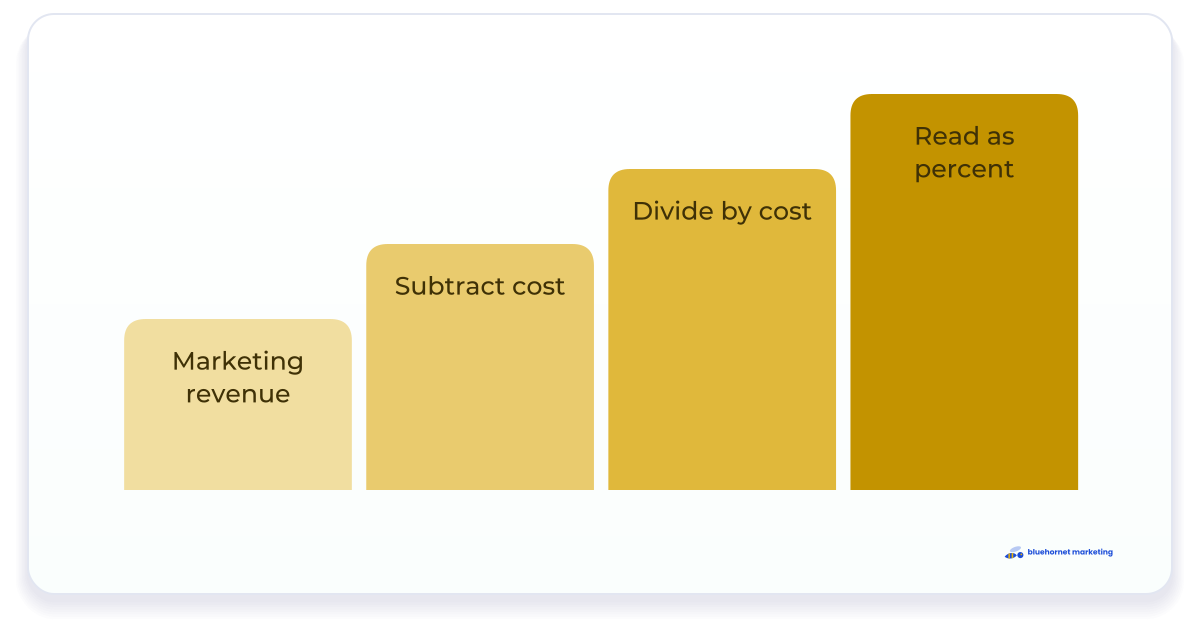
ROI answers one question: for every dollar I spend, how many dollars come back? The formula has three parts.
| Part | What to count | Where to find it |
|---|---|---|
| Marketing revenue | First-year production from the new patients the campaign brought in | Practice management software, filtered by patient source |
| Marketing cost | Ad spend, agency or consultant fees, software, print and any staff time you can price | Your accounting records for the same period |
| ROI | (Revenue − cost) ÷ cost, shown as a percentage | A spreadsheet or the calculator below |
A result of 100% means you earned back what you spent and the same amount again. A result of 0% means you broke even on first-year production, and a negative result means the campaign has not paid for itself yet. Count the cost completely. The most common error I see is leaving out the agency fee or the front desk hours spent on follow-up, which makes every campaign look better than it was.
A Worked Example With Real Numbers
Take a general practice that spends $3,000 a month on Google Ads and a landing page. In a typical month, the campaign brings 12 new patients. Suppose each of them produces $1,000 in the first year, which sits inside the $800 to $1,200 annual value range one agency benchmark reports.
- Revenue: 12 patients × $1,000 = $12,000
- Cost: $3,000
- ROI: ($12,000 − $3,000) ÷ $3,000 = 300%
- Cost per new patient: $3,000 ÷ 12 = $250
- Break-even: 3 new patients a month
The figures are my own illustration, so please swap in your own. Even so, they show why the cost per patient is only half the story. A $250 patient who produces $1,000 is a good deal, and a $250 patient who books one cleaning and never returns is not. Which of those you get depends on the offer, the front desk and the follow-up, and all three sit outside the ad account.
Now stress-test it. If conversion drops and you get 6 patients instead of 12, the same spend returns 100%, and at 3 patients you are at zero. This is why I ask practices for a range of outcomes, not one forecast. It also explains how the same channel looks great for one office and poor for the next.
What a New Patient Costs by Channel
Cost per patient varies widely by market and specialty, so use these ranges for orientation only. They come from a 2026 benchmark article by a dental marketing platform executive, and the article does not tie every figure to an outside source, so I treat them as industry estimates and not as measured data.
| Channel | Cost per new patient | Time to payback |
|---|---|---|
| Local SEO | $50 to $150, after six or more months | Slow start, low cost once it works |
| Google Ads | $150 to $350 | Weeks to a few months |
| Paid social | $200 to $500 | Weeks to a few months, with weaker intent |
| Google Business Profile | Time only | Quick if the profile is still incomplete |
| Referrals | $0 to $50 | Immediate |
The same source suggests 3 to 5% of collections to maintain current volume, 6 to 8% for moderate growth, and 10 to 15% for aggressive growth or a new location. These are rules of thumb. I would use them to sense-check a plan, then let your own cost per patient decide where the next dollar goes. I cover how those choices fit together in my dental marketing strategy guide.
Calculate Your Own Dental Marketing ROI
Enter your monthly spend, the number of new patients the campaign brought in and what each patient produces in the first year. The calculator shows your return, your cost per patient and how many patients you need to break even.
What Does Your Campaign Return?
Move the sliders to match one month of your marketing.
First-Year Production or Lifetime Value?
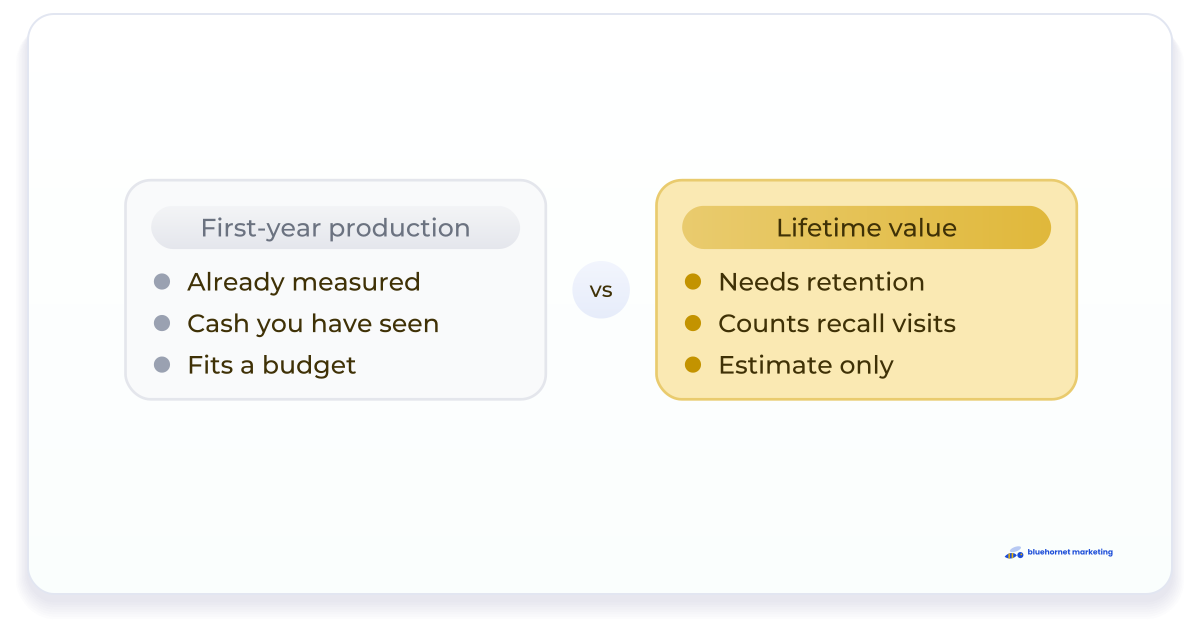
You will hear agencies quote lifetime value, and the numbers are big. The benchmark article cites a range of $4,000 to $8,400 per patient, based on annual value of $800 to $1,200 and five to seven years of retention, attributing the lifetime figure to the dental lab company Dandy. Those figures are plausible, and they carry a lot of assumptions.
Lifetime value assumes the patient stays, and that you will still own the practice. It is a fair way to argue for spending on a channel, and a poor way to judge whether this quarter’s campaign worked. I use first-year production for the budget decision and lifetime value to decide how much slack to allow. A $400 patient is easy to justify at $6,000 lifetime value and hard to justify if the same patient produces $300 in year one and then moves away.
Tracking That Makes the ROI Real
You cannot calculate ROI without knowing where patients came from, and most practices have gaps here. Three habits close most of them:
- Ask every new patient how they found you, in the same words, and record it as a required field.
- Use a separate tracking phone number for each paid channel and for your website.
- Tag every link in ads and emails so your analytics shows the source, then compare it with what patients tell you.
Give it a month, and you will probably find that patients who say “Google” split between maps, ads and organic results. That is normal. Report on the pattern and avoid false precision. The best tools for the tracking side are covered in my ranking of dental marketing tools, which flags where each one fits.
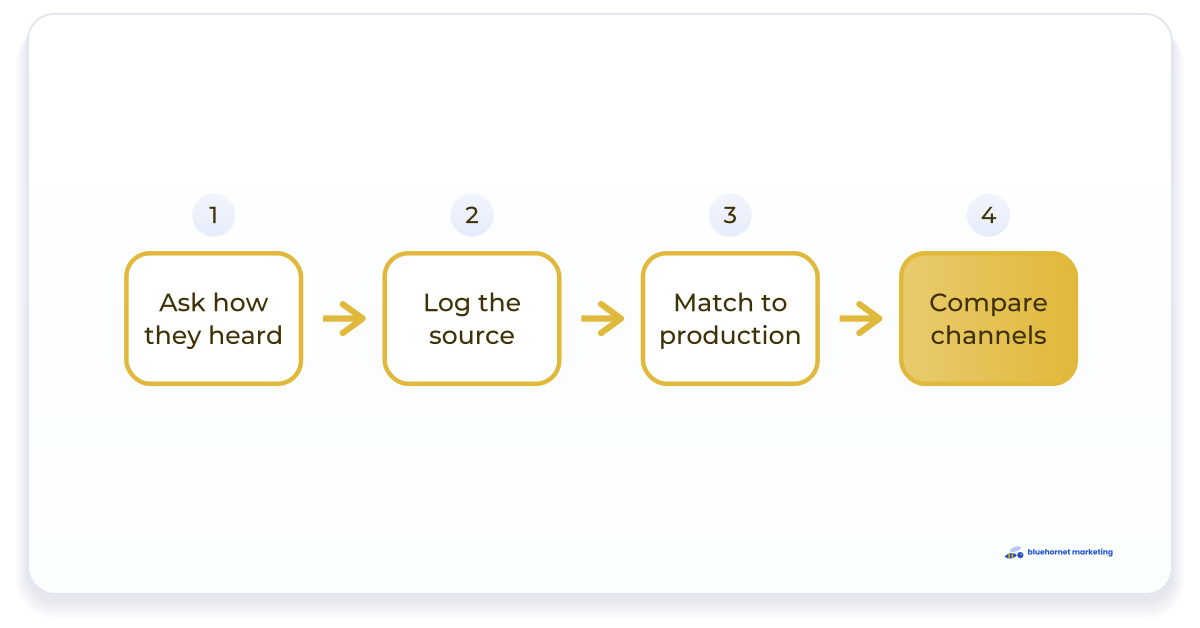
Also record the stage after the first call. A channel that brings many calls and few booked appointments has a problem at the front desk, and fixing that raises the return of every dollar upstream. Many practices I see lose a third or more of inbound calls to voicemail or slow replies, and the fix costs less than another ad campaign.
Why Some Channels Pay Back Faster
Referrals and reviews pay back quickly because the patient arrives with trust. Paid search pays back next, because people who search for a dentist have urgent intent. Social ads come last on this list for most practices, since people scrolling are not looking for a dentist right now, so you pay to interrupt them.
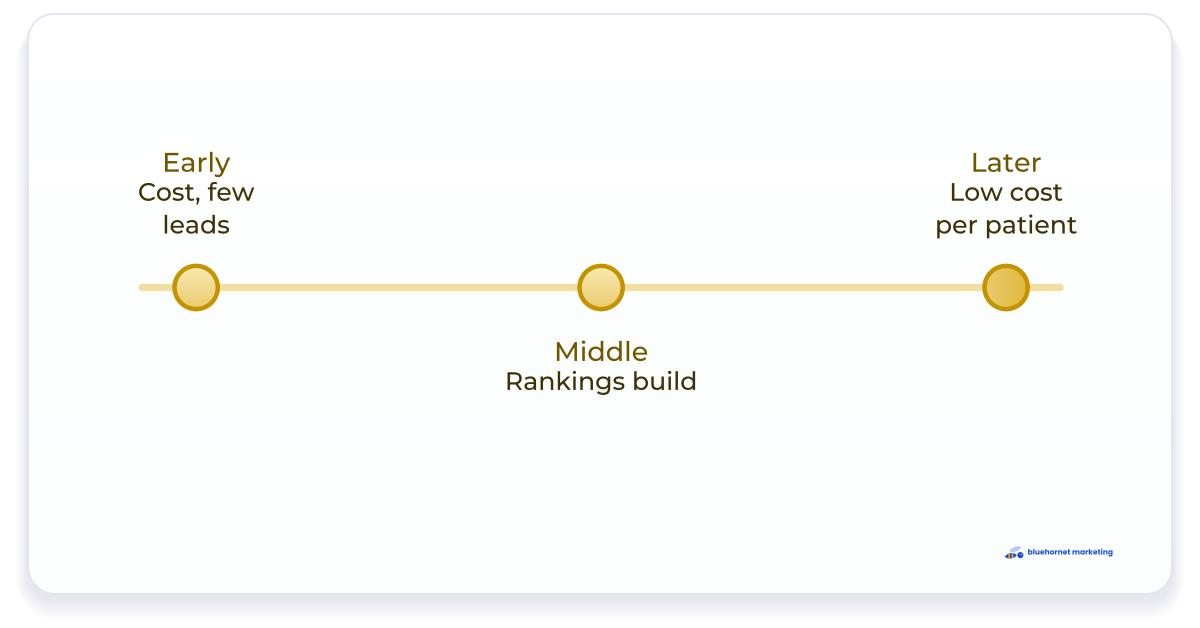
SEO behaves differently from all of these. It costs a lot in the first months and very little afterward, which makes it the channel most likely to look bad on a three-month report and good on a two-year report. If you evaluate it on the wrong timeline, you will cancel it right before it works. I put it on a separate timeline in the budget, with a review point at six months.
Reactivation deserves a place here too. Patients who have not visited in a year or more are expensive to acquire again through ads and cheap to reach through a text or email. In many practices I look at, a recall campaign returns more per dollar than any paid channel, for the simple reason that the patient already knows the office. The trends I track in dental marketing trends show texting and automated recall growing for the same reason.
Mistakes That Distort Dental Marketing ROI
- Counting revenue, not production collected. Insurance write-offs and unpaid balances shrink what you actually keep, so use collected revenue where you can.
- Judging SEO in the first quarter. Content and local rankings take months to build.
- Ignoring capacity. Marketing that fills a schedule your team cannot serve adds cost and lowers reviews.
- Mixing brand and campaign spend. A new logo or website has a different payback logic from an ad campaign, so track them separately.
- Skipping the baseline. Write down how many new patients you get per month before you start, or you cannot tell what changed.
How to Decide Where to Spend First
Start with the leaks. Complete your Google Business Profile, ask every patient for a review, answer every call and run a recall campaign for overdue patients. All four cost little and return fast. Then add paid search for the services with the highest production per patient, and put SEO on its own six-month track.
My rule is to add one channel at a time and give it enough budget to produce a readable result. A practice that splits a small budget over five channels learns nothing from any of them. My dental marketing tips list the order I follow with new clients. If you want help setting the break-even numbers for your office, the first call is free.
Questions About Dental Marketing ROI
What Is a Good ROI for Dental Marketing?
There is no single number, because it depends on the channel and on how you count patient value. Counted on first-year production, a campaign that returns more than it costs within the year is healthy, and referral and review work often returns several times more than paid ads. Set your own break-even point first, then judge each channel against it.
How Do I Calculate the ROI of Dental Marketing?
Subtract your marketing cost from the revenue the campaign produced, divide by the cost and multiply by 100. Use first-year production from the new patients the campaign brought in, and count every cost, including agency fees, ad spend and software. The calculator on this page does the same math.
How Long Does Dental Marketing Take to Pay Back?
Paid search and referral programs can pay back within a few months. Local SEO and content usually take six months or more before they produce steady patients, though the cost per patient falls once they do. Plan your cash flow around the slowest channel in your mix.
What Is the Average Cost to Acquire a New Dental Patient?
One agency benchmark puts Google Ads at roughly $150 to $350 per new patient, paid social at $200 to $500, and SEO at $50 to $150 after six months. Your own figure depends on your market and offer, so track it from your own records instead of relying on averages.
Should I Use Lifetime Value or First-Year Value to Measure ROI?
Use first-year production for budgeting and lifetime value for context. Lifetime figures rely on retention that you cannot know in advance, so they flatter every channel. A campaign that does not pay back within a year deserves a hard look even if lifetime value is high.
How Much of My Revenue Should Go to Marketing?
One benchmark suggests 3 to 5% of collections to hold steady, 6 to 8% to grow moderately and 10 to 15% for aggressive growth or a new location. Treat those as starting points and adjust by your capacity, because marketing that fills a schedule you cannot staff produces no return.
How Do I Track Which Marketing Brings in Patients?
Ask every new patient how they found you and record the answer in your practice software. Add call tracking numbers to each channel and tagged links to your website. Review the numbers every month, and watch for patients who say they found you through one channel while an ad drove the search.
Sources
Disclaimer: This article is for general information only and isn’t legal, financial or tax advice. Treat figures as estimates from typical work and confirm details with your providers before you act.
Was this guide helpful?
Thanks for your feedback.
Warren Albright
Warren leads the Blue Hornet editorial team and works with the consultants to turn real client projects into practical guides on content, paid media, marketing automation, CRM and analytics. He comes from content and demand generation work, edits every article before a working marketing consultant reviews it, and draws on strategies, channel plans and audits from client projects to keep the advice grounded in real numbers.