Quick Summary
- Count the full cost: software, setup, review time and outside help.
- Returns come from time saved, more tests per budget and lower waste, and they arrive at different speeds.
- Measure the share of time saved in a four-week pilot before you scale.
- Return disappears without a baseline, a review step and an owner for each workflow.
The honest answer to whether AI marketing pays off is: it depends on the task, and it is easy to measure if you set a baseline first. An AI marketing consulting project usually starts by putting numbers on the work you do today, because without a before figure, every claim of savings is a guess.
In my client work, the returns I can defend come from three places: hours saved on repeatable work, more tests per budget and lower cost per lead from better targeting. Each has a formula. Below I walk through them with a worked example and a table of typical costs, then show where the return disappears.
The AI Marketing ROI Formula
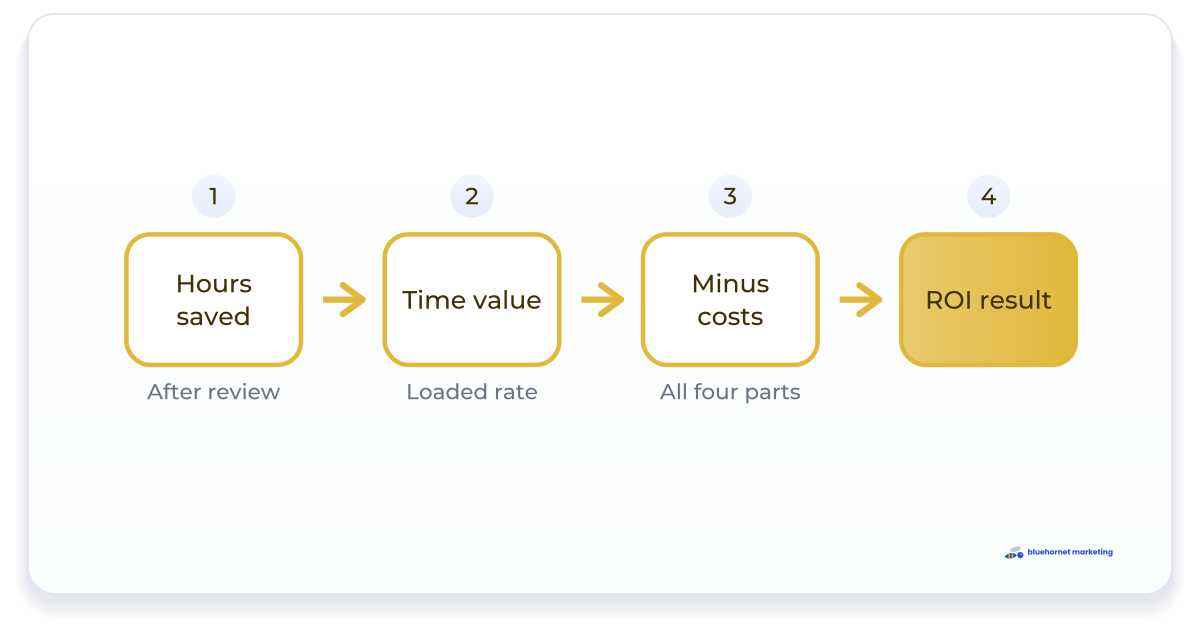
Keep the formula simple enough to explain to your finance team:
Total cost has four parts: software subscriptions, setup and training time, review time on the output and any outside help. Teams often count only the subscription, which makes returns look better than they are. Review time is the item most often left out, and it can be a third of the hours you thought you saved.
| Cost item | What to include | Often forgotten? |
|---|---|---|
| Software | Seats, credits, add-ons and upgrades after the trial | Credit overages |
| Setup and training | Hours to build prompts, voice guides and templates, plus team training | Yes |
| Review and editing | Time for a person to check facts, tone and claims on every output | Yes |
| Outside help | Consulting or agency time for audit and build | Sometimes |
Where the Return Actually Comes From
I split the return into three sources, since they behave differently and take different amounts of time to show up.
Time saved on repeatable work
This is the most reliable source. Drafting first versions of emails, ad variants, social posts, content briefs and monthly report summaries takes hours, and AI shortens each. Measure the time per task before and after, including review. In my experience, a realistic saving is somewhere between a quarter and a half of the drafting time, and less for work that needs strong original thinking.
More tests within the same budget
When producing variants is cheap, you test more headlines, images and offers. More tests find winners faster. This return is real but delayed, because you need a few test cycles to see cost per lead drop. Plan on one to two quarters.
Better targeting and lower waste
AI features in ad platforms and analytics tools can find audiences and flag wasted spend. The return depends on your account quality and tracking. Accounts with clean conversion data gain more, and accounts with messy tracking can lose money by following bad signals. Read more on those pitfalls in my piece on AI marketing challenges.
Worked Example: A Five-Person Marketing Team
This is an illustration with round numbers, not a client result. Replace each figure with your own.
| Line | Assumption | Yearly figure |
|---|---|---|
| Hours spent on drafting and reporting | 60 hours per week across the team | 3,120 hours |
| Share saved after review | 25% | 780 hours |
| Loaded hourly cost | $50 | $39,000 value |
| Software | Five seats at $60 per month | $3,600 cost |
| Setup and training | 60 hours at $50 | $3,000 cost |
| Outside help | Audit and first workflow build | $8,000 cost |
| Net first-year return | $39,000 minus $14,600 | $24,400 |
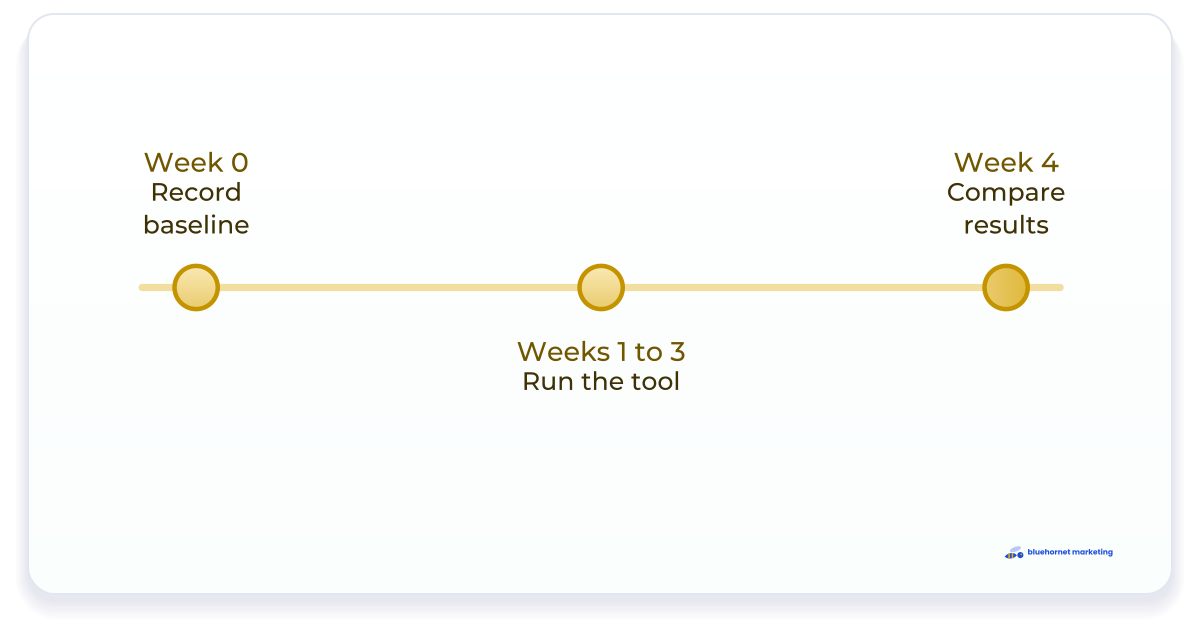
That works out to an ROI of about 167% in year one, and a higher figure in year two, when setup costs drop. The result is sensitive to one assumption: the share of time saved. At 10% savings, the value falls to $15,600 and the first-year return is close to $1,000. That is why I recommend measuring the share in a four-week pilot before you commit to a full rollout.
How to Set a Baseline Before You Spend
A baseline is a record of how the work runs today. Without it, you cannot show a saving, and your finance team will be right to doubt the claim. The good news is that it takes two weeks and almost no budget.
Pick two or three tasks
Choose tasks that happen often and that a person can review quickly: weekly email drafts, ad copy variants, the monthly report. Avoid starting with strategy work, which is hard to time and harder to compare.
Time the whole task, including edits
Ask the people who do the work to log start and finish times for two weeks. Count research, drafting, revisions and approval. Then record the output: how many emails, variants or reports came out of those hours. Hours per unit of output is the number you will compare against.
Record the result metrics too
For campaign work, note cost per lead, click-through rate and conversion rate for the same channels. If AI-written copy lowers the cost of a lead but takes longer to review, you want both facts on one page.
| Task | Baseline to record | Compare after four weeks |
|---|---|---|
| Email drafting | Hours per email, open rate, click rate | Hours per email, same rates |
| Ad variants | Hours per set, number of variants tested, cost per lead | Variants per hour, cost per lead |
| Monthly reporting | Hours to produce, number of errors found later | Hours to produce, errors found |
| Content briefs | Hours per brief, rounds of revision | Hours per brief, rounds |
Keep the measurement window short. Four weeks is enough to see a pattern without letting novelty or a seasonal spike distort the numbers. If the pilot shows a clear gain, extend it to a second workflow. If it does not, you have saved yourself a larger commitment.
How to Present the Result to Your Leadership Team
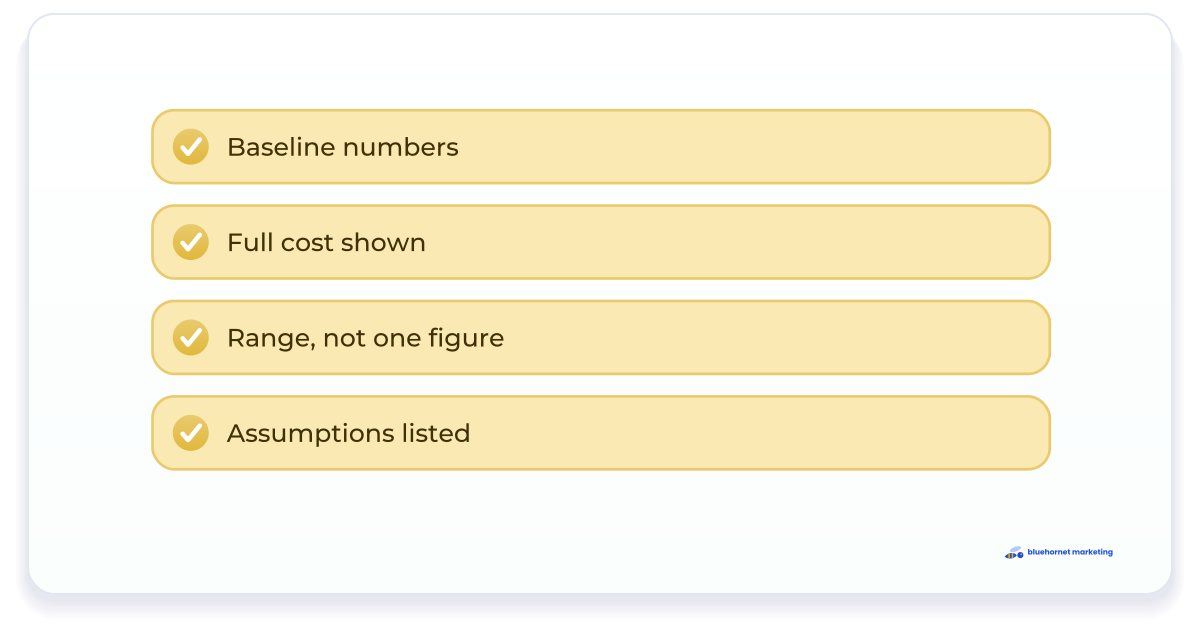
Leaders rarely want a tour of features. They want to know what it cost, what it returned and what happens next. A one-page summary works best: the baseline, the pilot result, the total cost including review time and a recommendation to stop, hold or expand.
Be open about what you do not know. If the saving came from one strong user, say so. If the quality of output was not yet measured, say that too, and put a quality check into the next phase. Finance teams trust numbers that come with their limits attached, and they tend to approve second rounds of budget for the teams that show them.
Estimate Your Own Return
Use the calculator with your own hours, hourly cost and tool price. Start with the free or lowest plan of a tool, since many teams find the first tier covers most of the value. My list of the best AI marketing tools shows which plans exist and what they cost.
Is the Tool Worth It for You?
Set the sliders to the work the tool would handle and the plan you have in mind.
How Long Until It Pays Back
Payback depends on the source of the return. The table shows what I typically see.
| Use | Typical payback | What delays it |
|---|---|---|
| Drafting emails, posts and briefs | 1 to 3 months | Heavy editing, no brand voice guide |
| Reporting and summaries | 1 to 2 months | Messy data sources |
| Ad creative variants | 2 to 4 months | Weak testing process |
| Targeting and bid optimization | 3 to 6 months | Poor conversion tracking |
| CRM-wide AI programs | 6 to 12 months | Data cleanup, change management |
These are ranges from my own project experience, and your timeline can differ. Working through the AI marketing implementation steps in order helps you avoid the delays in the right-hand column.
What Quietly Destroys the Return
I see the same four causes when a team says AI did not pay off.
- No baseline, so nobody can prove any saving.
- Too many tools, each used a little, with overlapping subscriptions.
- No review step, followed by an error that costs more than the time saved.
- Output volume rises, but results per piece fall.
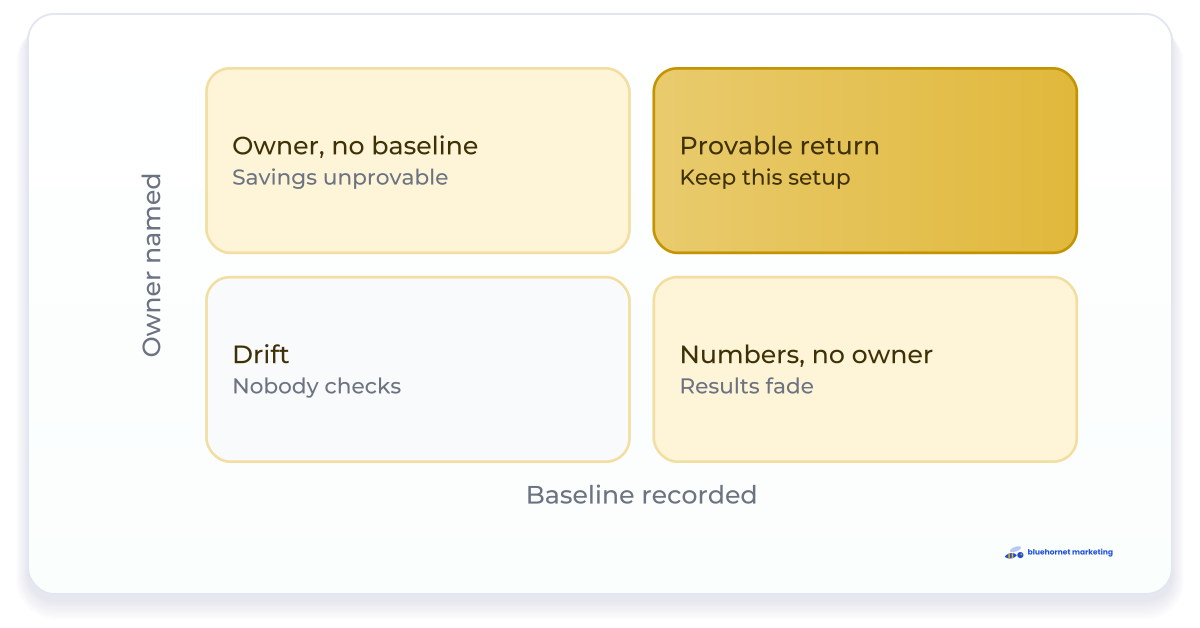
The fix is dull and effective: one baseline, one owner per workflow, one review checklist and a monthly look at the numbers. The AI marketing checklist covers each item.
One more point on quality. A saving that lowers output quality is not a saving. Track a simple quality score, such as the share of drafts approved without major rewrites, alongside hours. If the score falls as hours fall, you are trading brand strength for speed, and the true return is lower than the table shows.
What Changes in Year Two
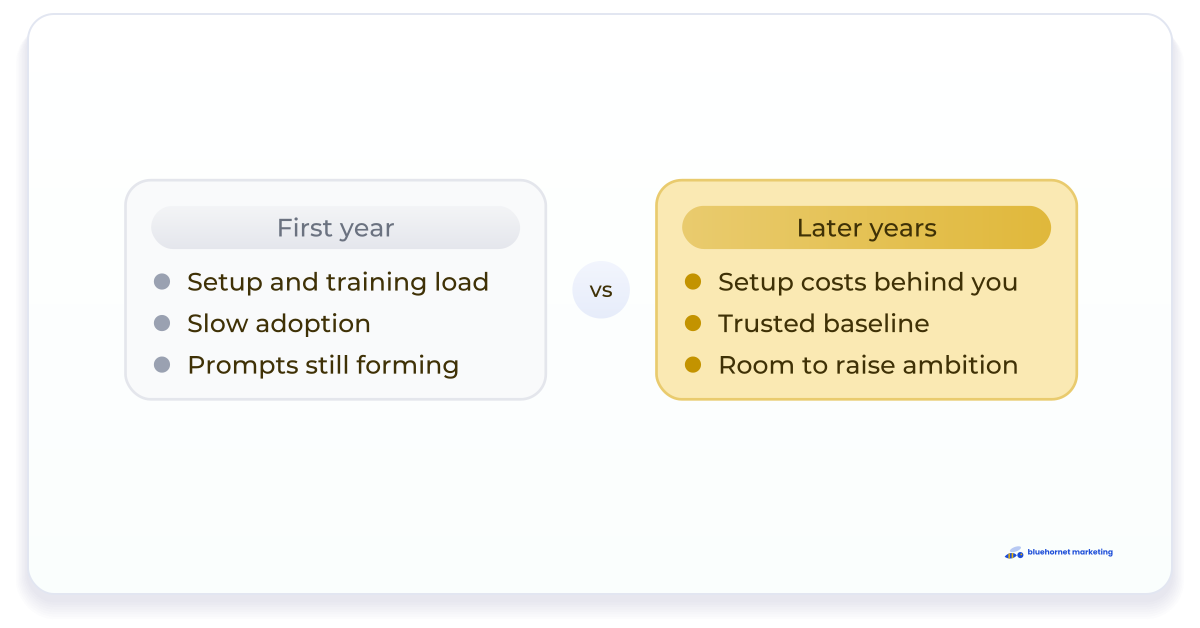
Setup costs fall away after the first year, so the same tools usually return more in year two. The risk moves the other way: usage drifts, subscriptions renew on autopilot and review habits slip. Put a calendar reminder 30 days before each renewal, and ask one question: what did this tool save us in the last quarter?
Year two is also when you can raise the ambition. With a trusted baseline and a review routine, you can move from drafting tasks to testing and targeting, where returns are larger but depend on clean data. Add one new workflow at a time, and measure it the same way as the first.
How to Decide Whether the Investment Is Worth It
Answer these before you spend:
- Is there a task your team repeats at least weekly that a person can review quickly?
- Do you know today's hours or cost for that task?
- Can you run a four-week pilot on a free or low-cost plan?
- Is someone responsible for checking output before it goes live?
If you answer yes to all four, the investment is usually worth a trial. If you answer no to the second, measure first. If a consultant could shorten the path, a free call will tell you whether that is true for your setup.
Questions About AI Marketing ROI
What Is a Good ROI for AI Marketing?
There is no single benchmark. A realistic goal for a first workflow is payback within three to six months. Returns depend on how much time the task takes today, how much of it AI can handle and how much review is needed.
How Do I Calculate the ROI of AI in Marketing?
Add up the value gained, which is hours saved times your loaded hourly cost plus any lift in revenue or drop in media cost. Subtract total cost, including software, setup, review time and outside help. Divide the result by total cost.
How Long Does It Take to See a Return?
Drafting and reporting tasks often pay back in one to three months. Ad testing and targeting take longer, usually three to six months, because you need several test cycles. Company-wide programs can take six to twelve months.
Does AI Really Save Marketing Teams Time?
Yes, on repeatable work such as first drafts, variants and summaries. The saving is smaller once you count review time, and small on work that needs original thinking. Measure the time per task before and after, including editing.
What Costs Do People Forget When Calculating AI ROI?
Review and editing time, setup and training, and credit overages. Subscription price alone makes returns look better than they are. Include the hours a person spends checking facts, tone and claims.
Can AI Marketing Lower My Cost per Lead?
It can, mostly through more tests and better targeting. The effect depends on clean conversion tracking and a working test process. With poor data, AI tools may optimize for the wrong actions and raise your cost.
Should I Start with a Free Plan?
Usually yes. A free or low-cost plan lets you run a four-week pilot and measure the time saved before committing budget. Move to a higher plan only when you hit a limit that blocks real value.
Disclaimer: This article is for general information only and isn’t legal, financial or tax advice. Treat figures as estimates from typical work and confirm details with your providers before you act.
Was this guide helpful?
Thanks for your feedback.
Warren Albright
Warren leads the Blue Hornet editorial team and works with the consultants to turn real client projects into practical guides on content, paid media, marketing automation, CRM and analytics. He comes from content and demand generation work, edits every article before a working marketing consultant reviews it, and draws on strategies, channel plans and audits from client projects to keep the advice grounded in real numbers.