Quick Summary
- Work through ten points in order: goal, data, stack, use case, tools, rules, review, pilot, training and measurement.
- The first four points decide most outcomes, so do not skip the baseline or the data audit.
- Put the review step inside the normal workflow, with a named reviewer, or it will be skipped.
- Run a small, time-boxed pilot with a stop or go rule before you scale anything.
AI projects in marketing usually go wrong in ordinary ways: a goal nobody measured, a contact list full of duplicates, a tool nobody was trained to use. If you want help working through it, AI marketing consulting covers every point below.
I use this list at the start of client engagements. It is deliberately plain, because a checklist you finish beats an elegant one you do not. Tick each item, write down the answer and move on only when the point is covered.
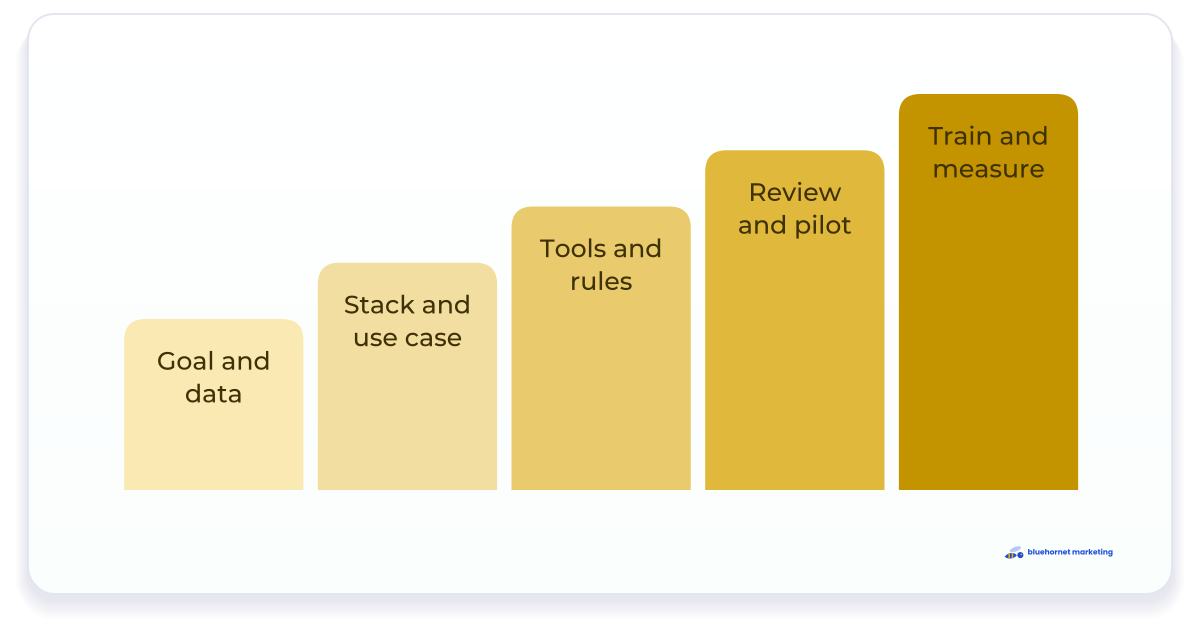
How to Use This Checklist
Work in order for a first rollout. For later workflows, you can often skip to the points that changed, such as a new tool or new data source. Give each point an owner and a date.
| Point | Focus | Time to complete |
|---|---|---|
| 1. Define the goal and the baseline | Result | 1 week |
| 2. Audit your customer data | Data | 1 to 2 days |
| 3. Map your current stack and integrations | Tools | 1 day |
| 4. Pick one use case with clear value | Scope | 1 week |
| 5. Choose tools against your needs | Tools | 1 to 2 weeks |
| 6. Write privacy and brand rules | Risk | 2 to 3 days |
| 7. Set the review and approval workflow | People | 2 to 3 days |
| 8. Run a small, time-boxed pilot | Proof | 3 to 4 weeks |
| 9. Train the team and assign owners | People | 1 to 2 weeks |
| 10. Measure, review and decide what is next | Results | Monthly |
The Ten Points, One by One
Define the goal and the baseline
Write down the one result AI should improve and the number you measure today. Without a baseline, you cannot say later whether anything worked, and every review turns into opinion. I ask clients for two weeks of real data on time spent, cost per asset or conversion rate.
What to write down
- One goal in one sentence, with a number and a date
- A baseline measured over at least two weeks
- A named owner for the result
Audit your customer data
AI tools are only as useful as the data you give them. Duplicates, missing consent fields and mixed-up tags lead to wrong segments and embarrassing messages. A one-day audit of your CRM and email list usually finds enough problems to fix before launch.
What to look for
- Duplicate and inactive contacts cleaned
- Consent status recorded for every contact
- Tags and fields consistent across tools
Map your current stack and integrations
List every tool that touches marketing: CRM, email, ads, analytics, content, social. Note which ones already include AI features. In my client work, about as many teams pay twice for the same capability as find a real gap, so check what you already own first.
What to include
- A one-page list of tools, owners and costs
- Existing AI features in current tools noted
- Integration gaps marked
Pick one use case with clear value
Choose a task that is frequent, low risk and easy to check, such as first drafts of emails, lead tagging or report summaries. A narrow first use case finishes fast and gives you proof. Large projects usually stall before they show any.
How to decide
- Use case scored on volume, risk, effort and measurability
- A review step a person can do in minutes
- Out-of-scope items parked in a backlog
Choose tools against your needs
Compare options on data handling, integrations, output quality, access control and price at your expected volume. A short trial with your own content shows more than a demo. My ranking of AI marketing tools helps you build the shortlist.
What to compare
- Two or three tools tested with real content
- Data use and training policies read
- Total cost at expected volume calculated
Write privacy and brand rules
Decide which data may go into AI tools, which claims need a human check and how your brand voice is enforced. One page is enough if people actually read it. Ask your legal adviser to review current privacy requirements for the markets you serve.
Rules to cover
- Data allowed and banned in prompts listed
- Claims that need approval named
- Brand voice guide and examples attached
Set the review and approval workflow
Output should pass through a named reviewer before it reaches customers. Put the review step inside the tool or queue your team already uses, or it will be skipped under deadline pressure. Track how often reviewers change the output, because that rate tells you how good the setup is.
What to set up
- A reviewer named for each workflow
- Approval inside the normal workflow
- Edit rate tracked
Run a small, time-boxed pilot
Run the use case on a small real slice of work for three to four weeks. Agree the stop or go rule before the start, such as a one-third drop in time per asset with no rise in errors. If results are mixed, adjust one thing and run a short second round.
How to run it
- Pilot scope and dates written down
- Stop or go rule agreed in advance
- Weekly notes from the people using it
Train the team and assign owners
Give each person a short guide, a prompt or workflow library and real working time to practice. Assign an owner to each workflow for monthly checks. Training that happens when there is a spare moment does not happen.
What to prepare
- Training booked on the calendar
- Guide and prompt library shared
- An owner for every live workflow
Measure, review and decide what is next
Compare results to your baseline each month: hours saved, cost per output, conversion, quality complaints. Keep what beats the baseline and retire what does not. Then pick the next use case from your backlog. My guide to AI marketing ROI shows how to turn the numbers into a business case.
What to track
- Monthly review in the calendar
- Results compared with the baseline
- Next use case chosen from the backlog
Where Teams Usually Skip Ahead
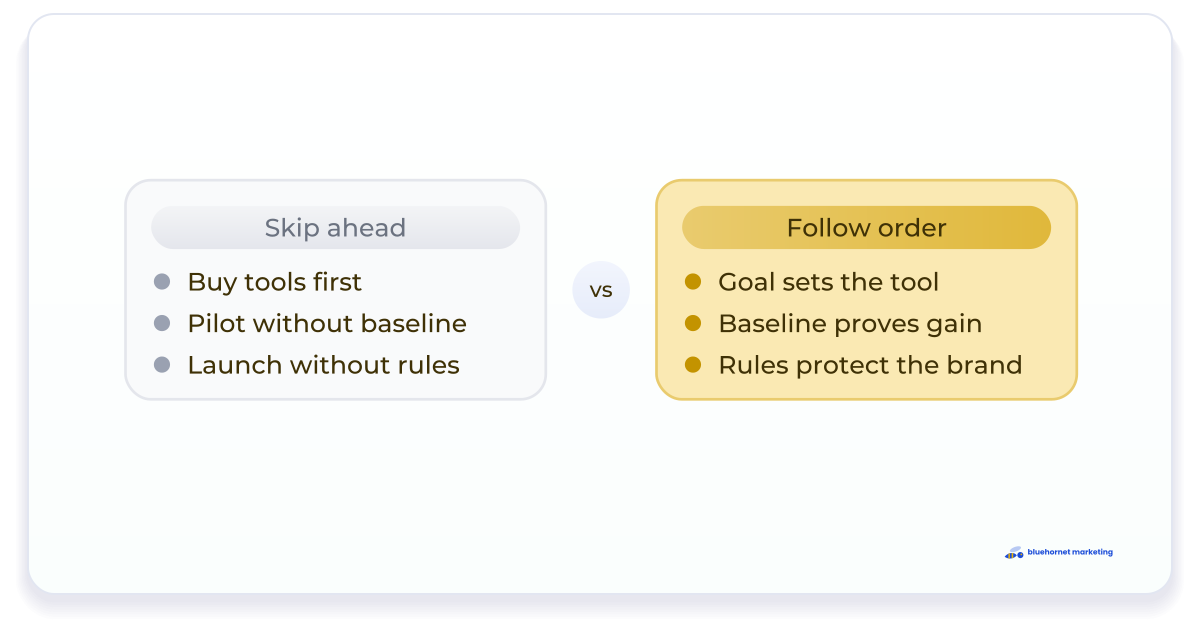
In my experience, three points get skipped more than any others: the baseline, the data audit and the review step. They feel slow, and they are the ones that save the most time later. If your team is short on time, shorten the pilot. Do not shorten these three.
If a project is already running and results are weak, use the checklist as a diagnosis. Find the first unchecked point, fix it and rerun the pilot. My overview of AI marketing challenges explains what each gap usually looks like in practice, and the AI marketing implementation plan shows how to sequence the fixes without losing weeks.
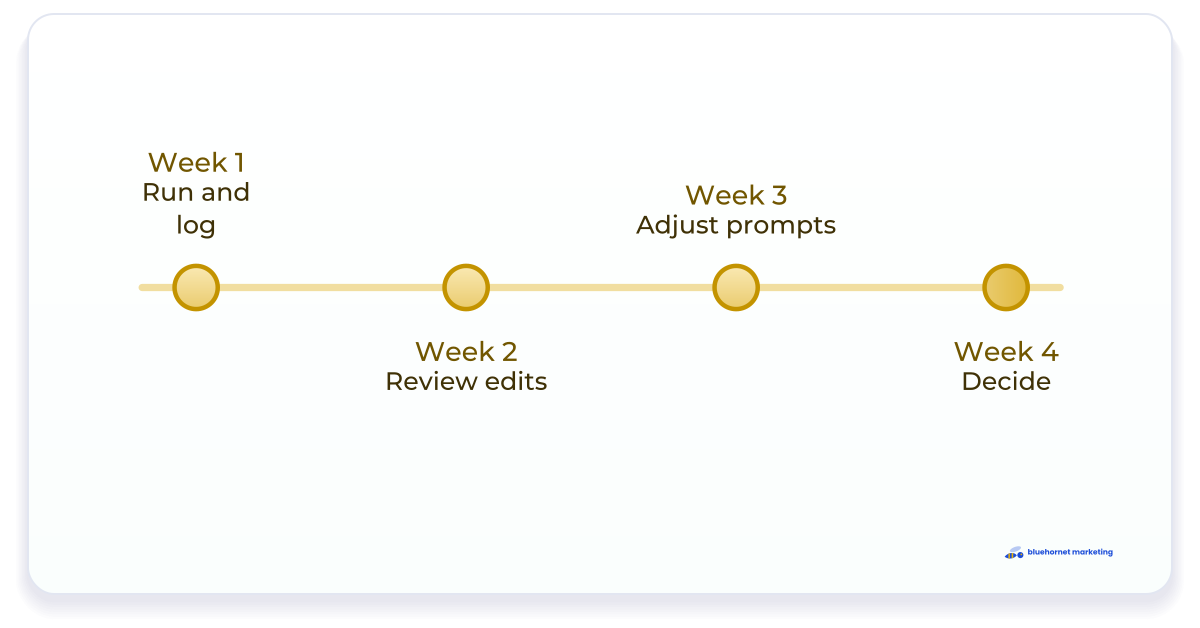
A Four-Week Plan for a Small Team
A small team does not need a long program. Here is how I would spread the ten points over four weeks for a team of three to five marketers with one person leading the work part-time.
| Week | Points covered | What you have at the end |
|---|---|---|
| Week 1 | 1, 2 and 3 | A written goal, a baseline, a data audit and a stack list |
| Week 2 | 4, 5 and 6 | A chosen use case, a tool trial and a one-page rulebook |
| Week 3 | 7 and 8 | A review workflow and the first pilot week running |
| Week 4 | 8, 9 and 10 | Pilot results, training dates and the first monthly review booked |
The plan is tight on purpose. A pilot that runs for three weeks inside a four-week plan leaves little room for delay, so move the dates out if data access is slow. What matters is the order, not the calendar. Teams that start the pilot before they finish points one to three nearly always have to redo the pilot.
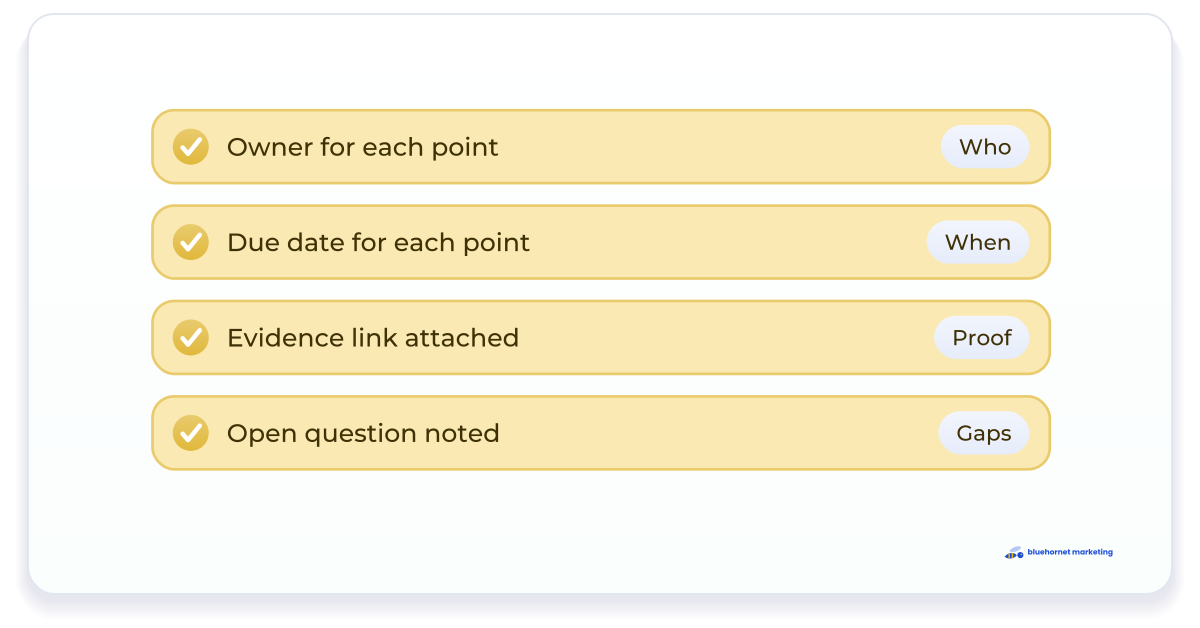
Keep a single shared document for the whole checklist. Each point gets its answer, its owner and its date. When someone new joins the team or a tool changes, that document is the first thing they read, and it replaces a dozen scattered messages. I also add a short "decisions" log, because six months later nobody remembers why a tool was rejected.
The Three Documents to Keep
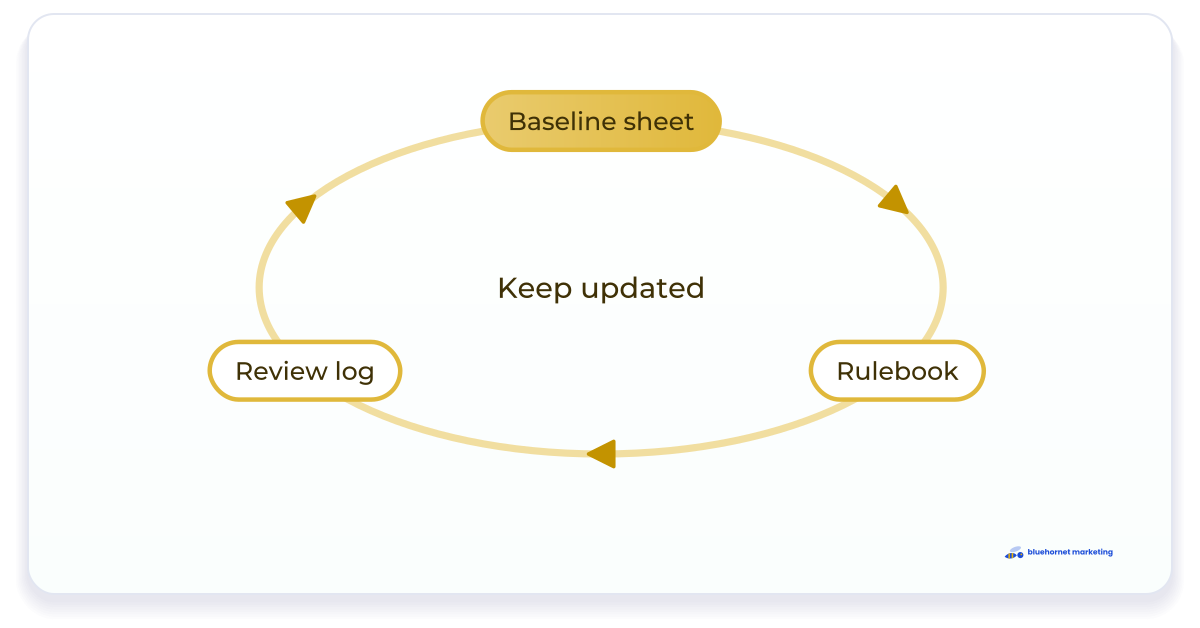
You do not need a thick binder. Three short documents carry the whole checklist, and each one should fit on a page or two.
The first is the baseline and goal sheet from point one, with the numbers and the date. The second is the rulebook from point six, covering data use, claims that need approval and brand voice. The third is the workflow guide from points seven and nine, which tells a new team member who reviews what, where, and how long they have. Review all three at your monthly meeting and date every change. When someone asks six months from now why the team works the way it does, these pages answer in a minute.
Picking Your Starting Point
If you have not started, begin at point one. If a pilot is running, begin at point seven and check review and measurement. If a tool is live and nobody uses it, begin at point nine, training and ownership.
- No baseline recorded: start with point one.
- Results are unclear: check points one and ten.
- Output quality is poor: check points two, six and seven.
- Adoption is low: check points four and nine.
Once the checklist is complete, the question changes from whether AI works to where it pays back most. That is the moment to compare tools again and to put numbers on the next step.
Questions About the AI Marketing Checklist
What Should Be on an AI Marketing Checklist?
A good checklist covers goals and baseline, data quality, your tool stack, a first use case, tool selection, privacy and brand rules, a review workflow, a pilot, training and ongoing measurement. The ten points below follow that order, so you can work through them one by one.
How Often Should I Review My AI Marketing Setup?
I suggest a short monthly review of quality, cost and results for each workflow, and a deeper review every quarter. Tools and pricing change quickly, so a quarterly look at whether a better option exists is worth the hour.
Do Small Businesses Need a Full Checklist?
Yes, in a lighter form. A small business may skip a formal stack map, but still needs a goal, a baseline, privacy rules and a review step. Those four points prevent most of the problems I see in small teams.
Who Should Own AI in Marketing?
Assign an owner for each workflow, ideally the marketer closest to the work, with a sponsor who can approve budget and access. Shared ownership usually means nobody checks quality, so name a person.
How Do I Keep AI Output on Brand?
Give the tool a brand voice guide with examples, ban phrases you never use and keep a human reviewer. Track how often reviewers rewrite output. If the rate stays high, improve the guide before you add more volume.
Is It Safe to Put Customer Data into AI Tools?
It depends on the tool and the data. Read how each vendor handles inputs, check whether they are used for training, limit what you share and confirm consent. Ask your legal adviser to check current privacy requirements before you upload personal data.
How Do I Know the Checklist Worked?
You will see it in your baseline numbers. Hours per task, cost per asset and response times should move in the direction you wrote down in point one. If they do not, review the pilot notes before you scale anything.
Disclaimer: This article is for general information only and isn’t legal, financial or tax advice. Treat figures as estimates from typical work and confirm details with your providers before you act.
Was this guide helpful?
Thanks for your feedback.
Warren Albright
Warren leads the Blue Hornet editorial team and works with the consultants to turn real client projects into practical guides on content, paid media, marketing automation, CRM and analytics. He comes from content and demand generation work, edits every article before a working marketing consultant reviews it, and draws on strategies, channel plans and audits from client projects to keep the advice grounded in real numbers.