Quick Summary
- A fast, specific thank-you is the cheapest way to lift second gifts, where most nonprofits lose donors.
- Make monthly giving visible, since monthly donors had 71% one-year retention in M+R's data.
- Test your donation page on a phone, because more than half of visits come from mobile devices.
- Plan year-end backward from December, which carried 37% of annual online revenue.
Nonprofit marketing advice often comes as a long list of things to start. This list is shorter and more practical, because small teams have a limited number of hours. If you want help choosing which tips to put first for your own organization, nonprofit marketing consulting can narrow the list to one priority.
Each tip below has a short explanation, a do list and an avoid list. Where I use a figure, I name its source. The broader plan behind these tips is in my nonprofit marketing strategy guide, and the full set of benchmarks is in nonprofit marketing statistics.
The Nine Tips at a Glance
| Tip | Main benchmark | Effort |
|---|---|---|
| 1. Thank donors fast | 24% new donor retention | Low |
| 2. Promote monthly giving | 71% monthly donor retention | Low |
| 3. Fix the mobile page | 8% mobile page conversion | Medium |
| 4. One story per email | $54 per 1,000 emails | Low |
| 5. Welcome new subscribers | 12% unsubscribed in a year | Medium |
| 6. Plan year-end early | 37% of revenue in December | Medium |
| 7. Aim Ad Grants well | $0.17 return on grant spend | Medium |
| 8. Show where money goes | 69% worry about data security | Low |
| 9. Test one thing | Hundreds of tests a year at Wikimedia | Low |
Nine Tips, With What to Do and What to Skip
You can read the tips in order or start with the one that matches your weakest number. The tools to run them, such as email and donor platforms, are compared in my guide to nonprofit marketing tools, and real campaigns that use similar ideas are in nonprofit marketing examples.
Thank Every Donor Within a Day
The gap between the gift and the thank-you is where a first-time donor decides whether they are part of something or just made a payment. M+R found that only 24% of new online donors gave again in its latest data, against 66% of prior donors. A quick, warm message is the cheapest way to move that number, and it takes less time than any campaign.
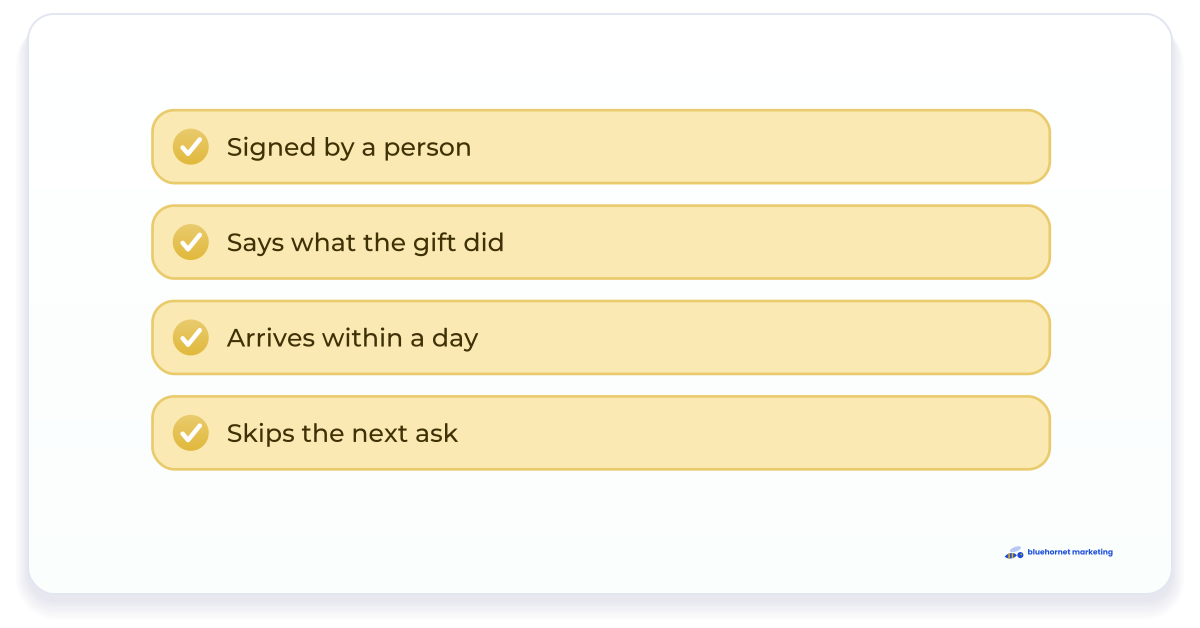
Write the message in a person's voice and sign it with a name. Say what the gift will do in one sentence. Then send a second message about a month later with a short story from the program.
Do This
- Send an automatic receipt right away and a personal-sounding thank-you the same day.
- Name the program the gift supports.
- Ask nothing in the first message except that they read the story.
Avoid This
- A receipt that is only a tax form.
- Asking for a second gift in the thank-you.
- Waiting for a weekly batch.
Make Monthly Giving Easy to Find
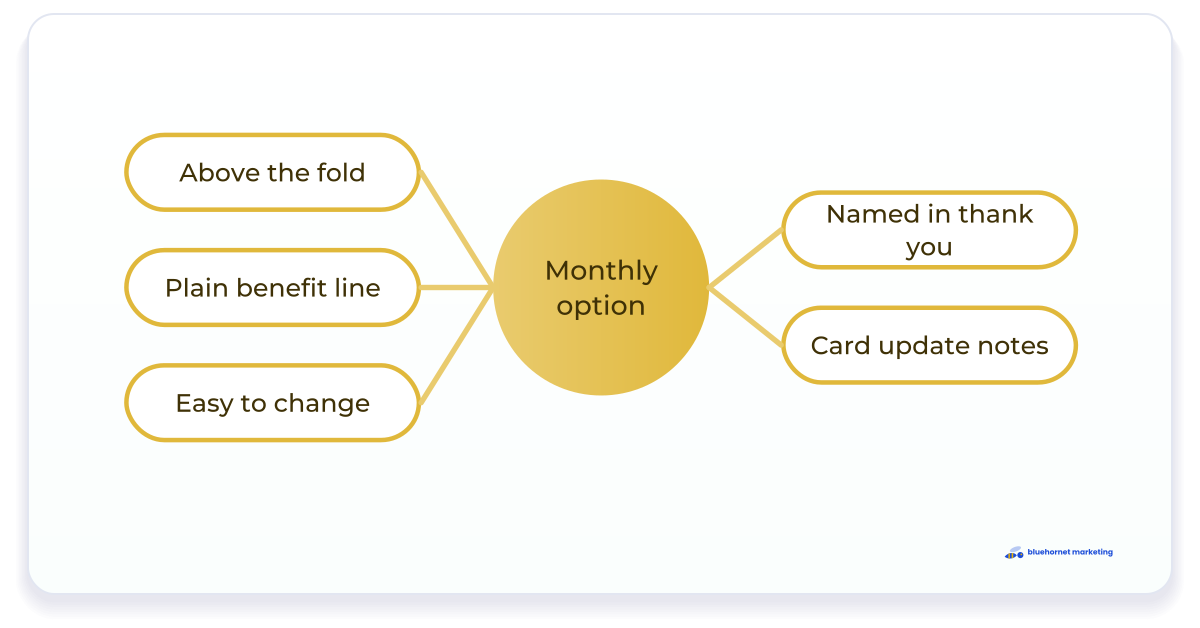
In M+R's 2026 Benchmarks report, monthly giving made up 27% of online revenue, and monthly donors had 71% one-year retention, compared with 24% for new one-time donors. Monthly gifts are also predictable, which helps you plan. Yet NonProfit PRO, citing M+R, reports that 64% of nonprofits set their donation pages to default to one-time gifts.
Check what your page shows first. If the monthly option hides behind a tab, many donors never see it. Explain what a monthly gift covers in concrete terms, such as one meal a week or one hour of tutoring a month.
Do This
- Show the monthly option next to the one-time option.
- Describe what a monthly amount does.
- Give monthly donors their own thank-you and updates.
Avoid This
- Hiding the monthly toggle.
- Pushing only large monthly amounts.
- Treating monthly donors like everyone else on your list.
Test Your Donation Page on a Phone
M+R found that 52% of nonprofit website visits came from mobile devices, and that 11% of desktop visitors who landed on a primary donation page completed a gift, compared with 8% of mobile visitors. The gap suggests that many of your visitors have a harder time than they should.
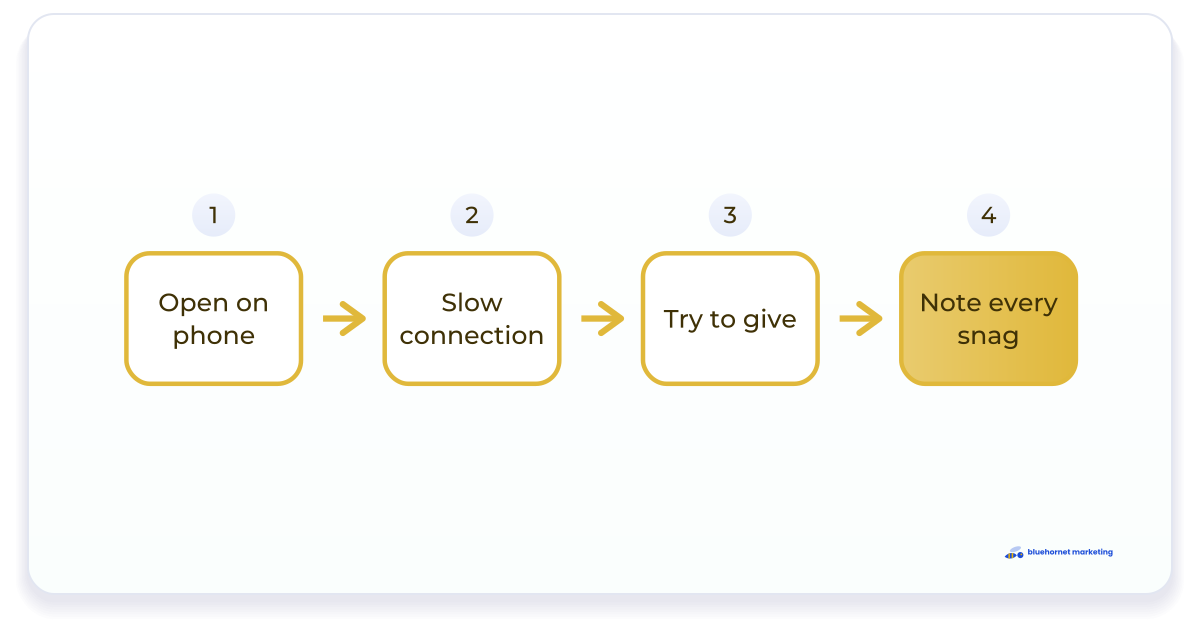
Open your page on a phone with a slow connection and try to give with a card, a digital wallet and a bank account if you offer one. Count the taps and the fields. Remove everything that is not needed to finish a gift, such as optional address lines or a long list of designations.
Do This
- Offer digital wallets and a short form.
- Keep the page loading quickly.
- Repeat your message at the top of the page.
Avoid This
- Forms with ten or more fields.
- Pop-ups that cover the form.
- Sending people to a different site to finish giving.
Tell One Story per Message
Email brought in about 11% of online revenue in the M+R data, and nonprofits raised $54 per 1,000 fundraising emails. Fundraising emails had a click-through rate of 0.59% and a response rate of 0.05%. Those numbers are small, which is why every message needs a clear purpose.
Choose a single person, family or moment and tell it in a few short paragraphs. Make one ask, with one button. If you have more to share, put it in the next message. A mixed newsletter with five items and three links asks readers to decide too much.
Do This
- Open with a specific person or moment.
- Put the ask in a button and a closing line.
- Use a subject line that names the story.
Avoid This
- Newsletters with five competing links.
- Insider terms and program acronyms.
- Long introductions before the story.
Send a Welcome Series to New Subscribers
M+R reports that the average list lost 12% of its starting subscribers to unsubscribes and 4% to bounces in a year. Meanwhile it grew by about 5% on average in net terms. New subscribers are the group most likely to engage, and a welcome series is the fastest way to use that moment.
Three or four emails over two weeks is enough. The first says who you are and what happens next. The second tells your story. The third shares a way to help that is not a gift, such as a volunteer slot or a short action. The fourth makes the first ask.
Do This
- Send the first email within minutes of sign-up.
- Include a link to your most helpful page.
- Ask for a gift only after you have given something.
Avoid This
- Adding new subscribers straight to your main list.
- A welcome that is only a logo and a button.
- Skipping the series for donors who signed up at an event.
Plan Year-End Backward From December
M+R found that 37% of annual online revenue arrived in December, and 4% on December 31 alone. That concentration means the work you do in September and October shapes the final result, and a rushed December plan is one of the most common problems I see in small teams.
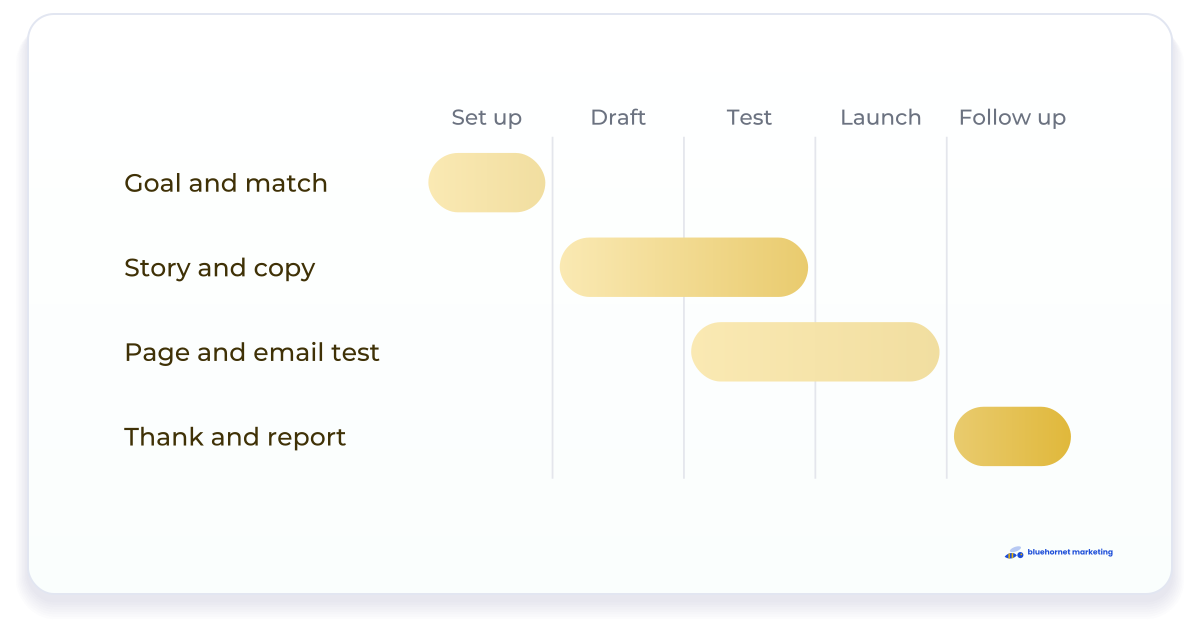
Pick your goal, your matching gift if you have one and your main story by early autumn. Write the emails, the page updates and the thank-you before Thanksgiving, so that December is for sending and answering donors. Ask your board for introductions and gifts early, since they influence the whole season.
Do This
- Set the goal and the story by early autumn.
- Draft and schedule emails weeks ahead.
- Reserve time in December for thanking donors.
Avoid This
- Writing emails the week they send.
- Changing the donation page in late December.
- Treating December 31 as optional.
Use Google Ad Grants for the Right Goal
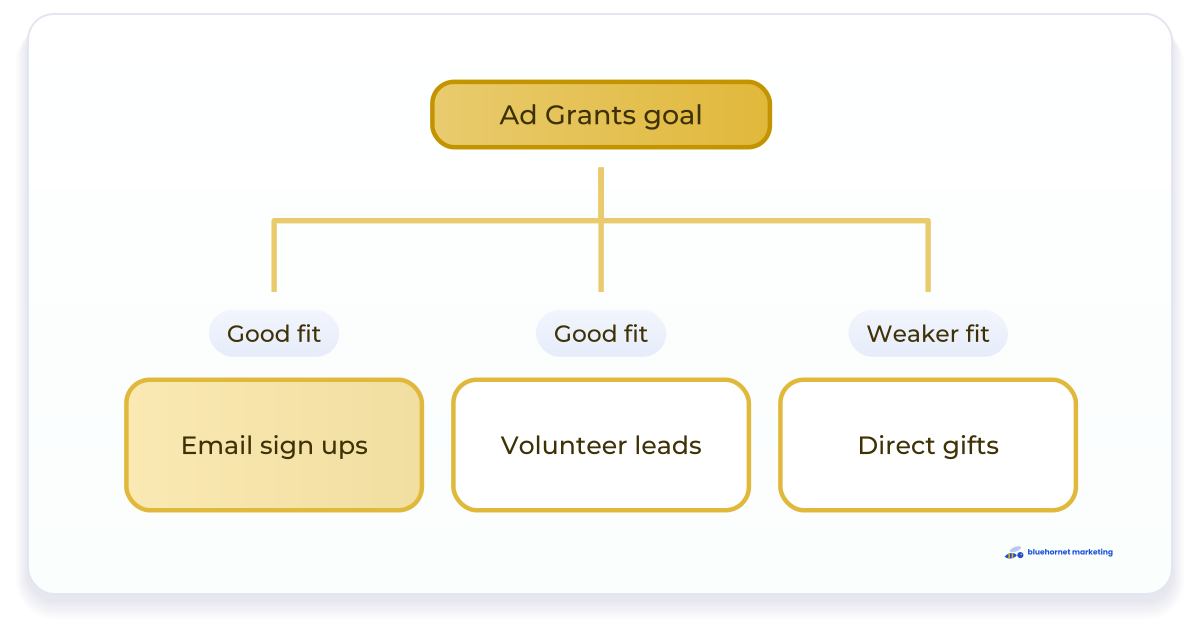
Google offers qualifying nonprofits up to $10,000 per month in search ads. M+R found a return on ad spend of $0.17 for Google Grants in its study, with a cost per donation of $793 and 229 site visits per $1,000 of grant spend. Paid search overall returned $2.48.
Read that as guidance about the goal, not a reason to skip the grant. The visits are free, so use them for volunteers, program sign-ups and awareness, where the value is real, and treat donations as a bonus. Check the program's current requirements before you apply, because they change.
Do This
- Build campaigns around what your clients and volunteers search.
- Track sign-ups and requests, not only gifts.
- Review search terms every month.
Avoid This
- Judging the grant only on donations.
- Leaving campaigns unattended for months.
- Sending visitors to a page that has no clear next step.
Show Where the Money Goes
Donors worry about trust. In a Give.org donor trust report cited by NonProfit PRO, nearly 69% of donors worried their information could be hacked when giving to a new charity, and 62% feared data sharing with third parties. Clear information about what you do with money and data answers a concern that rarely appears in a survey of campaign results.
Put a short, plain explanation of how gifts are used on your donation page and link your annual report or financials. State how you protect donor data. The Wikimedia Foundation, for example, publishes how its budget splits across programs, fundraising and administration.
Do This
- State what a typical gift does in one sentence.
- Link your financial reports.
- Explain how you protect and use donor data.
Avoid This
- Vague claims such as making a difference.
- Impact numbers with no source.
- Hiding your privacy policy.
Test One Thing at a Time
A small team cannot run complex experiments, but it can run simple ones. The Wikimedia Foundation says its fundraising team tests hundreds of banner messages each year. You do not need that scale, because one clean test per month teaches you more than five changes at once.
Pick one element, such as a subject line, the opening paragraph or the donate button wording. Split the list in half, send both versions and compare gifts per recipient, not just opens. Record the result in a shared sheet so the lesson survives staff changes.
Do This
- Change one element per test.
- Compare gifts per recipient.
- Log every test and its result.
Avoid This
- Calling a winner after one send to a tiny list.
- Testing only opens.
- Forgetting what you tested last quarter.
How to Choose Which Tip to Start With
Look at your own numbers first. A tip matters most where your result is weakest, so use this short check:
- If few first-time donors give again, start with tips 1 and 5.
- If many visitors reach the donation page but few give, start with tips 2 and 3.
- If email results are flat, start with tips 4 and 9.
- If everything is last-minute, start with tip 6 and build the calendar.
Pick one tip, set a date to review the number and share the result with your team. Small wins make it easier to ask for time and budget for the next one.
Questions About Nonprofit Marketing Tips
What Is the Single Most Useful Marketing Tip for a Small Nonprofit?
Thank donors quickly and tell them what the gift did. It costs almost nothing, it can be automated in part and it addresses the biggest leak in most programs, which is the second gift.
How Often Should a Nonprofit Email Its List?
Often enough to stay familiar, and not so often that people leave. Many small organizations do well with one story email a month plus campaign messages at key moments. Watch your unsubscribe rate and adjust. M+R found 12% of starting subscribers unsubscribed over a year, so keep an eye on it.
Do I Need to Be on Every Social Media Platform?
No. Choose one or two where your supporters already spend time and post steadily. M+R reports that nearly all nonprofits use Facebook and Instagram, and that YouTube is used by 74% and TikTok by 43%, but being present on a platform and getting results from it are different things.
How Do I Get My Board Involved in Marketing?
Give them specific, small tasks: share a post, introduce you to a funder, forward an email to five friends. Show them a one-page dashboard each month so they see the effect of what you ask them to do.
What Should I Do with a Very Small Budget?
Spend time before money. Fix your donation page, write a welcome series, send a monthly story and thank every donor fast. Then look at free options such as Canva for Nonprofits, the Google Ad Grants program and free tiers from email platforms.
Is Giving Tuesday Worth It for a Small Organization?
It can be, mainly as a way to start relationships. A Blackbaud Institute and GivingTuesday report found 65% retention for GivingTuesday donors, against 52% for donors who gave earlier in the year. Set a goal such as new monthly donors and plan your follow-up.
How Do I Know If My Marketing Is Working?
Track a handful of numbers every month: list growth, donation page conversion, new donor retention, monthly donor count and gifts from each channel. Compare them with last year and with benchmarks such as M+R's, noting that benchmark averages are medians from a sample of organizations.
Sources
- Truesense, What the 2026 M+R Benchmarks Reveal
- M+R Benchmarks, Email Messaging
- M+R Benchmarks, Website Performance
- M+R Benchmarks, Advertising
- M+R Benchmarks, Social Media and Influencers
- NonProfit PRO, 12 Revealing Nonprofit Stats From 2025
- Google for Nonprofits, Ad Grants
- Wikimedia Foundation, Fundraising FAQs
Disclaimer: This article is for general information only and isn’t legal, financial or tax advice. Treat figures as estimates from typical work and confirm details with your providers before you act.
Was this guide helpful?
Thanks for your feedback.
Warren Albright
Warren leads the Blue Hornet editorial team and works with the consultants to turn real client projects into practical guides on content, paid media, marketing automation, CRM and analytics. He comes from content and demand generation work, edits every article before a working marketing consultant reviews it, and draws on strategies, channel plans and audits from client projects to keep the advice grounded in real numbers.