Quick Summary
- Strategy comes first: map where work waits before you buy or build anything.
- Score each problem by hours lost, revenue at risk and effort to fix, then work in that order.
- A small workflow with named owners beats a complex diagram nobody follows.
- Pilot on one real campaign and share the before and after numbers with leadership.
Marketing operations strategy decides where you spend scarce effort before you touch a tool. Teams that skip it end up automating a messy process faster. Most of the marketing operations consulting work I do starts with a short list of priorities, not a software demo.
This guide gives you a six-phase playbook with an overview table, a way to rank your priorities and a realistic 90-day plan. I wrote it for teams of 3 to 30 marketers, and the logic scales up or down.
The Six Phases at a Glance
| Phase | Key question | Output you keep | Typical time |
|---|---|---|---|
| 1. Diagnose | Where does work wait or break today? | A one-page map of the current process | 1 to 2 weeks |
| 2. Prioritize | Which problems cost the most to leave alone? | A ranked list of three to five priorities | 1 week |
| 3. Design | Who does what, in which order? | Roles, workflow and handoff rules | 2 to 3 weeks |
| 4. Connect | Which data and tools support the design? | A tool and data plan, with owners | 2 to 4 weeks |
| 5. Pilot | Does the design work on a real campaign? | A tested workflow and a list of fixes | 3 to 6 weeks |
| 6. Improve | What changed, and what is next? | A monthly review and updated priorities | Ongoing |
Phase 1: Diagnose Where Work Waits
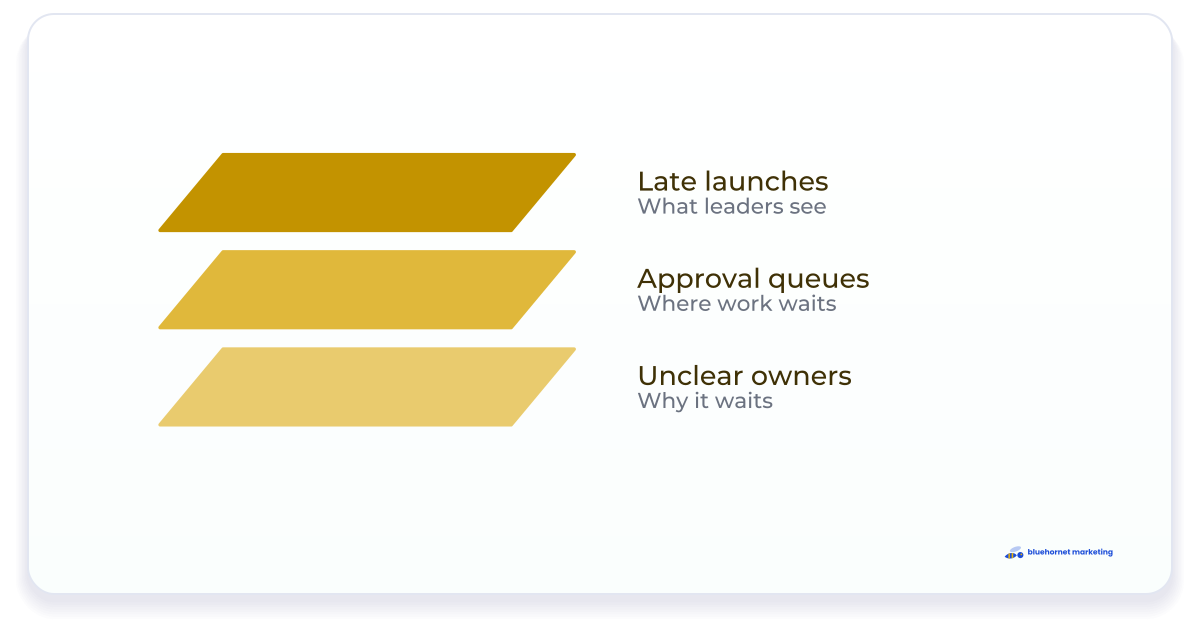
Pick the last three campaigns you launched and trace each from first idea to live. Write down every handoff, every approval and every day a task sat idle. In my client work, the idle time is usually bigger than the working time, and it clusters in the same two or three places: briefs, approvals and asset handover.
Add a quick look at your data. Ask three people for last month's lead count and compare the answers. If they differ, you have found a priority before you open a tool.
Phase 2: Rank Your Priorities With a Simple Score
You will find more problems than you can fix. Score each one so the order is defensible. I use a simple formula for this: priority score = (hours lost per month x cost per hour + revenue at risk) / weeks to fix. Divide by effort so that cheap, valuable fixes rise to the top.
Here is a worked example for a team of eight marketers. Hours and costs are illustrative, so use your own.
| Problem | Hours lost per month | Revenue at risk | Weeks to fix | Rank |
|---|---|---|---|---|
| Leads wait two days for follow-up | 20 hours at $60 each | $8,000 per month | 3 | 1 |
| Approvals stall in email | 60 hours at $60 each | None counted | 4 | 2 |
| Reports built by hand from six tools | 40 hours at $60 each | None counted | 8 | 3 |
| Three tools do the same job | 10 hours at $60 each | $1,200 per month in licenses | 2 | 4 |
Before you commit to the list, check the ranking against what your leaders care about. A priority that saves 60 hours but does not touch a business goal will lose its budget at the next review. My guide to marketing operations KPIs shows how to tie each priority to a measure your leadership already watches.
Phase 3: Design Roles, Workflow and Handoffs
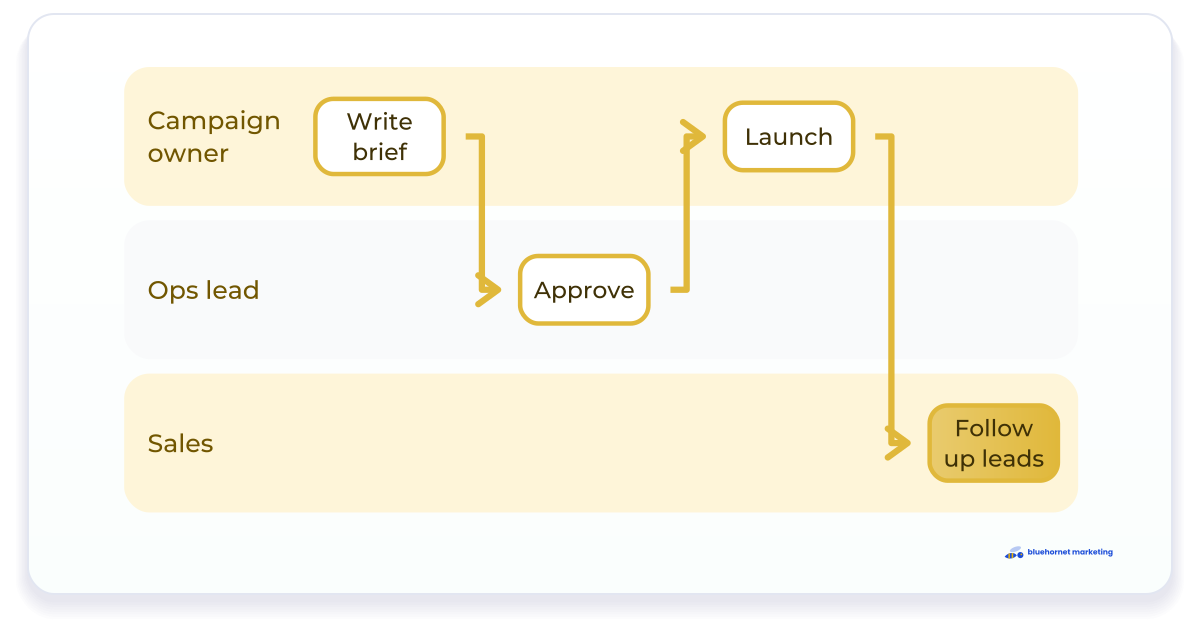
Draw the workflow you want on one page: intake, brief, build, review, launch and report. For each stage, write the owner, the input, the output and the deadline. The most common gap I find is a missing owner for the handoff between marketing and sales, so give it a name and a response time.
Keep the design small. A first version with six stages and one approval path beats a diagram with forty boxes that nobody follows. If you want a ready structure, the marketing operations framework breaks these stages down step by step.
Phase 4: Connect Your Data and Tools
Now match tools to the design. List every platform you pay for, what it does and who uses it. You will usually find overlap and a few tools nobody can explain. Decide what to keep, connect, replace or cancel, and record which tool is the source of truth for each type of data: contacts, campaigns, spend and revenue.
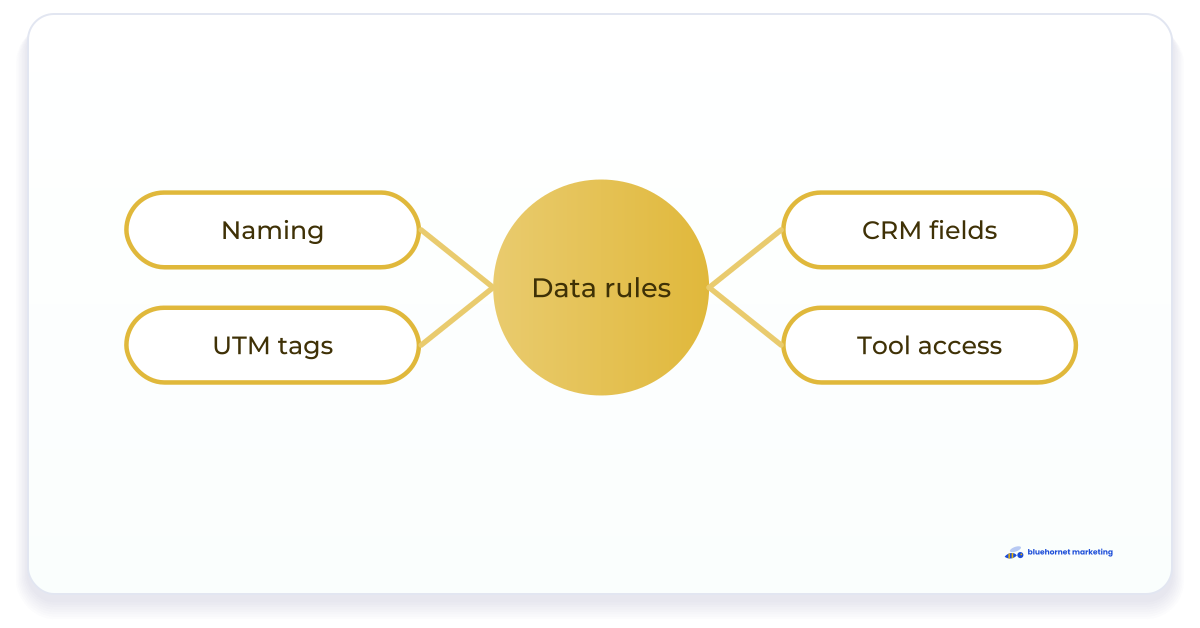
Add rules for naming, UTM parameters and required CRM fields in the same step. These rules look boring and save more reporting time than any dashboard. When you reach the shopping stage, my ranking of marketing operations tools compares the main options with live prices.
Phase 5: Pilot on One Real Campaign
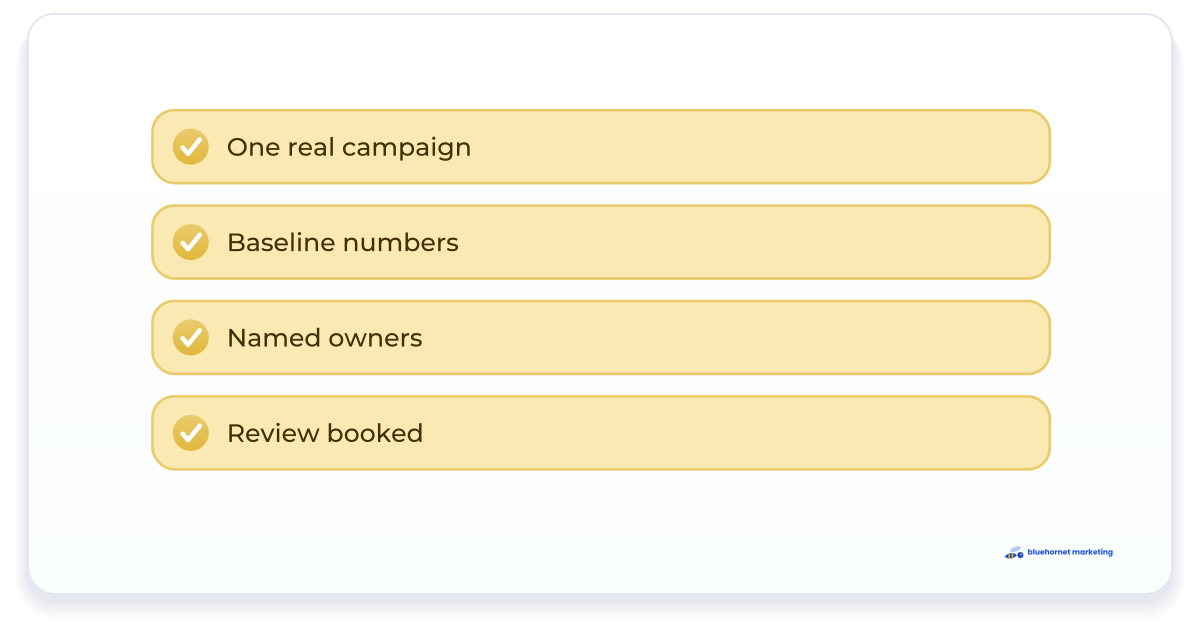
Pick one upcoming campaign of medium size and run it through the new workflow. Do not choose your biggest launch or an unimportant one. Track cycle time from brief to live, approval time and lead response time, and write down every spot where people ignored the process.
Hold a short review after launch. Ask what slowed people down and what they skipped, then fix the process, not the people. Most pilots need two or three adjustments before the design holds up. Share the before and after numbers with leadership, since those numbers pay for phase six.
Phase 6: Review Monthly and Reset Priorities
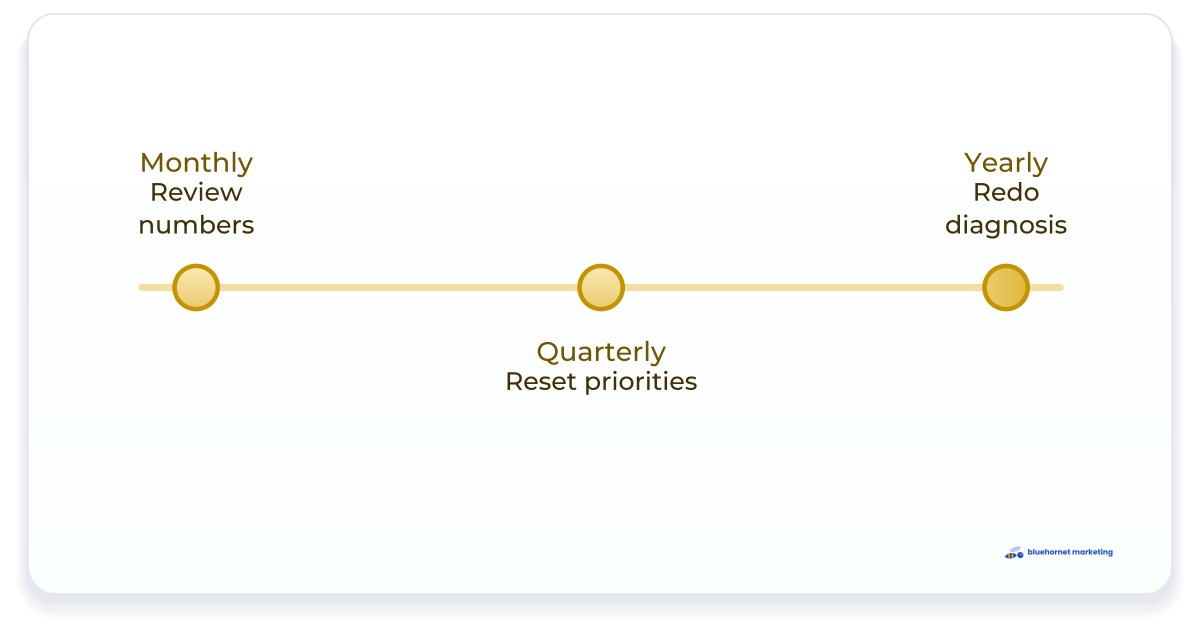
Operations work does not finish. Review three to five numbers every month and move one priority at a time. The marketing operations best practices I rely on for this phase are small habits: one owner per process, one change log and one monthly review.
Once a year, redo the diagnosis. Teams change, tools change and last year's priority is often solved. If you need a sound set of measures for the review, use the list in marketing operations metrics.
A Realistic 90-Day Plan
This sequencing includes the delays I normally see, such as approvals for tool changes and a vacation week in the middle.
| Days | Focus | Result you should see |
|---|---|---|
| 1 to 15 | Trace three campaigns, compare lead counts, interview owners | A current-state map and a list of problems |
| 16 to 30 | Score and rank problems, agree on three priorities | Leadership sign-off on priorities and success measures |
| 31 to 60 | Design workflow and handoffs, write naming and data rules | Documented process and a trained pilot team |
| 61 to 90 | Pilot on one campaign, measure, adjust | Before and after numbers and a revised plan |
What to Budget for the Work
Operations projects cost less in software than in time. Plan for your team's hours first: roughly four to six hours a week for the operations lead, one to two hours a week for each campaign owner during the pilot, and a few hours from sales leadership to agree on lead rules. Training and documentation take more effort than most budgets allow, so reserve about a fifth of the total for them.
Software spend should follow the design, not lead it. In many reviews I find that cancelling overlapping tools pays for a good share of the project. Ask each tool owner to justify the license with one sentence about what would break without it. Licenses that nobody can justify are the easiest savings you will find, and they build trust with finance for the larger changes.
Finally, agree up front how you will report the result. A one-page summary with the starting numbers, the numbers after the pilot and the hours saved each month is enough. Leadership rarely asks for more, and it makes the second year of funding far easier.
Who Does What in a Marketing Operations Setup
Clear roles stop operations work from landing on whoever shouts loudest. You do not need a large team, but you do need each of these jobs to have a name next to it, even if one person covers several.
| Role | Owns | Signs of a gap |
|---|---|---|
| Operations lead | The workflow, the roadmap and the monthly review | Process changes happen informally and nobody records them |
| Data owner | Naming rules, CRM fields, tracking and data quality | Different reports give different lead counts |
| Tool admin | Licenses, integrations, access and onboarding | Nobody can say who uses which tool or why |
| Sales counterpart | Lead definitions, response times and feedback | Marketing and sales argue about lead quality |
| Campaign owners | Briefs, deadlines and handover for each launch | Work starts without a clear goal or deadline |
Strategy Mistakes I See Again and Again
The first mistake is writing a strategy document and never using it. A twelve-page deck that sits in a shared drive changes nothing. Keep the working version to two pages: priorities, owners, dates and the numbers you will check.
The second is choosing priorities by what is interesting. Attribution modeling and AI workflows sound exciting, but if leads wait two days for a reply, that comes first. Rank by cost, and let the boring fix win.
The third is skipping the people side. A process works only when the team agrees to follow it. Involve the people who do the work in the design phase, show them what they get back, such as fewer status meetings, and ask for their objections early. In one project I worked on, an approval path that looked perfect on paper failed in week two because the designer had never been asked how files were actually shared.
The fourth is measuring too much. Choose three to five numbers and stick with them for a quarter. A dashboard with thirty charts invites debate, not action.
How to Choose Your First Priority
If you can only fix one thing, choose the problem that touches the most campaigns. For most teams that is the path from brief to launch. A clear intake form and one approval path remove delays from everything that follows.
- The problem appears in every campaign, not only the large ones.
- You can describe the fix in one paragraph.
- You can measure the result within a month.
- One person can own it after launch.
If two problems tie, pick the one nearest to revenue, such as lead response time. Faster follow-up shows results in pipeline, which makes the next request for budget much easier.
Questions About Marketing Operations Strategy
What Is a Marketing Operations Strategy?
It is a plan for how your marketing team runs: who does what, how work moves from idea to launch, how leads reach sales and how data and tools support all of it. It sits between your marketing strategy, which says what to do, and daily execution.
How Is Marketing Operations Strategy Different from Marketing Strategy?
Marketing strategy chooses audiences, offers and channels. Operations strategy decides the processes, roles, data and tools that let your team carry out the strategy reliably. A strong strategy still fails if the operating layer is slow or inconsistent.
How Long Does It Take to Build One?
A first version takes four to six weeks for most teams: diagnosis, priorities and a designed workflow. A pilot adds three to six weeks. Plan on 90 days to see before and after numbers, and treat the plan as a living document afterward.
Who Should Own Marketing Operations?
Ideally a named marketing operations lead who reports into marketing leadership, with clear counterparts in sales operations and IT. In small teams a senior marketer can own it part-time, as long as the role has written responsibilities and time set aside.
Do I Need New Software to Start?
No. Most teams own enough software already. Start with the process, naming rules and handoffs, then decide whether a tool change is justified. Buying first usually locks in confusion at a higher price.
Which Metrics Show the Strategy Is Working?
Track campaign cycle time, approval time, lead response time, cost per lead and data accuracy in your CRM. Review them monthly, and compare against your starting numbers from the diagnosis phase.
What Is the Most Common Reason Strategies Fail?
Nobody owns the changes after launch. Processes drift back to old habits when no one maintains them. Give each process an owner, keep a change log and hold a short monthly review, even when everything seems to work.
Disclaimer: This article is for general information only and isn’t legal, financial or tax advice. Treat figures as estimates from typical work and confirm details with your providers before you act.
Was this guide helpful?
Thanks for your feedback.
Warren Albright
Warren leads the Blue Hornet editorial team and works with the consultants to turn real client projects into practical guides on content, paid media, marketing automation, CRM and analytics. He comes from content and demand generation work, edits every article before a working marketing consultant reviews it, and draws on strategies, channel plans and audits from client projects to keep the advice grounded in real numbers.