Quick Summary
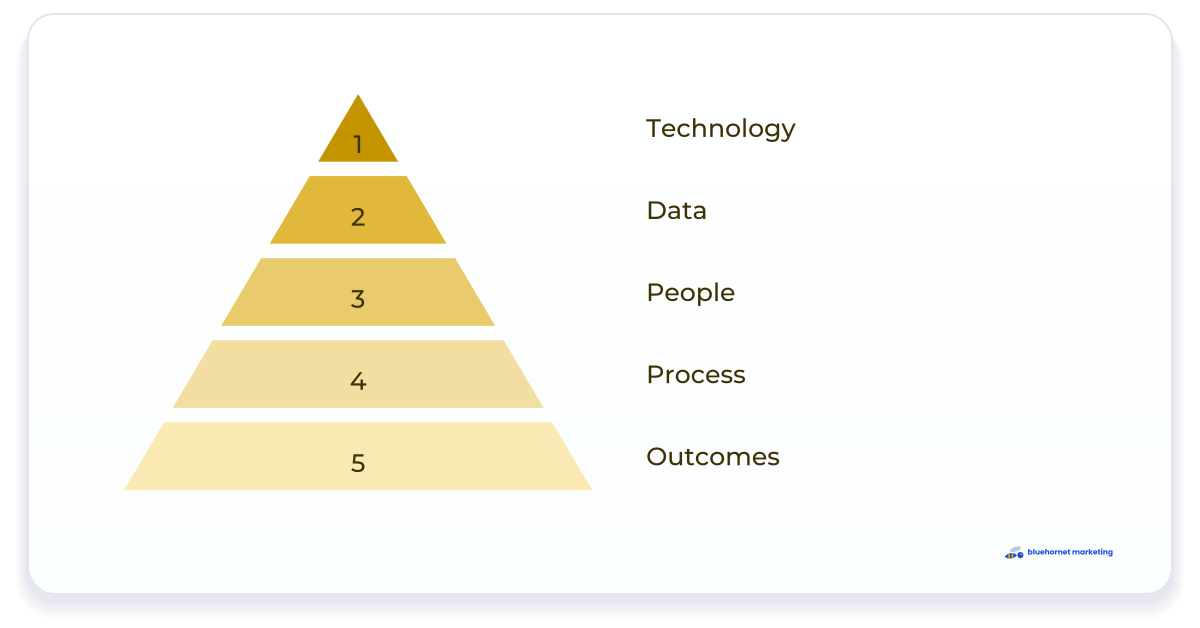
- The framework has five layers: outcomes, process, people, data and technology, and each depends on the one before it.
- Your weakest layer caps your results, so score each layer and fix the lowest one first.
- Use the capacity formula to see how many campaigns your team can really run before you plan the quarter.
- Build in six steps over eight to twelve weeks and review monthly.
A framework earns its place when it tells you what to fix first and how you will know it worked. The one below came out of repeated marketing operations consulting projects, where the same five layers kept explaining why good marketers still struggled to launch on time.
You get the five layers, a six-step build, a scoring formula that points at your weakest layer and a capacity formula that tells you how many campaigns your team can really run. Use it as a checklist for the build, and use my marketing operations strategy guide when you need the priorities and timing around it.
The Five Layers of a Marketing Operations Framework
Every marketing operation, whatever its size, rests on five layers. Each layer depends on the one before it, which is why the order matters.
| Layer | Core question | What good looks like | Common failure |
|---|---|---|---|
| 1. Outcomes | What must marketing deliver? | Three to five goals tied to pipeline or revenue | Goals that are activity counts |
| 2. Process | How does work move from idea to report? | One intake, one approval path, one launch checklist | Different routes for each team |
| 3. People | Who owns each step? | Named owners and backups for every process | Shared ownership and unclear handoffs |
| 4. Data | What gets measured, and where does it live? | Naming rules, required fields, one source of truth | Free-text fields and duplicate records |
| 5. Technology | Which tools support the layers above? | A short list of tools with owners and purposes | Tools bought before the process existed |
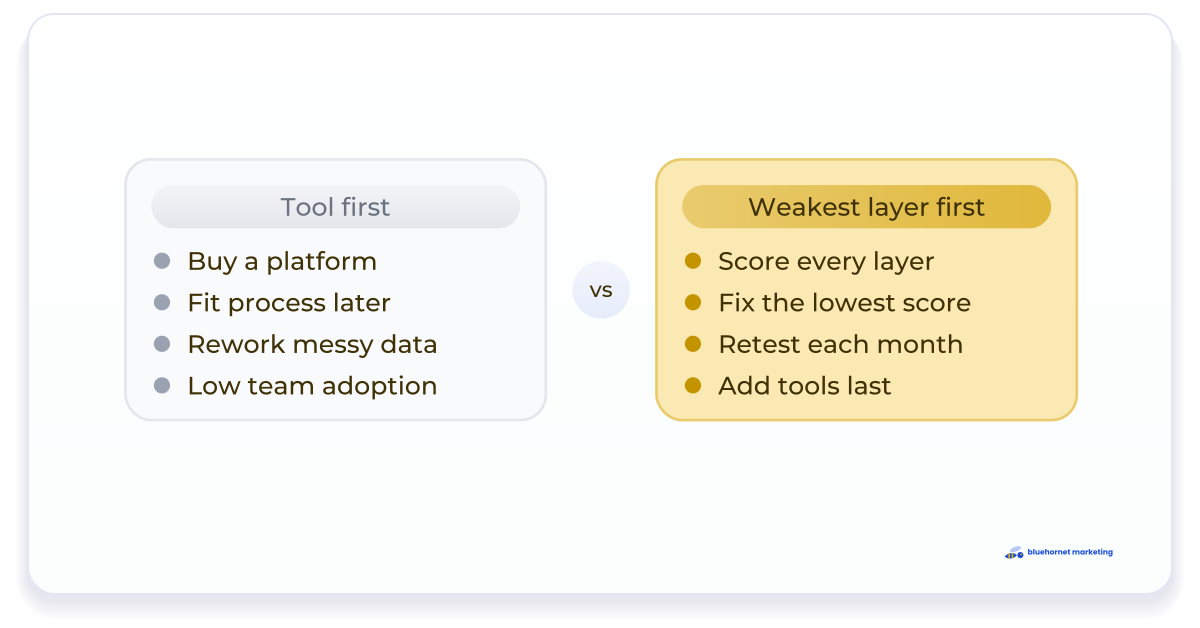
The most common mistake is starting at layer five. A new tool installed over a weak process, unclear roles and messy data does not fix any of them. A clear picture of the layers also explains why the same tool succeeds in one company and fails in another.
Six Steps to Build the Framework
The steps follow the layers, with a final step to keep the system alive. Plan on roughly eight to twelve weeks for a team of around ten marketers.
| Step | Action | Output | Weeks |
|---|---|---|---|
| 1. Define outcomes | Agree three to five goals and the numbers that show progress | One-page goal sheet | 1 |
| 2. Map the work | Trace three campaigns and draw the workflow you want | Current and target workflow maps | 2 |
| 3. Assign roles | Name an owner and backup per process | Ownership list | 1 |
| 4. Standardize data | Write naming, tracking and field rules | Data guide and CRM validation rules | 2 to 3 |
| 5. Select and connect tools | Match tools to the process and remove overlap | Tool list and integration plan | 2 to 3 |
| 6. Measure and refine | Set a monthly review and a change log | Dashboard and review calendar | Ongoing |
Step 1: Define Outcomes
Ask leadership which three numbers marketing must move this year. Translate each into a measure you can read monthly, such as pipeline created, cost per lead or time to launch. If a goal has no number, rewrite it until it does. The marketing operations KPIs list gives you nine tested choices.
Step 2: Map the Work
Draw the path a campaign takes today and mark every wait. Then draw the target path with fewer stages, one intake and one approval route. Keep it to one page. If you cannot explain the target workflow in two minutes, it is too complex for a first version.
Step 3: Assign Roles
For each stage write the owner, the backup, the input and the output. Check the load as well: an owner with eight processes and no time will fail, however clear the chart looks. Move work before you move people.
Step 4: Standardize Data
Write rules for campaign names, UTM parameters, lead sources and required CRM fields. Then enforce them with dropdowns and validation, because guidance alone fades within weeks. This is the step that finally makes your reports match, and my list of marketing operations best practices shows the habits that protect it.
Step 5: Select and Connect Tools
Only now do you look at software. Write down what each layer needs, check what your current tools already provide and fill genuine gaps. When you compare options, use a ranking such as the one in marketing operations tools and run a trial with a real campaign.
Step 6: Measure and Refine
Book a monthly review of five or six numbers. Keep a change log of every process change with the date and the reason. After two quarters, look back at the log, since it shows which changes moved the numbers and which were noise. For the full set of diagnostic numbers, see marketing operations metrics.
The Maturity Formula: Find Your Weakest Layer
Score each layer from 1 to 5 using the descriptions below. Then use this formula: Operations score = average of all five layer scores, capped at the weakest layer plus one. The cap keeps you honest. A team with a 5 in technology and a 1 in process does not have a 3, it has a 2.
| Score | Meaning | How it feels |
|---|---|---|
| 1 | Ad hoc | Everything depends on individuals and memory |
| 2 | Defined | Steps exist on paper but are followed inconsistently |
| 3 | Managed | Most work follows the process, with owners and basic metrics |
| 4 | Measured | Numbers are trusted and reviewed monthly, changes are logged |
| 5 | Optimized | The team tests improvements and removes steps routinely |
Here is a worked example. A SaaS team of nine scores outcomes 4, process 2, people 3, data 2 and technology 4. The average is 3.0, the weakest layer is 2 and the cap is 3, so the score stays 3.0. The lesson is the pair of 2s: process and data. They get the next eight weeks, and the technology layer waits.
The Capacity Formula: How Many Campaigns Can You Run?
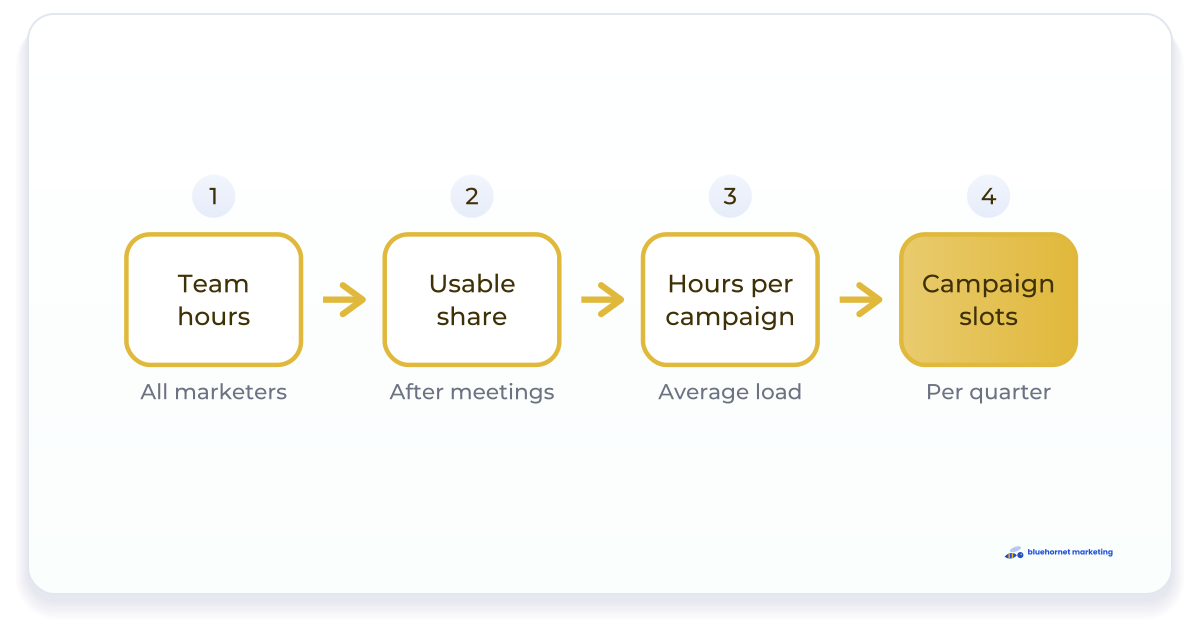
Teams overcommit because nobody divides hours by effort. Use this: campaigns per month = (team hours per month x productive share) / average hours per campaign. Productive share is the portion of time spent on campaign work, which is rarely above 60 to 70 percent after meetings, admin and reporting.
Example: six marketers at 140 hours each give 840 hours. At a 65 percent productive share you have 546 hours. If an average campaign takes 70 hours from brief to report, you can run about eight campaigns a month. If the plan says twelve, the framework has just found your bottleneck before it became a missed deadline.
Layer-by-Layer Checks You Can Run This Week
Before you score, run these quick checks. Each takes under an hour and shows how the layer behaves in real work, not on paper.
Outcomes and Process Checks
Ask three team members to name marketing's top three goals. If the answers differ, your outcomes layer is weak. Then pick last month's most recent launch and count the days between the approved brief and the live date. Mark the days where nothing happened. If idle days outnumber working days, the process layer needs work before anything else.
People Checks
Ask who approves a campaign when the usual approver is away. A blank stare means no backup exists. Count how many processes each person owns, and flag anyone with more than four, since quality drops quickly beyond that.
Data and Technology Checks
Export last month's leads and check three things: how many have a source, how many have an owner and how many are duplicates. Then list every tool the team pays for and mark the ones that nobody logged into last month. The result tells you how clean your data layer is and how much room you have to simplify technology.
Adapting the Framework to Your Team Size
The five layers stay the same, but the effort changes. Teams under five people can run the whole framework on a few pages in a shared wiki, with the owner list doubling as the process document. The risk at that size is key-person dependence, so write the backup name next to each task.
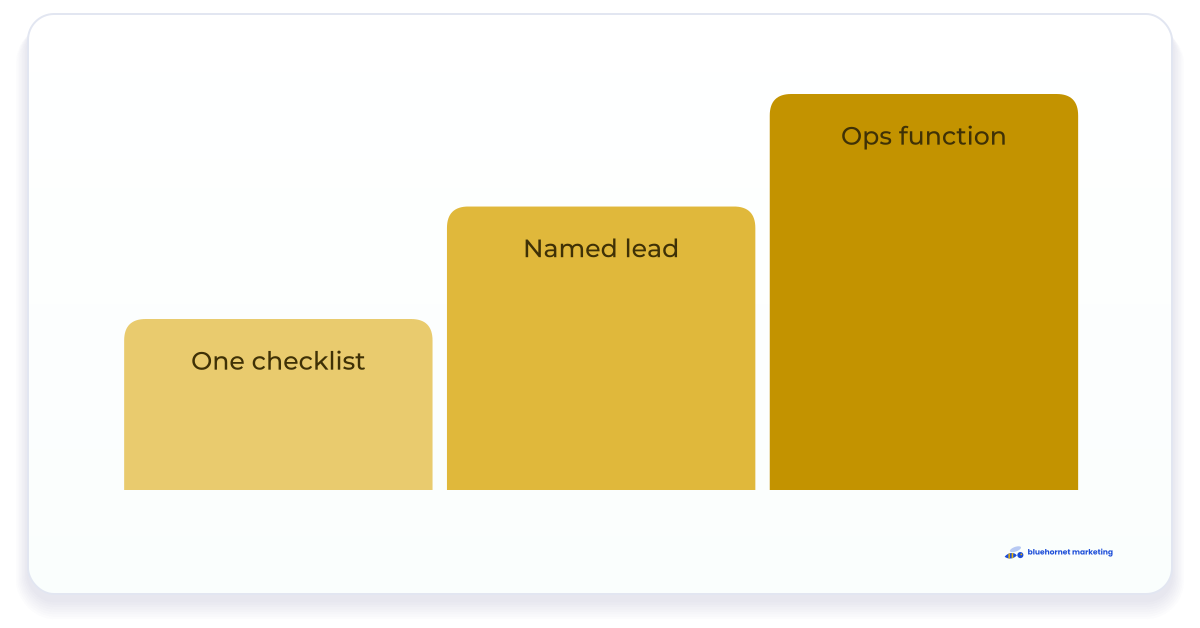
Teams of six to fifteen need a named operations lead, a standard brief and basic data validation in the CRM. This is where the framework pays back most, since coordination costs start to grow faster than headcount. Above fifteen, add regional or product owners and a shared change log, and consider a formal intake queue so requests do not bypass the process.
Mistakes That Break a Framework in the First Quarter
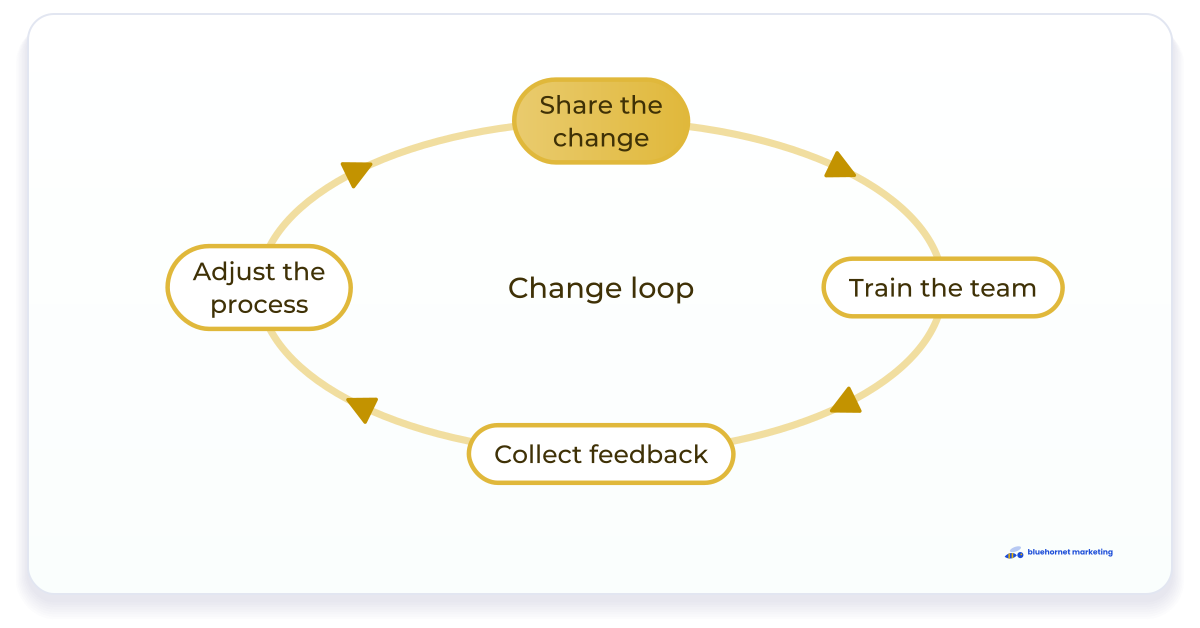
The first is treating it as a project with an end date. Marketing operations is a habit, and the monthly review is the part that keeps it alive. Teams that skip the review find the old workarounds back within ninety days.
The second is over-designing. A workflow with ten approval stages looks careful and acts as a brake. Start with two approvals at most, one for content accuracy and one for brand or legal, and add a stage only when you can name a specific failure it would have prevented.
The third is ignoring change management. People follow a process when they see what they get back. Tell your team which meetings disappear, which chasing stops and which reports build themselves, and then deliver on it in the first month.
How to Decide Where to Start
Run the maturity scoring with your team in a 60-minute session. Let each person score the layers privately and compare the answers. Gaps between scores show where people experience the operation differently, which is often more useful than the average.
- Start with the lowest-scoring layer that sits closest to the top of the stack.
- If two layers tie, fix process before data and data before technology.
- Re-score every six months and keep the old scores for comparison.
Questions About the Marketing Operations Framework
What Is a Marketing Operations Framework?
It is a structured model of the layers that make marketing run: goals, process, people, data and technology. Using it, you can see which layer is weakest, fix things in the right order and measure progress, instead of buying tools or adding meetings at random.
How Long Does It Take to Implement?
A team of about ten usually needs eight to twelve weeks to define outcomes, map workflows, assign roles, standardize data and connect tools. The monthly review and refinement continue afterward. Smaller teams can move faster, and larger ones often phase the work by region or product.
Which Layer Should I Fix First?
Fix the weakest layer that sits highest in the stack. Outcomes and process come before people, data and technology. If you score a 2 in process and a 4 in tools, the process wins every time.
Do I Need a Dedicated Marketing Operations Hire?
Not at first. A senior marketer can lead the work part-time for the first quarter. Once you have more than about eight marketers, many campaigns running at once and several tools to manage, a dedicated lead usually pays for itself.
How Is a Framework Different from a Strategy?
A strategy picks priorities and timing for your situation. A framework is the reusable structure that holds those priorities: layers, steps and scores. You use the framework to build the plan, and the plan to sequence the work.
What If My Team Is Too Small for All Five Layers?
Keep all five but make each very light. One page for goals, one workflow map, a list of owners, a short data guide and a list of tools. A five-person team can finish this in a few weeks and benefit as much as a larger one.
What Shows the Framework Is Working?
Cycle time falls, the share of campaigns launched on time rises, reports match across tools and your maturity score moves up in the layers you worked on. Compare with the baseline you recorded in step one and check again after one quarter.
Disclaimer: This article is for general information only and isn’t legal, financial or tax advice. Treat figures as estimates from typical work and confirm details with your providers before you act.
Was this guide helpful?
Thanks for your feedback.
Warren Albright
Warren leads the Blue Hornet editorial team and works with the consultants to turn real client projects into practical guides on content, paid media, marketing automation, CRM and analytics. He comes from content and demand generation work, edits every article before a working marketing consultant reviews it, and draws on strategies, channel plans and audits from client projects to keep the advice grounded in real numbers.