Quick Summary
- Authentication and list hygiene are the most costly mistakes, because they shrink the audience for every email.
- Segmentation and a proper welcome flow usually give the fastest revenue gains.
- Judge results by clicks, conversions and revenue, not by open rate.
- Test one variable at a time and report revenue per email sent every month.
Email rarely fails loudly. Sends go out, a few people click and the report looks acceptable, while the revenue it should earn goes missing. If you want an expert to find those gaps, email marketing consulting starts with exactly this kind of review.
Below are ten mistakes I see again and again, in the order I would fix them. Each one has a short "avoid" and "do" line, so you can use the list as a quick check against your own program.
The Ten Mistakes at a Glance
| Mistake | What it costs you |
|---|---|
| 1. Skipping Domain Authentication | Inbox placement |
| 2. Emailing the Whole List the Same Message | Relevance and revenue |
| 3. Buying or Renting Email Lists | Sender reputation |
| 4. Running a One-Email Welcome | Early conversions |
| 5. Ignoring Mobile Layout | Readability on phones |
| 6. Judging Results by Open Rate | Wrong decisions |
| 7. Sending Without a Clear Goal or Call to Action | Clicks and sales |
| 8. Never Cleaning the List | Engagement and cost |
| 9. Testing Too Many Things at Once | Learning |
| 10. Forgetting to Measure Revenue | Proof of return |
Ten Email Marketing Mistakes and Their Fixes
Skipping Domain Authentication
The most expensive mistake is also the least visible. Without SPF, DKIM and DMARC, mailbox providers cannot verify your mail, and a growing share of it lands in spam. You will not get an error message. You will just see opens and revenue slip while the copy looks fine.
Avoid This
Sending from a domain that has no authentication records, or from a free mailbox address.
Do This Instead
Publish SPF, DKIM and DMARC, confirm they pass with a free checker and send from your own domain.
Emailing the Whole List the Same Message
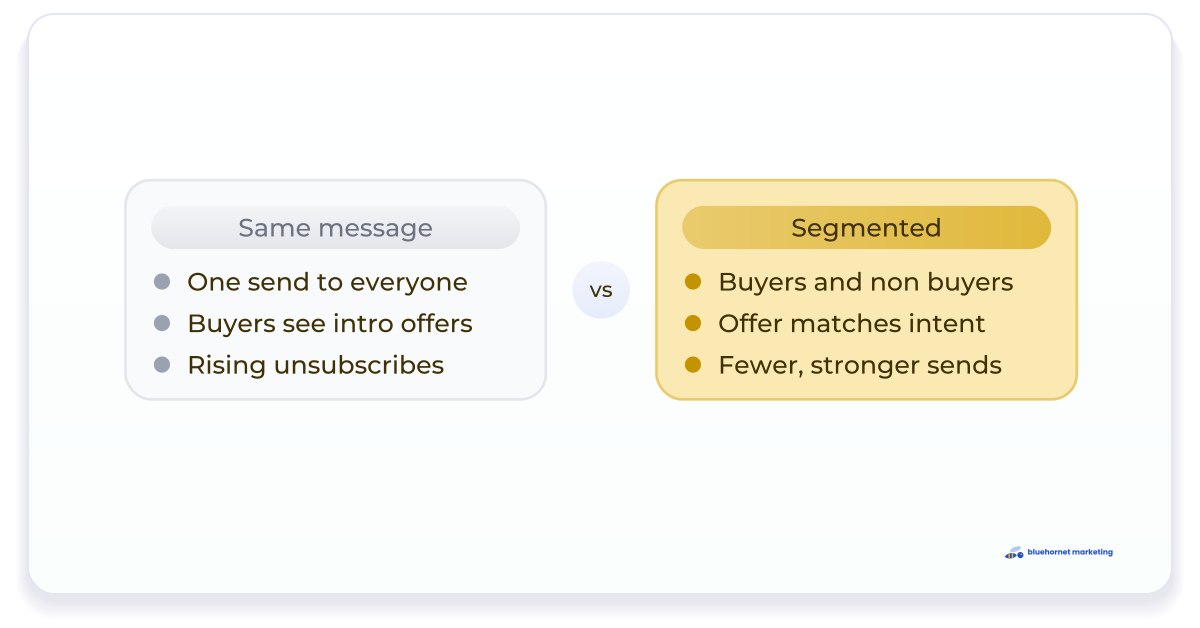
One blast to everyone feels efficient and works worst. A new subscriber, a loyal buyer and someone who has not clicked in a year need different messages. In my client work, simply splitting a list into three behavior groups is often the first change that moves revenue.
Avoid This
Sending every campaign to every contact.
Do This Instead
Create segments by purchase history, engagement and interest, and send the offer that fits each group.
Buying or Renting Email Lists
Purchased contacts never asked to hear from you. They mark mail as spam, bounce and hit spam traps, which damages your sending reputation for everyone else on the list too. The short-term reach is never worth the months of deliverability repair.
Avoid This
Uploading bought, rented or scraped contacts.
Do This Instead
Grow the list with signup forms, lead magnets and checkout opt-ins where people choose to join.
Running a One-Email Welcome
New subscribers are at their most interested right after signing up. A single welcome email wastes that. A short sequence that delivers what you promised, introduces your best content and suggests a first step turns a signup into a customer much more often.
Avoid This
A single welcome email with a discount code and nothing else.
Do This Instead
Build a three to five email welcome flow with one clear action per message.
Ignoring Mobile Layout
Many readers open on a phone, in a hurry. Wide tables, tiny text and two-column layouts become unreadable and tap targets get missed. I check every template on a small screen before a client sends, and I regularly find buttons that cannot be pressed.
Avoid This
Multi-column designs with small text and several competing buttons.
Do This Instead
Use a single column, readable type size and one primary button that is easy to tap.
Judging Results by Open Rate
Mail apps that preload images count opens that no human made, so open rate is now a weak signal. Teams that optimize for it write misleading subject lines and see clicks fall. Judge campaigns by clicks, conversions and revenue per email sent instead.
Avoid This
Declaring a winner from open rate alone.
Do This Instead
Track click rate, conversion rate and revenue per email, and use opens only to spot large changes.
Sending Without a Clear Goal or Call to Action
An email that tries to announce news, promote three products and invite feedback does none of them well. Readers decide in seconds. Each email needs a single goal and a single main action, written so the reader knows exactly what happens after the click.
Avoid This
Cramming several offers and links into one email.
Do This Instead
Write the goal in one sentence before you draft and design around one button.
Never Cleaning the List
Inactive contacts drag down engagement, raise complaint risk and, on many platforms, raise your bill. Leaving them in feels safe because the list looks bigger. It is not safe. It teaches mailbox providers that people ignore your mail.
Avoid This
Keeping every address forever to protect the list size.
Do This Instead
Send a re-engagement series, then remove contacts who still do not respond.
Testing Too Many Things at Once
If you change the subject line, offer, layout and send time together, you will never know which one worked. Run one test at a time with a written hypothesis and enough volume to judge it. Small lists need longer tests, not more variables.
Avoid This
Changing several elements in one test and calling the winner a lesson.
Do This Instead
Test one variable, write what you expect and record the result in a shared log.
Forgetting to Measure Revenue
Teams that only watch opens and clicks cannot say whether email pays for itself. Connect your store or CRM so each campaign and flow reports revenue and attributed sales. Then compare flows against campaigns and decide where time goes. A regular email marketing audit is the best way to catch what dashboards hide.
Avoid This
Reports that stop at open rate and click rate.
Do This Instead
Report revenue per email sent for every flow and campaign each month.
In What Order Should You Fix Them?
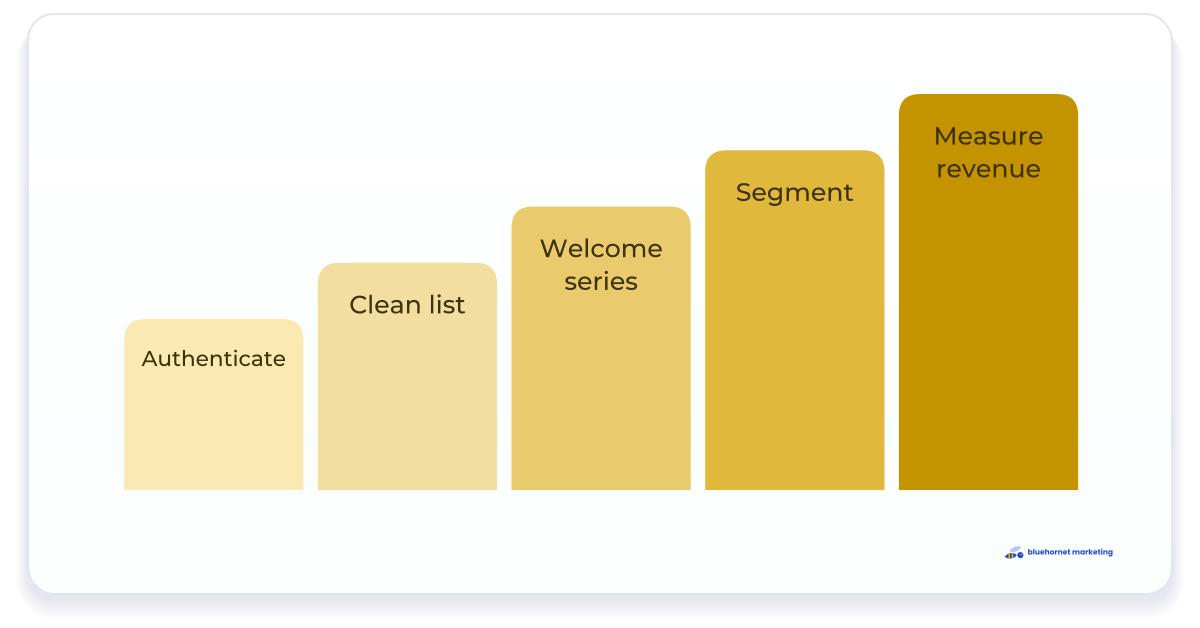
Fix in this order: authentication, list quality, segmentation, welcome flow, measurement. The first two decide whether anyone sees your mail. The next two decide whether they act on it. Measurement tells you whether it all worked.
If you only have a week, spend it on authentication and one clean-up of your list. If you have a month, add segmentation and a real welcome flow. Content improvements come after these, because better copy sent to the wrong people or the spam folder changes little. A fuller list of steps is in my email marketing checklist.
When you are unsure whether a platform limits you, compare it with the tools in my guide to email marketing software. Sometimes the mistake is the tool, but far more often it is the way the tool is set up.
What These Mistakes Cost in Practice
It is hard to put one number on mistakes, because the cost depends on your list and your margins. A simple way to see it is to compare two versions of the same month. In version one, you email the full list a weekly offer. In version two, you send the same offer to engaged buyers first, a different one to new subscribers and nothing to contacts who have been silent for a year.
Version two usually sends fewer emails and earns more per email sent. The complaint rate falls, the sender reputation improves and the next month starts from a better place. That compounding effect is why I put authentication and list quality ahead of copy and design. Each fix raises the return on all the others.
A Worked Example
Say you send 20,000 emails a week and earn a small amount per email. If 30% of your list has been inactive for a year and you remove those contacts after a re-engagement series, you send fewer emails and your engagement rates rise. If your authentication also gets fixed, more of the remaining mail reaches the inbox. Even if revenue per week stays the same at first, your cost per send falls and your reputation improves, which protects every future campaign.
Use your own numbers. Pull the last 90 days, split revenue by flows and campaigns and divide by emails sent. If flows earn several times more per email than campaigns, the answer to your next move is likely a better flow, not another campaign.
Habits That Prevent Most of These Mistakes
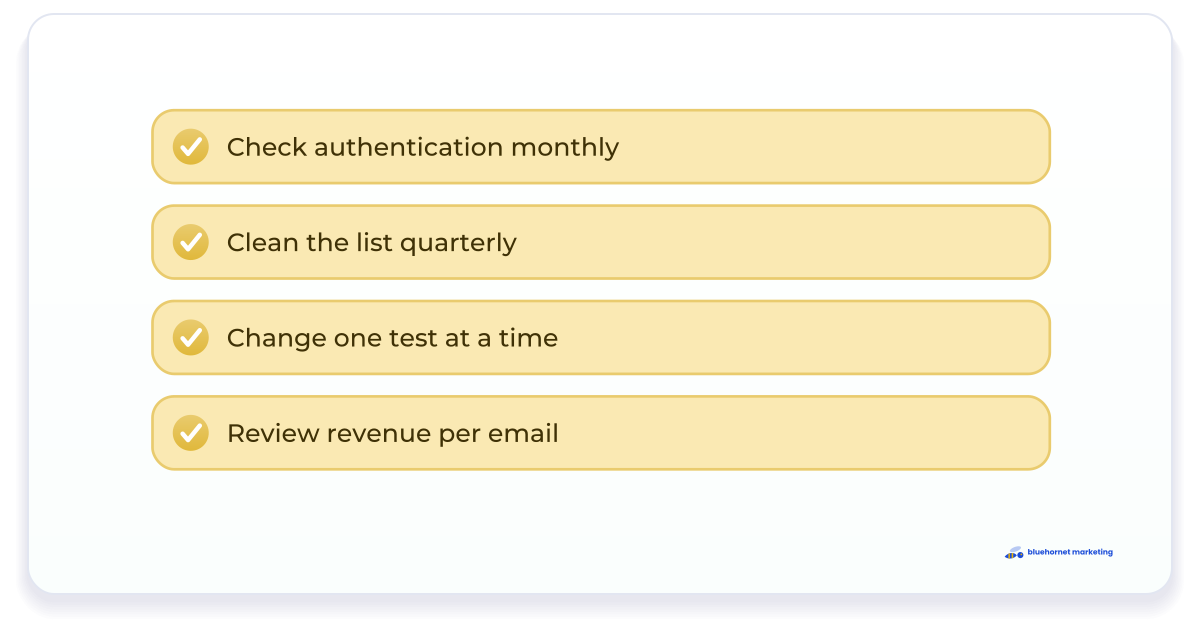
A few routines keep a program out of trouble. Check authentication and complaint rates after every platform or domain change. Send a test to a phone before every campaign. Review the list every quarter. Keep a test log. Look at revenue per email each month.
None of this takes long, and together it catches most of the mistakes above before they cost you money. The teams I see with the steadiest results are not the ones with the cleverest copy. They are the ones that run these small checks every month without fail.
How to Decide Where to Start
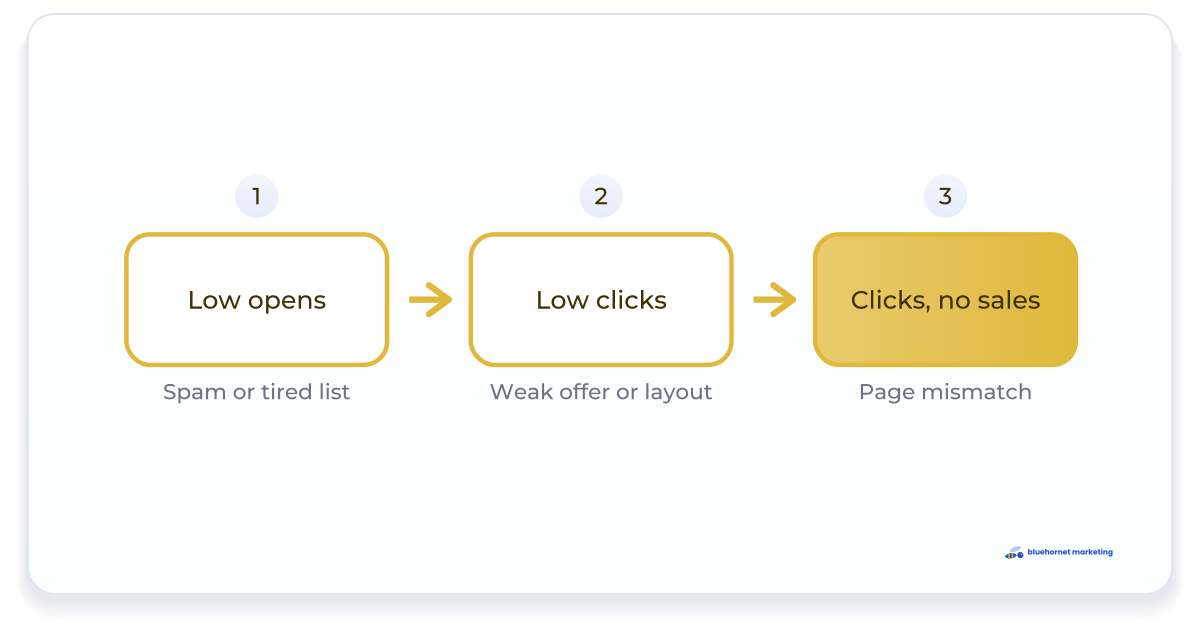
Match your symptom to the most likely cause:
- Opens and clicks dropped across the board: mistakes 1, 3 and 8.
- Clicks are fine but sales are weak: mistakes 4, 6 and 7.
- Unsubscribes and complaints are rising: mistakes 2, 3 and 7.
- You cannot tell what works: mistakes 9 and 10.
Questions About Email Marketing Mistakes
What Is the Biggest Email Marketing Mistake?
In my experience, it is skipping authentication and list hygiene. Both quietly reduce how much of your mail reaches an inbox, so every other improvement works on a smaller audience. Fix them first, then work on content and segmentation.
How Often Should I Email My List?
It depends on your audience and what you offer. Many businesses do well with one to three campaigns a week plus automated flows. Watch unsubscribe and complaint rates as you change frequency, and let segments with high engagement hear from you more often.
Why Are My Emails Going to Spam?
Common causes are missing authentication, a stale or purchased list, spammy wording, heavy images with little text and high complaint rates. Check authentication first, then list quality, then content. A free inbox placement test can show where you land.
What Is a Good Open Rate?
Open rates vary widely by industry and have become less reliable because many apps preload images. Compare against your own past results and focus on clicks, conversions and revenue, which still reflect real behavior.
How Many Segments Should I Create?
Start with three to five: new subscribers, customers, repeat customers, engaged non-buyers and inactive contacts. Add more only when you have a different message for each. Too many segments you never use only add work.
Should I Use the Same Email Platform Forever?
Not necessarily. Switch when your tool limits segmentation or automation you need, or when cost grows faster than revenue. My ranking of email marketing software shows the options. Plan a move carefully so your sending reputation carries over.
How Do I Recover from a Bad Sending Reputation?
Stop sending to inactive contacts, fix authentication, send only to engaged subscribers for a few weeks and increase volume slowly. Recovery takes weeks or months, depending on how severe the problem was, so prevention is much cheaper.
Disclaimer: This article is for general information only and isn’t legal, financial or tax advice. Treat figures as estimates from typical work and confirm details with your providers before you act.
Was this guide helpful?
Thanks for your feedback.
Warren Albright
Warren leads the Blue Hornet editorial team and works with the consultants to turn real client projects into practical guides on content, paid media, marketing automation, CRM and analytics. He comes from content and demand generation work, edits every article before a working marketing consultant reviews it, and draws on strategies, channel plans and audits from client projects to keep the advice grounded in real numbers.