Quick Summary
- Aviation audiences are small, so strategy is mostly about choosing who to ignore.
- Trust and speed of reply win more bookings than price in most segments I see.
- Pick two channels per quarter, fund them properly and judge them on quotes and bookings.
- A one-page plan with owners and dates is worth more than a 40-page deck.
An aviation marketing strategy is a set of choices: which buyers you will pursue, what you will tell them and where you will spend. The choices matter more than the document, and the discipline is in saying no. A charter operator, a flight school and an MRO shop all share a small, high-value audience that punishes scattered effort.
This playbook is the version I use in aviation marketing consulting. It has six phases, each short enough to finish in a week or two, and it ends with a 90-day plan you can start on Monday.
The Six Phases at a Glance
| Phase | Key question | Output | Time |
|---|---|---|---|
| 1. Audience | Who books, who influences, who signs? | Two or three ranked buyer profiles | 1 week |
| 2. Position | Why you instead of the next operator? | One-sentence position plus three proof points | 1 week |
| 3. Offer | What do you ask buyers to do first? | A clear first step per audience | 1 week |
| 4. Channels | Where do these buyers look? | Two priority channels and a stop list | 1 week |
| 5. Budget | What do you fund and what do you test? | A split by channel and quarter | Few days |
| 6. Measurement | How will you know it works? | A dashboard of leads, quotes and bookings | 1 week |
Phase 1: Choose Your Audiences
List who buys, who influences and who signs. For a charter operator, that may be an executive assistant, a travel manager and the passenger. For an MRO shop, it is a maintenance director, a purchasing lead and a fleet manager.
Rank them by revenue potential and how reachable they are. Then pick the top two. In client work, firms that drop from five audiences to two usually see better results within a quarter, because each campaign finally has enough budget to work.
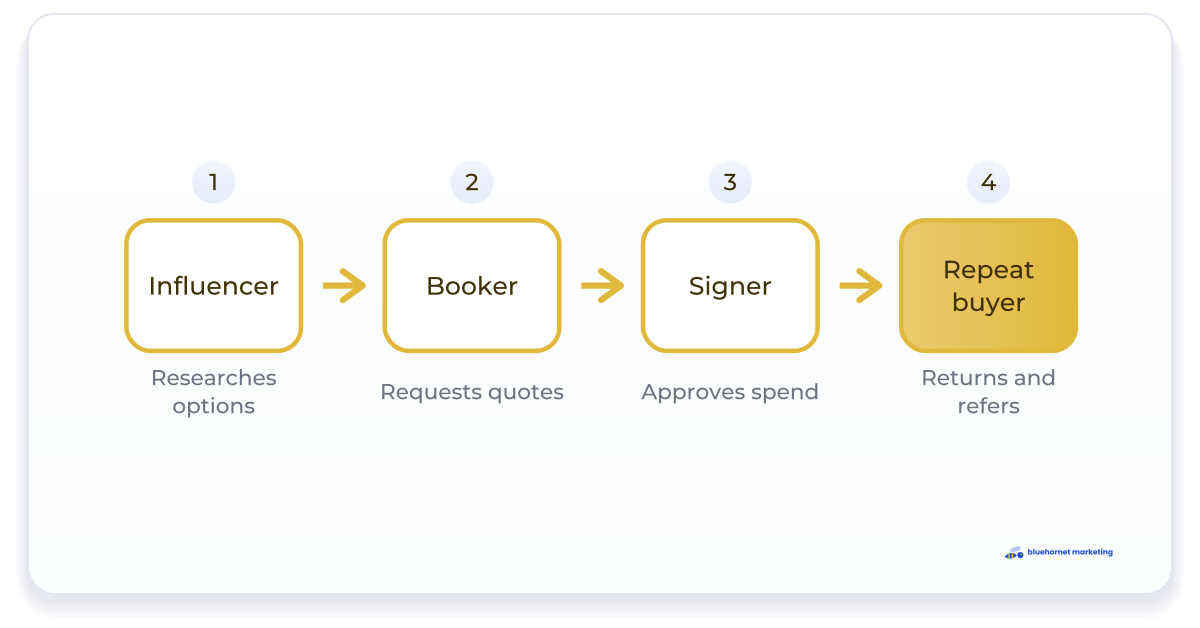
Do not skip the interview step. A private owner and a corporate flight department use the same aircraft and want very different things. One cares about the cabin and the crew, the other about cost per hour, scheduling and a clean audit trail. Write each profile as a short paragraph with the questions that person asks before they call.
Phase 2: Write a Position You Can Prove
Position is the short answer to "why you". "We care about safety" is true for everyone, so it sets you apart from no one. "Part 135 operator with a published safety management system and a two-hour quote promise" gives a buyer something to check.
Gather three proof points you can show: certifications, a response-time record, a fleet detail or a named customer. If you cannot find three, you have found a business problem before a marketing one.
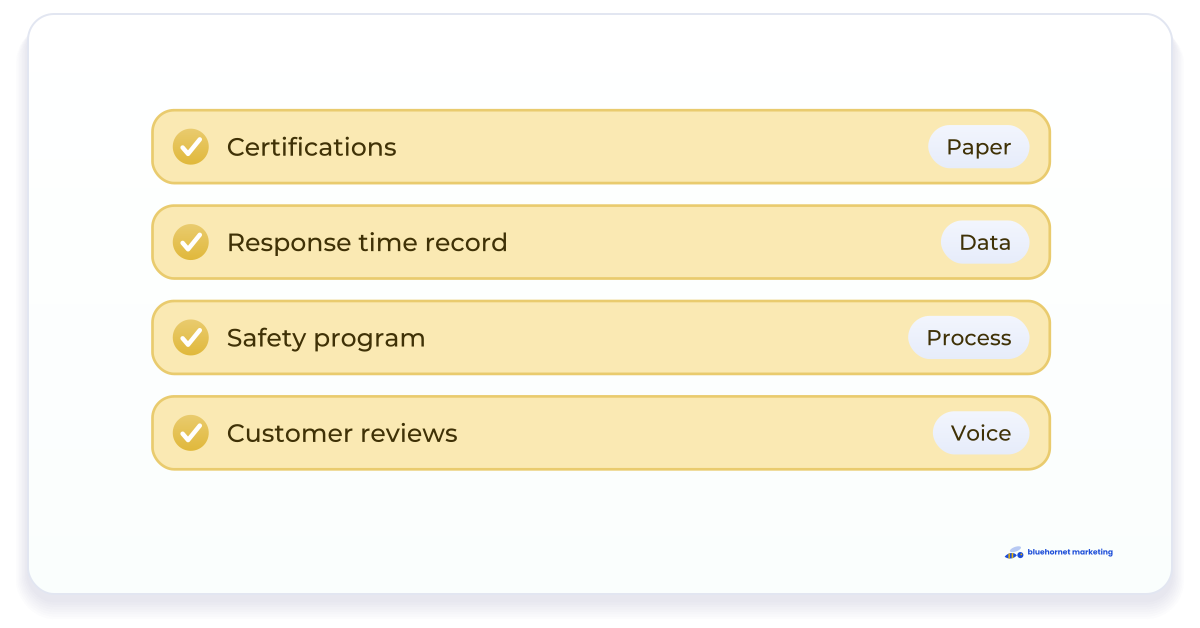
Test the position on a stranger. Show it to someone outside aviation and ask what they think you do and why they would pick you. If the answer is vague, the sentence is too. Fix it before you spend anything on ads, because every campaign repeats it.
Phase 3: Define the First Step
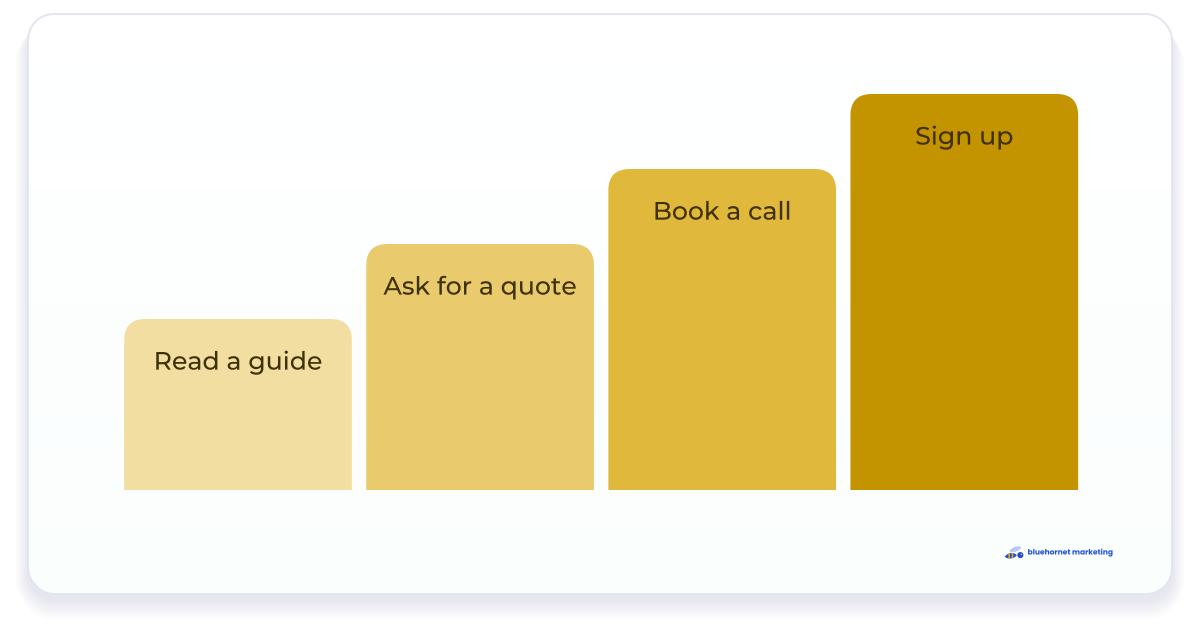
Buyers in aviation rarely commit on a first visit. Give each audience a small, low-risk step: a discovery flight, a sample quote, a capability sheet or a short call. Then make it easy to take on a phone.
Test the step by asking five recent customers what nearly stopped them from inquiring. Their answers are better copy than anything I can write.
Match the step to the stage. A cold audience may only accept a guide, a price range or a short video. A warm one, such as a past customer, will take a call or a quote. Using the same ask for both lowers results for each, so give every audience its own first step and its own page.
Phase 4: Pick Two Channels and Stop the Rest
Match channels to where each audience looks. The table gives my default starting points, based on projects across segments, which you should treat as hypotheses to test.
| Segment | Lead channels | Supporting channels |
|---|---|---|
| Charter and fractional | Search, referrals, retargeting | Email, reviews, LinkedIn |
| Flight schools | Local search, reviews | Video, email, social |
| MRO and suppliers | LinkedIn, account-based outreach | Content, trade events, search |
| FBOs and airports | Local search, listings | Email, partnerships |
| Aircraft sellers | Listing platforms, search | Video, email, communities |
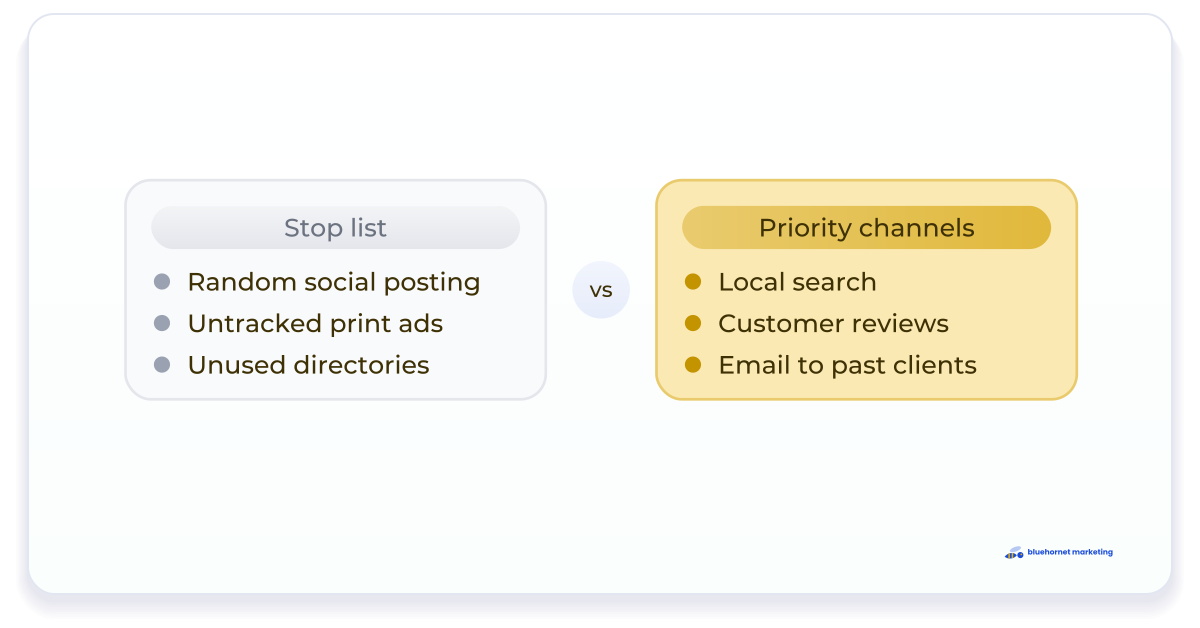
Write a stop list as well. The channels you leave out are as much a part of the strategy as the ones you fund, and they protect your budget from the loudest suggestion in the next meeting. For a view of where buyer habits are heading, read my overview of aviation marketing trends.
Phase 5: Split the Budget
I use a simple 70, 20, 10 split as a starting point. Put 70% on channels that already book, 20% on one channel you want to prove and 10% on experiments. Adjust it after each quarter, based on cost per quote and cost per booking.
Remember the long cycle. A campaign that launched in March may book in August, so measure leading indicators such as qualified inquiries along the way and judge revenue later. Leave room for sales follow-up costs, because a lead nobody calls is waste.
Phase 6: Build the Measurement Plan
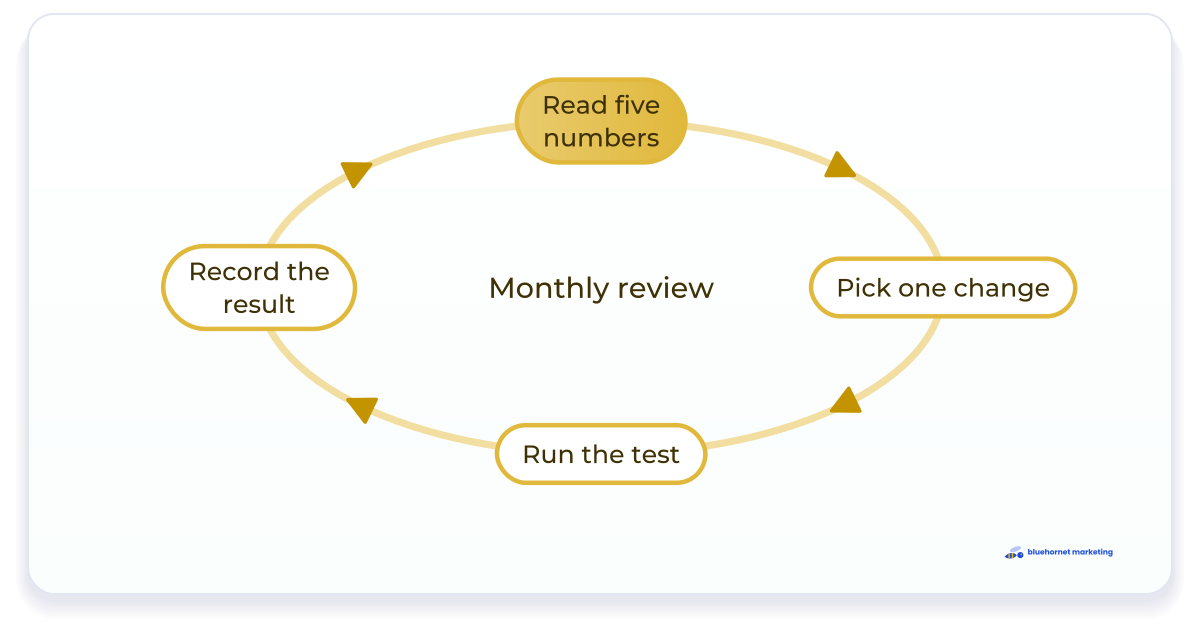
Track five numbers every month: qualified inquiries, quotes sent, quotes won, cost per booking and average booking value. If you can see only one thing, make it quotes won by source.
Set up your CRM so every inquiry carries a source from the first click. Review the numbers on a fixed day each month with whoever owns sales. Strategy without that meeting turns into a document nobody opens.
Keep the dashboard small. One page with five numbers, a trend line for each and a note on what changed is enough. When a number moves, write down your explanation and revisit it next month. After a year, those notes become the best record of what actually works in your market.
Strategy Mistakes I See Most Often
The first mistake is treating the website as a brochure. In aviation, buyers check it for safety, credentials and fleet details, so a dated page costs you inquiries you never see. The second is spreading a small budget across six channels, which leaves each one too weak to learn from.
The third is measuring clicks and calling it done. A campaign with cheap clicks and no bookings is a loss, and only CRM tracking shows it. The fourth is slow follow-up. If an inquiry waits a day, the buyer has often called someone else.
The fifth is skipping existing customers. Past passengers, students and clients are your cheapest source of bookings and referrals, yet many firms never email them. A simple twice-a-quarter message, tied to a service or seasonal offer, often outperforms a new ad campaign.
A last point on mistakes: most of them share a cause, which is a plan nobody owns. Name one person who is accountable for each phase, put the dates in a shared calendar and review progress with the same group each month. Plans with named owners get finished, and plans with a team name on them usually do not.
Your First 90 Days
- Weeks 1 to 2: interview five customers and set up source tracking in your CRM.
- Weeks 3 to 4: rewrite your key service page around your position and proof points.
- Weeks 5 to 8: launch your first priority channel with a clear first step.
- Weeks 9 to 12: review quotes and bookings, then fix or double down.
If you want smaller moves to run alongside the plan, my list of aviation marketing tips has nine that fit. For software that supports each phase, see my comparison of aviation marketing tools.
If your firm has several segments, run the six phases once per segment and compare the outputs. Overlap is common: a charter operator that also sells aircraft management has two audiences with different first steps. Keeping their plans separate avoids a muddled message and lets you see which line earns more per marketing dollar.
Finally, put the whole plan on one page and share it with every person who touches a customer, from the dispatcher to the line technician. They answer calls and greet visitors, so they carry your position into every first conversation, whether you planned for it or not.
Revisit the plan every quarter with three questions: which audience booked most, which channel cost least per booking and what did customers say that surprised you? The answers decide what to fund next and what to retire. Write the decisions into the plan, with dates, so the next review starts from facts and not from memory.
How to Choose Between Doing It Yourself and Getting Help
You can run this playbook yourself if you have someone with time, access to your data and the authority to say no. Get outside help when that person does not exist, when your numbers are unclear or when you need results faster than a first-time effort allows.
A partner should show you the audit method, give a fixed quote, report on bookings and not clicks and leave you with the accounts and documentation. A free call is enough to see whether that is how they work.
Questions About Aviation Marketing Strategy
How Long Does It Take to Build an Aviation Marketing Strategy?
A focused plan takes four to six weeks for a small operator, and longer when several segments or sites are involved. Most of the time goes into interviews and data, not writing. Rushing the audience work is the most expensive shortcut I see.
What Should an Aviation Marketing Strategy Include?
At minimum it needs your audiences, your position, the channels you will use, a budget split, a measurement plan and a 90-day action list. Everything else is detail. If a plan cannot be summarized on one page, it is probably too complicated to run.
How Much Should I Spend on Aviation Marketing?
It depends on margins, deal size and how fast you want to grow. Many firms I advise start with a modest share of revenue and raise it only after a channel proves it books. I will not quote a universal percentage, because it would be a guess for your business.
Which Channel Should I Start With?
Start where intent is highest and measurement is easiest, which is usually search and your own website. Add LinkedIn for B2B, email for repeat customers and video where seeing the product helps. Do not open more than two new channels in the same quarter.
Do I Need a CRM for a Small Aviation Business?
Yes, a simple one. Without it you cannot see which inquiries turned into bookings or why quotes went quiet. A basic CRM with source tracking and follow-up reminders pays for itself faster than most ad spend.
How Do I Handle Seasonality in My Strategy?
Plan campaigns around your demand curve, not the calendar year. Build content and email lists in slow months, then spend on ads when buyers are active. Track year-over-year results, since month-to-month comparisons mislead in seasonal businesses.
When Should I Hire a Consultant for Aviation Marketing?
When you are spending money on marketing without knowing what it returns, when growth has stalled or when you are entering a new segment. A short audit often finds the biggest leak in the first few weeks.
Disclaimer: This article is for general information only and isn’t legal, financial or tax advice. Treat figures as estimates from typical work and confirm details with your providers before you act.
Was this guide helpful?
Thanks for your feedback.
Warren Albright
Warren leads the Blue Hornet editorial team and works with the consultants to turn real client projects into practical guides on content, paid media, marketing automation, CRM and analytics. He comes from content and demand generation work, edits every article before a working marketing consultant reviews it, and draws on strategies, channel plans and audits from client projects to keep the advice grounded in real numbers.