Quick Summary
- Split the year into four phases, each with one job and one decision gate.
- Spend months 1 and 2 on goals, customer definition and baseline numbers before you fund channels.
- Fund two or three channels properly instead of spreading budget over six.
- Give every roadmap line one owner, one date and a review in the calendar.
A strategic marketing roadmap turns your goals into a calendar of work, with an owner, a budget and a success number for each quarter. If you are starting from scratch, a strategic marketing consulting engagement produces this plan with you, but you can also build a first version yourself using the steps below.
I have drafted dozens of these roadmaps, and the good ones are shorter than people expect. They fit on two pages, they name what you will stop doing, and they leave room to change course after each quarter. Below is the 12-month plan I start from, with the reasoning behind each phase so you can adapt it to your business.
The 12-Month Roadmap at a Glance
The year splits into four phases. Each one has a single job, and each ends with a decision gate where you check a number before moving on.
| Phase | Months | Main job | Decision gate |
|---|---|---|---|
| 1. Foundation | 1 to 2 | Fix goals, data, customer definition and positioning | Baseline numbers agreed by sales and marketing |
| 2. Core channels | 3 to 5 | Fund two or three channels well and set up tracking | Cost per lead within the target range |
| 3. Optimize and test | 6 to 9 | Raise conversion and test one new channel | Lead-to-customer rate improving |
| 4. Scale and plan ahead | 10 to 12 | Put more budget behind winners and plan next year | Pipeline on track for the revenue target |
Months 1 to 2: Lay the Foundation Before You Spend
Most roadmaps I see skip straight to channels. That is why they stall in month four, when someone asks what a qualified lead is and nobody agrees. Spend the first two months on the boring questions.
Set the revenue goal and work backward
Start with the revenue marketing has to influence this year. Divide it by your average deal size to get the number of customers, then divide by your close rate to get the number of qualified leads. If you close one in five and need 60 customers, you need about 300 qualified leads. That number, not "more traffic", is your target.
Agree on the customer and the message
Pull your 20 best customers from the CRM and look at what they share: industry, size, trigger event, the competitor they compared you with. Talk to five of them. Then write one sentence that says who you help, what changes for them and why you are the better choice. My strategic marketing framework walks through that step in detail.
Get a baseline
Record where you stand today: leads by source, cost per lead, lead-to-customer rate, average sales cycle. If a number is unreliable, fixing the tracking is your first task. A roadmap without a baseline cannot tell you whether it worked.
Months 3 to 5: Fund Two or Three Channels Properly
The temptation here is to be everywhere. Resist it. A channel needs enough budget and enough time to produce readable data, and a small budget spread over six channels produces none.
Choose channels by evidence and fit
Rank channels on three questions: where do your best customers look for answers, where have you already seen leads, and what does a lead cost? For a B2B software company that usually means search, one social platform and email. For a local clinic it usually means local search, reviews and referrals. If you want a faster way to make these choices, a short list of strategic marketing tips covers the moves that hold up across industries.
Split the budget with a floor
A split I use as a starting point is 60 to 70% on proven channels, 20 to 30% on one promising channel and 10% for tests. It is a starting point only. If one channel clearly beats the others after eight weeks, shift money toward it.
| Budget bucket | Share | What it funds | Review after |
|---|---|---|---|
| Proven | 60 to 70% | Channels that already produce leads at an acceptable cost | Every month |
| Promising | 20 to 30% | One channel with good fit but little history | 8 to 12 weeks |
| Test | About 10% | Small experiments with a stated question and stopping rule | 4 to 6 weeks |
Set up measurement before launch
Each channel gets a tracking plan before the first dollar goes out: a defined conversion, a source tag and a place in the CRM where the lead lands. Retrofitting tracking in month five costs you the data from months three and four.
Months 6 to 9: Optimize What Works and Test One New Thing
By now you have four to five months of data. This phase is about conversion, not volume. Lifting a landing page from 2% to 3% adds half again as many leads for no extra media spend.
Fix the leaks in your funnel first
Look at each stage: visit to lead, lead to qualified, qualified to opportunity, opportunity to customer. Find the stage with the biggest drop against what you expected and work on that one. Often it sits late, in follow-up speed or in how sales handles marketing leads.
Run one new test at a time
Choose one new channel or offer, write the question it should answer, set the budget and the stop date. Treat a failed test as a cheap answer. A channel you tested for six weeks and dropped saved you from funding it for a year.
Hold a mid-year review
At month six and again at month nine, compare actuals with the plan. Write down which assumptions were wrong. This is where a roadmap earns trust with leadership: you show the change and the reason for it, instead of defending a plan that no longer fits.
Months 10 to 12: Scale the Winners and Draft Next Year
With nine months of numbers, you can forecast. If a channel produces customers at a cost your margins support, you can add budget and estimate the return with a reasonable range.
Scale in steps
Raise spend on the winning channel in two or three increments and watch cost per lead. Most channels show rising costs as you push volume. The point to stop is where the marginal cost per customer crosses what a customer is worth to you.
Retire what did not work
Write a short list of what you will stop doing and why. Teams that skip this step carry last year's experiments into next year's plan.
Start next year's roadmap in month ten
Reuse the same structure. Update the revenue goal, refresh the customer research and carry the baseline forward. The first roadmap is the most work, and the second is mostly editing.
Who Owns What in the Roadmap
A roadmap with no owners is a wish list. Give every line a single named person and a date. Shared ownership means no ownership, and I have watched important tasks sit for a quarter because two people each assumed the other had it.
| Roadmap item | Owner | Needs from others |
|---|---|---|
| Revenue and lead targets | Head of marketing | Sales leader agrees on lead definition |
| Customer research | Marketing manager | Sales introduces 5 customers |
| Channel budgets | Head of marketing | Finance approves quarterly limits |
| Tracking and reporting | Marketing operations | IT access to site and CRM |
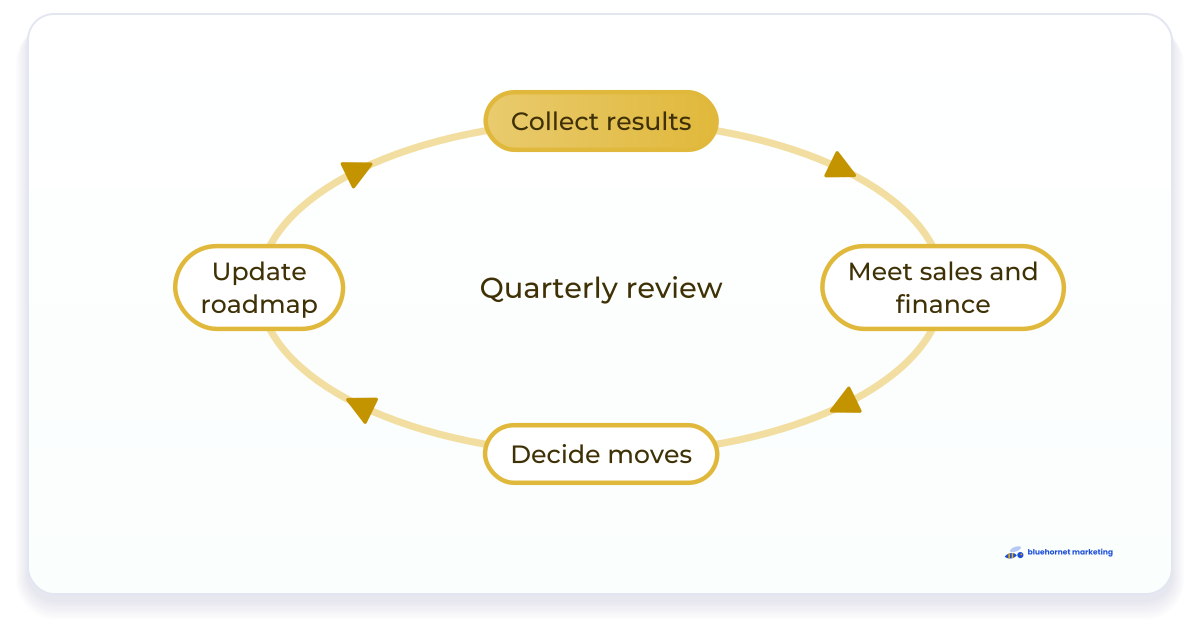
| Quarterly review | Head of marketing | Sales and finance attend |
Small teams combine roles, and that works as long as each task still has one name beside it.
Where Roadmaps Break Down
Roadmaps rarely fail in the plan. They fail in the weeks after it is approved. The patterns repeat.
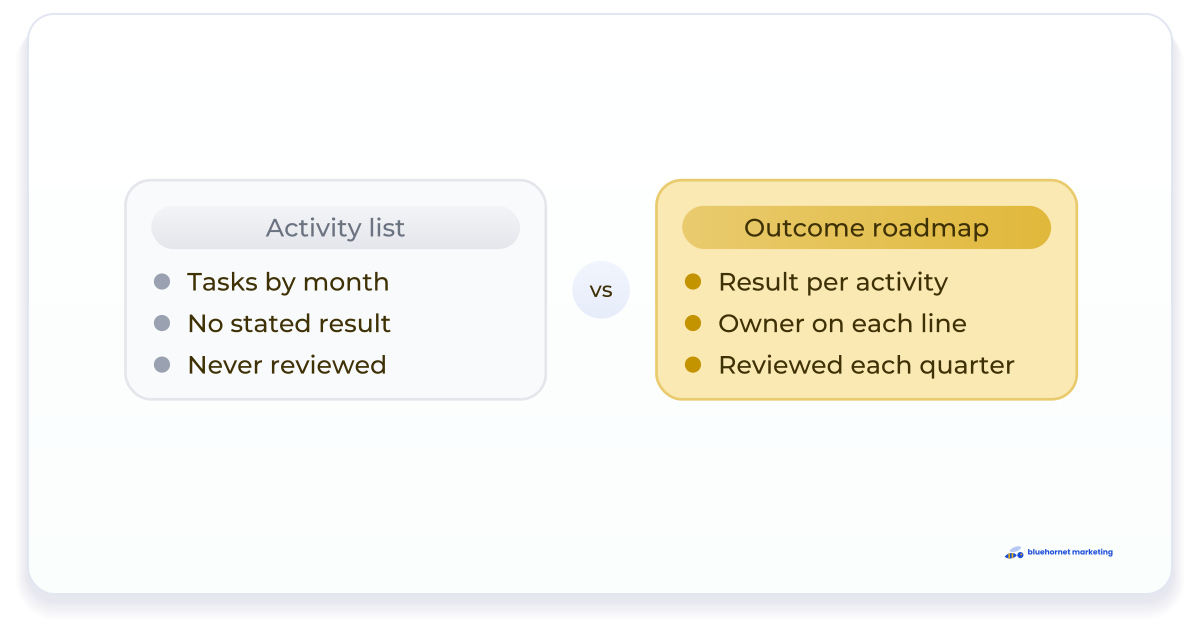
- The plan lists activities, not outcomes, so nobody can say whether a quarter went well.
- Reviews get skipped when a busy month arrives, and the plan quietly becomes fiction.
- New requests are added without anything being removed.
- The roadmap lives in a slide deck that only the head of marketing opens.
The fix for each is simple: write outcomes next to every activity, put reviews in calendars a year ahead, apply a one-in, one-out rule and keep the plan in a shared document your whole team can see.
Copy This Roadmap Template Into Your Own Document
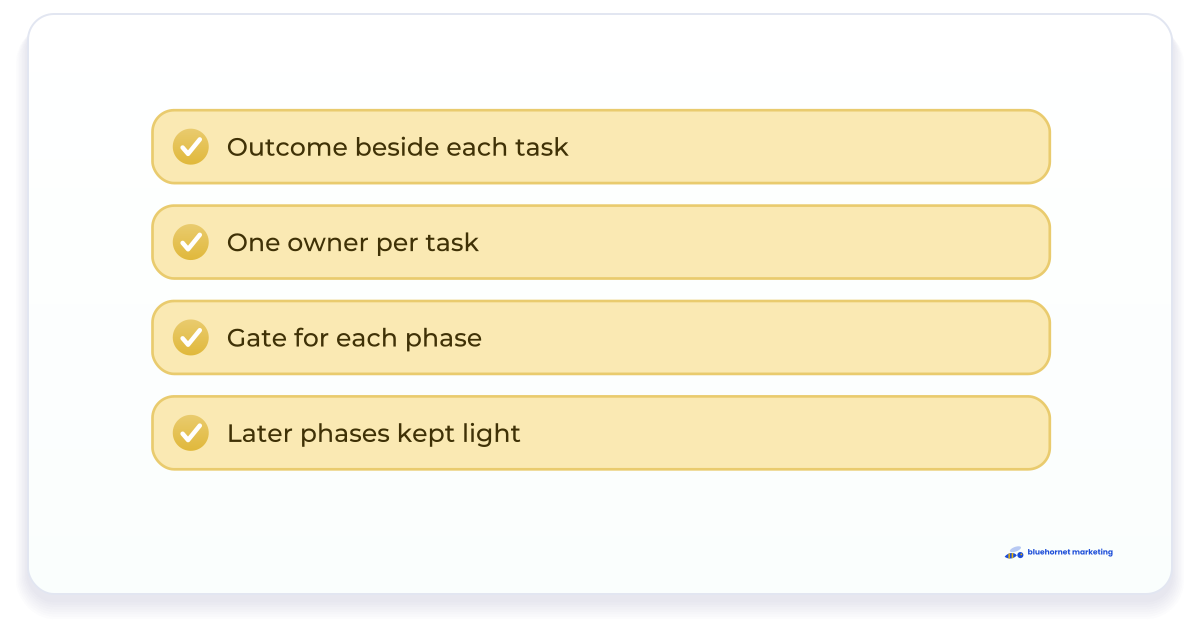
Create one page per phase with the same five headings: goal, numbers to hit, channels and budget, owners and risks. Under goal write a single sentence. Under numbers list no more than four metrics. Then add a final line called "Stop doing", which forces a choice each quarter.
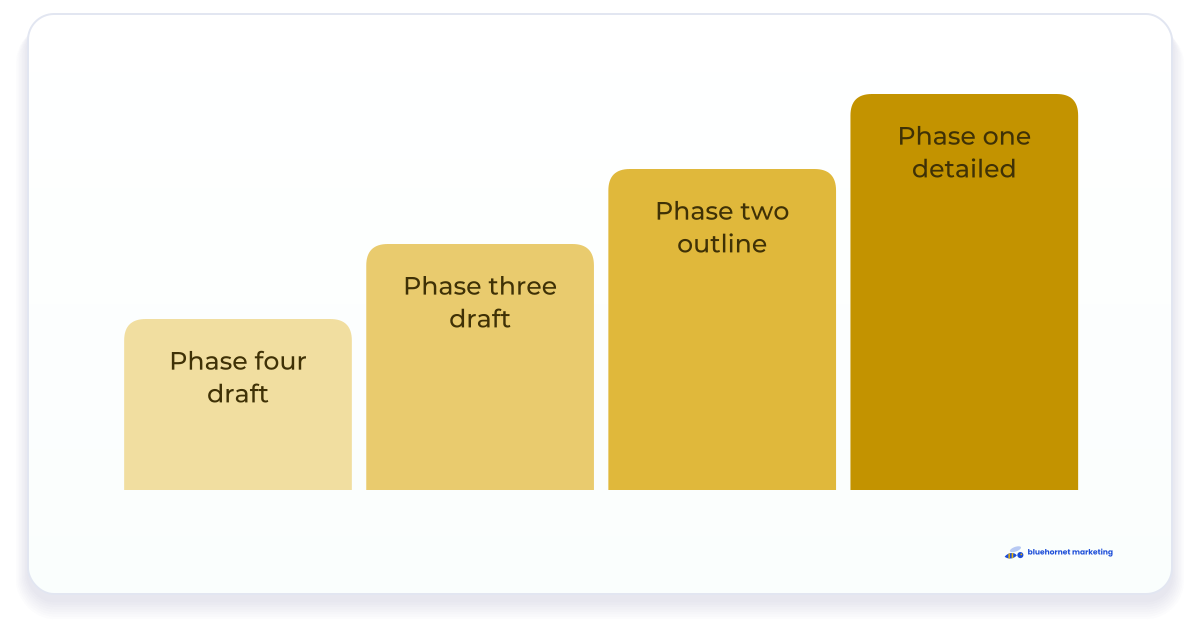
Fill phase one in this week. Leave phases three and four lightly drafted, because they depend on what you learn. Keeping them loose is a feature, and it keeps the roadmap honest.
How to Pick Your First Three Moves
If a full roadmap feels like too much, choose three moves for the next 90 days. Check each against these points:
- It ties to a number in your revenue goal.
- You can start it without new headcount.
- You will know within 90 days whether it worked.
- Someone has agreed to own it.
Those three moves become phase one of your roadmap, and the rest follows as the data comes in. If you want help ranking them, a short call with a consultant usually settles it in an hour.
Questions About Building a Strategic Marketing Roadmap
How Long Should a Strategic Marketing Roadmap Be?
Two pages is enough for most teams. One page holds the goals and numbers, and the second holds the quarterly priorities, owners and budgets. Longer documents rarely get read after the kickoff meeting, which defeats their purpose.
How Detailed Should the Roadmap Be for Later Months?
Be specific for the next quarter and light for the rest. Months 1 to 3 should list tasks, owners and dates. Months 7 to 12 should name goals and the questions you want answered, because results from earlier quarters will change the plan.
How Often Should I Update the Roadmap?
Review it every quarter and adjust it when a number moves far from plan. Small changes inside a quarter are fine. Rewriting the whole roadmap monthly means the plan is too detailed or the goals are unclear.
What Is the Difference Between a Roadmap and a Marketing Calendar?
A calendar lists what gets published and when. A roadmap explains why you chose those activities, what budget each gets and how you will judge success. Your calendar sits underneath the roadmap and changes more often.
How Much Budget Should I Assign to Each Channel?
A common starting point is 60 to 70% on proven channels, 20 to 30% on one promising channel and about 10% on tests. Your split depends on how much history you have, so treat it as a first version and revise after eight weeks of data.
Can a Small Team Use a 12-Month Roadmap?
Yes, and small teams often benefit most because they cannot afford wasted effort. Keep it to two or three channels, one owner per item and a single page of numbers. The structure stays the same, and the work is lighter.
When Should I Bring in a Consultant?
Bring one in when your team disagrees on priorities, when results have stalled or when you need an outside view of your channels. A consultant can build the first roadmap with you and show your team how to maintain it afterward.
Disclaimer: This article is for general information only and isn’t legal, financial or tax advice. Treat figures as estimates from typical work and confirm details with your providers before you act.
Was this guide helpful?
Thanks for your feedback.
Warren Albright
Warren leads the Blue Hornet editorial team and works with the consultants to turn real client projects into practical guides on content, paid media, marketing automation, CRM and analytics. He comes from content and demand generation work, edits every article before a working marketing consultant reviews it, and draws on strategies, channel plans and audits from client projects to keep the advice grounded in real numbers.