Quick Summary
- Work in order: goal, customer, positioning, channels, plan, measurement.
- Convert your revenue target into a qualified lead number with a simple formula.
- Score channels on fit, cost, speed and ability to execute before you fund them.
- Keep your scorecard to eight numbers or fewer, and review it every month.
A strategic marketing framework is a repeatable sequence of decisions: who you sell to, what you promise them, where you reach them and how you measure the result. Teams that work with a strategic marketing consulting partner usually get one built around their numbers, and you can build a lean version yourself with the six steps below.
I use a six-step model with my clients because it forces choices in the right order. Most marketing trouble I see comes from deciding channels before customers, or messages before positioning. The model below fixes the order, adds a formula for the numbers and ends with a checklist you can run in an afternoon.
Why Marketing Needs a Framework
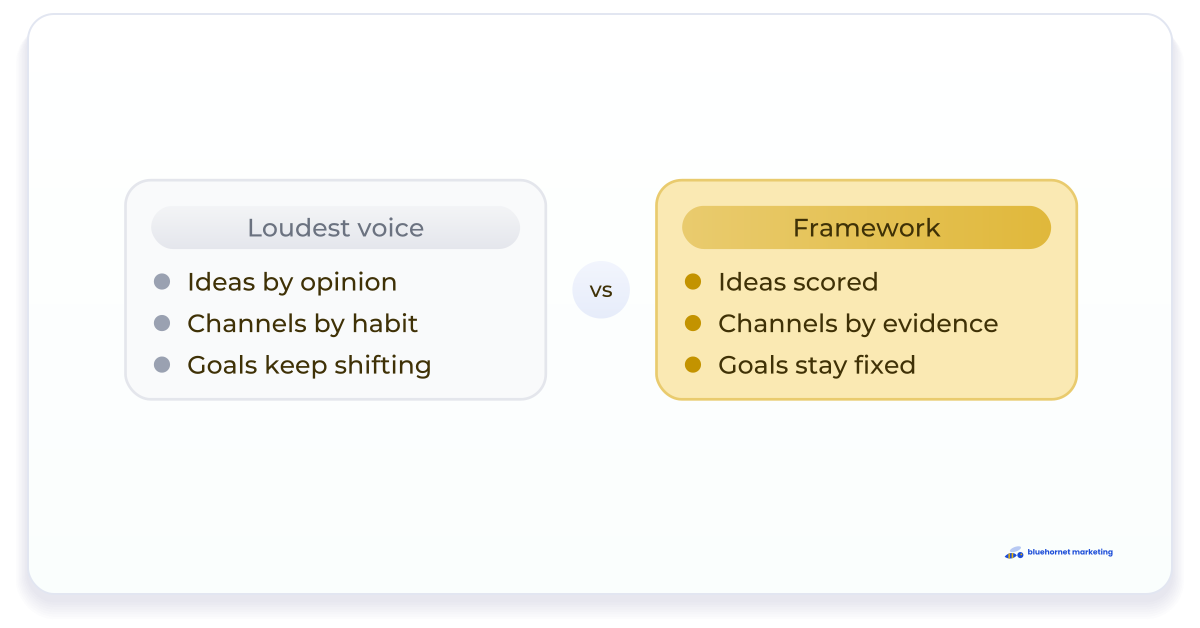
Without a framework, every decision is made from scratch and under pressure. A new quarter arrives, a competitor launches something, and the team reacts. A framework gives you a standing set of questions, so you answer the same ones each time and compare results across quarters.
It also protects you from the loudest voice in the room. When someone proposes a new channel, you can ask which step of the model it serves and which number it should move. That one question removes a large share of random requests.
The Six-Step Strategic Marketing Model
Each step feeds the next. The table shows the question, the output and how long it takes a small team.
| Step | Key question | Output | Typical time |
|---|---|---|---|
| 1. Goal | What revenue must marketing influence? | Lead and customer targets | 2 to 3 days |
| 2. Customer | Who buys, and why us? | Segments and buying triggers | 1 to 2 weeks |
| 3. Position | Why choose us over the alternatives? | Positioning statement and proof points | 1 week |
| 4. Channels | Where do we reach them at the lowest cost? | Ranked channels with budgets | 1 week |
| 5. Plan | Who does what, and when? | Roadmap with owners | 3 to 5 days |
| 6. Measure | How do we know it works? | Scorecard and review rhythm | 2 to 3 days |
Step 1: Turn the Revenue Goal Into a Lead Target
Every framework starts with a number. Take the revenue target, subtract what existing customers will renew, and divide the rest across new business. That figure tells you how many customers marketing must help win.
The formula
Leads needed = new customers needed divided by lead-to-customer rate. If you need 40 new customers and 8% of qualified leads become customers, you need 500 qualified leads. If your sales cycle is long, work out when those leads have to arrive, not only how many.
| Input | Example | Where to find it |
|---|---|---|
| New revenue target | $1,200,000 | Finance or leadership plan |
| Average first-year deal | $30,000 | CRM closed-won report |
| Customers needed | 40 | Target divided by deal size |
| Lead-to-customer rate | 8% | CRM funnel report |
| Qualified leads needed | 500 | Customers divided by rate |
The numbers above are an illustration. Replace each with your own, and if any input is a guess, mark it as one and plan to firm it up.
Step 2: Define the Customer Beyond Demographics
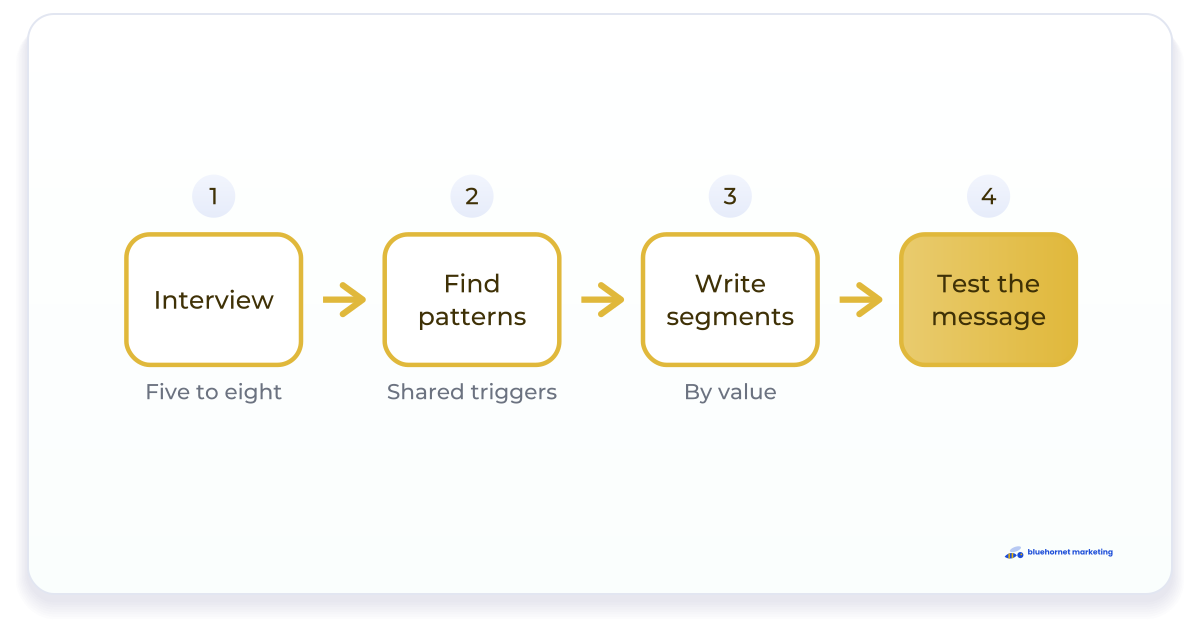
Job titles and company size describe who is on your list. They do not explain why someone buys. Add the trigger event (a new hire, a failed audit, a competitor launch), the alternative they considered and the objection that nearly stopped them.
The fastest way to get this is five to eight customer interviews of 30 minutes each. Ask what was happening before they looked for help, who else they talked to and what almost made them say no. Patterns appear by the fifth call. You can pair this with CRM data to see which segments close fastest and stay longest.
Segment by value, not by size alone
Score segments on three measures: how quickly they buy, how much they spend over time and how costly they are to serve. A smaller segment that buys in 30 days and renews often can beat a large one that takes nine months.
Step 3: Position Against the Real Alternative
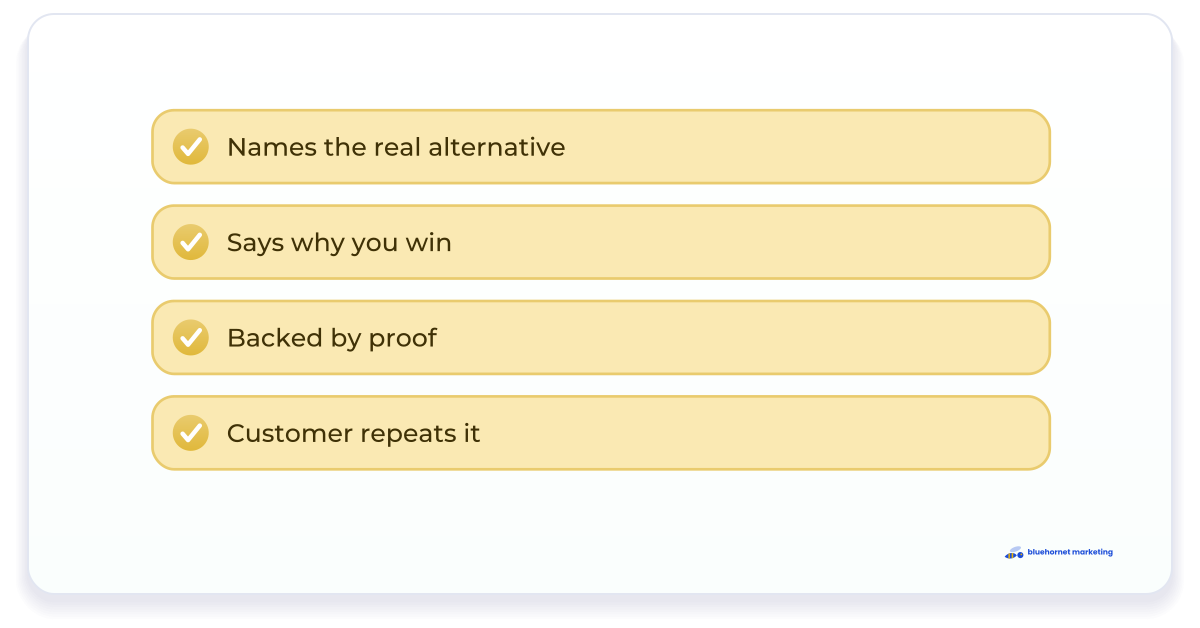
Positioning tells a buyer why you are the better choice for a specific job. A usable statement has four parts: the customer, the problem, your category and the reason to believe. It should be specific enough that a competitor could not say the same thing.
The alternative is often not a competitor at all. For many service businesses, the main rival is "do nothing" or "do it in-house". Your proof points need to answer that, with numbers from your own work where you can share them and reasoning where you cannot.
Step 4: Choose Channels With a Scoring Method
Scoring keeps channel choice honest. Rate each channel from 1 to 5 on four criteria, multiply by the weight and add up.
| Criterion | Weight | What a 5 looks like |
|---|---|---|
| Customer fit | 35% | Your best customers use it to research purchases |
| Cost per customer | 30% | Well below what a customer is worth |
| Speed to results | 20% | Leads inside 60 days |
| Your ability to execute | 15% | You have the skills and assets today |
The weights are a starting point, and a young company with little cash might raise speed. Fund the top two or three, and park the rest in a "later" list with a date to revisit. My strategic marketing roadmap shows how those budgets spread across 12 months.
Step 5: Write a Plan People Can Execute
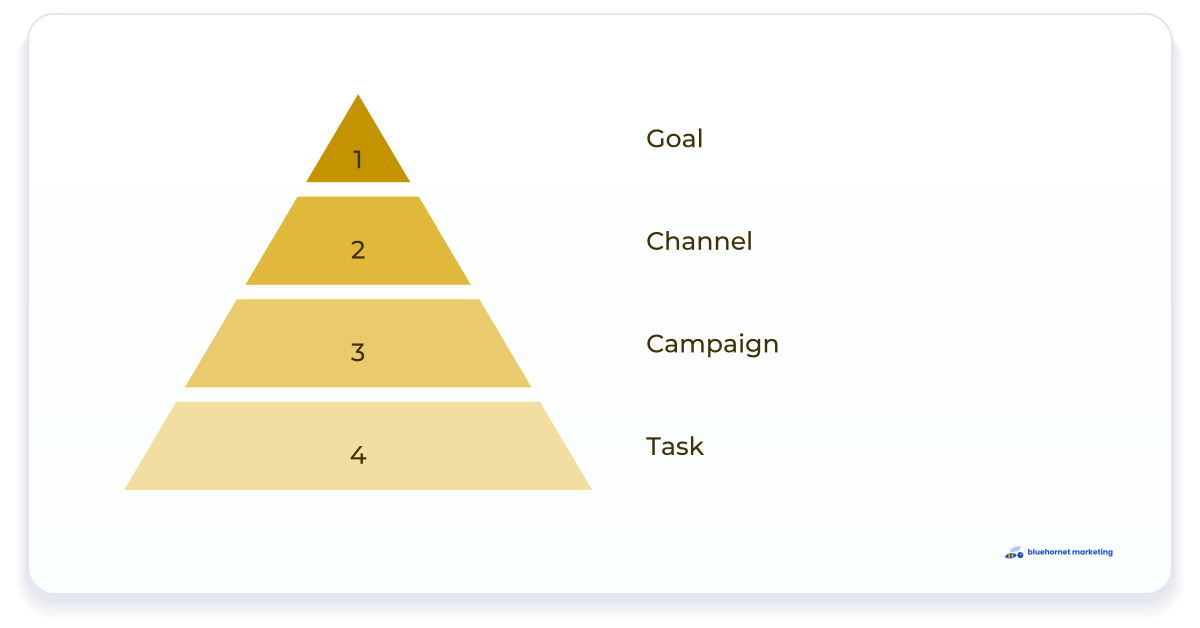
The plan converts the first four steps into quarters. Each quarter gets three or four priorities, each with an owner, a date and the metric it should move. Keep the language plain. If a task needs a paragraph to describe, it is probably two tasks.
Add one line called "not now", listing good ideas you are deliberately setting aside. This protects the team from scope creep, and it gives you a record for when someone asks why an idea was passed over. For quick wins to start with, see these strategic marketing tips.
Step 6: Build a Scorecard You Will Actually Read
A scorecard has no more than eight numbers. Mix leading indicators (qualified leads, cost per lead, conversion rate by stage) with lagging ones (pipeline, customers, revenue influenced). Show the target, the actual and a simple status.
- Every number has an owner and a source.
- The scorecard is reviewed monthly and discussed quarterly.
- When a number is off by a set margin, the owner brings a proposed fix.
- Definitions never change mid-year without a written note.
Common Mistakes When You Apply the Framework
I see the same slips across clients, and most are easy to avoid once you know them.
- Skipping step two and writing positioning from internal opinion.
- Treating the channel scoring as final, instead of rerunning it each quarter.
- Setting a goal in leads and never connecting it to revenue.
- Building a scorecard that tracks everything and informs nothing.
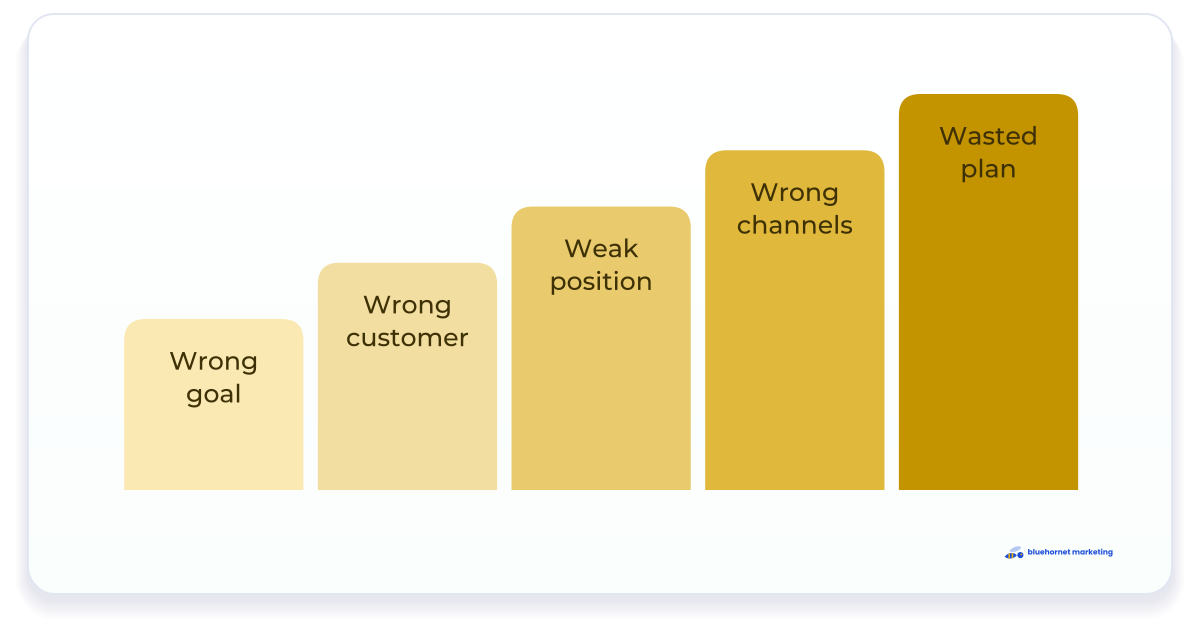
Each mistake costs you time, but the worst is the first, since every later step builds on it. If your customer research is thin, go back and talk to five buyers before you finish the rest.
How This Model Compares With Other Frameworks
You will hear about SOSTAC, the 4 Ps, RACE and others. They overlap with this model and differ mainly in emphasis.
| Framework | Strength | Gap |
|---|---|---|
| 4 Ps | Simple view of product, price, place and promotion | Says little about customers or measurement |
| SOSTAC | Full planning sequence from situation to control | Can become paperwork for small teams |
| RACE | Maps activity to the digital customer journey | Weak on positioning and goals |
| Six-step model | Starts from revenue and ends in a scorecard | Needs your own data to work well |
Pick the one your team will use and borrow from the others. The best framework is the one that gets run every quarter.
A Short Example: A Regional Accounting Software Firm
This is a composite built from patterns in my client work, not a single named company. The firm sold accounting software to mid-sized construction companies and wanted to grow new revenue by a third.
The goal step produced a target of about 450 qualified leads. Interviews showed that buyers were triggered by a failed audit or a change of finance lead, and that their main alternative was a spreadsheet, not a rival product. The positioning shifted from "easy accounting" to audit-ready job costing for contractors. Channel scoring put search and a partner program first and dropped trade show sponsorships, which scored low on cost per customer. The plan assigned owners and the scorecard held seven numbers.
Within two quarters, cost per qualified lead fell by roughly a fifth, mostly because search pages spoke to the audit trigger. Your own results will differ, but the sequence is the point: the customer work changed the message, and the message changed the channel choices.
Notice that the framework did not add work for its own sake. It removed an activity, narrowed the message and gave the team numbers to watch. That is the test of a useful framework.
Checklist: Is Your Framework Ready to Use?
Before you roll it out, confirm the following:
- Your goal is a lead and customer number, not a traffic number.
- You have spoken to real customers in the last 90 days.
- Your positioning statement could not be copied by a competitor.
- Channels are ranked, and the bottom ones are paused on purpose.
- Every priority has an owner and a date.
- You can read your scorecard in five minutes.
If you can tick all six, you have a working framework. If you want an outside review of yours, a short call is usually enough to find the weak step.
Questions About Strategic Marketing Frameworks
What Is a Strategic Marketing Framework?
It is a structured sequence of decisions that links your revenue goal to your customers, positioning, channels, plan and measurement. You answer the same questions in the same order each planning cycle, which makes plans easier to compare and defend.
How Many Steps Should a Framework Have?
Five to seven steps work for most teams. Fewer steps skip important decisions, and more steps turn into paperwork. The six-step model here covers goal, customer, position, channels, plan and measurement.
How Long Does It Take to Build One?
A small team can build a first version in three to five weeks, with most of the time going to customer interviews and pulling clean data. Your second round takes much less, because you update rather than start over.
Do I Need Customer Interviews?
Yes, if you can get them. Five to eight short calls reveal triggers and objections that CRM data cannot show. If you cannot reach customers, talk to your sales team and read recorded calls, and mark your assumptions as untested.
How Is a Framework Different from a Marketing Plan?
The framework is the method for deciding, and the plan is the result of using it for one period. You keep the framework for years and produce a new plan each quarter or year.
Which Framework Is Best for a Small Business?
The one you will run. Small teams do well with the six-step model scaled down: one goal, two customer segments, two channels and a scorecard of five numbers. Heavier frameworks like SOSTAC add steps that a small team rarely needs.
How Do I Know If the Framework Is Working?
Check whether decisions get faster and meetings get shorter, and whether your scorecard moves toward target. If your team still debates the basics every quarter, one of the first four steps needs more work.
Disclaimer: This article is for general information only and isn’t legal, financial or tax advice. Treat figures as estimates from typical work and confirm details with your providers before you act.
Was this guide helpful?
Thanks for your feedback.
Warren Albright
Warren leads the Blue Hornet editorial team and works with the consultants to turn real client projects into practical guides on content, paid media, marketing automation, CRM and analytics. He comes from content and demand generation work, edits every article before a working marketing consultant reviews it, and draws on strategies, channel plans and audits from client projects to keep the advice grounded in real numbers.