Quick Summary
- Security buyers are skeptical and work in committees, so your strategy needs content for every role in the room.
- A specific position backed by proof beats a broad promise to stop threats.
- Comparison, integration and pricing-logic pages meet buyers where they quietly decide.
- Measure demos, opportunities and pipeline, not downloads and traffic.
Cybersecurity marketing has a credibility problem. Every vendor says it protects, detects and responds, and buyers have learned to discount the words. A good strategy does the opposite: it narrows the claim, shows the evidence and speaks to each person who has a say in the purchase.
This is the six-phase playbook I use in cybersecurity marketing consulting. Each phase has a clear output, so you can see progress and stop when you have what you need.
The Six Phases at a Glance
| Phase | Key question | Output |
|---|---|---|
| 1. Position | What do you do better than the next three vendors? | A one-sentence position with proof |
| 2. Committee | Who decides, and what does each person need? | Role map with questions and objections |
| 3. Content | What proves it at each stage? | A core set of pages and assets |
| 4. Channels | Where do these buyers look and listen? | Two lead channels and a stop list |
| 5. Pipeline | How do leads become opportunities? | Scoring, handoff and follow-up rules |
| 6. Measurement | What proves it works? | A monthly pipeline report |
Phase 1: Write a Position You Can Prove
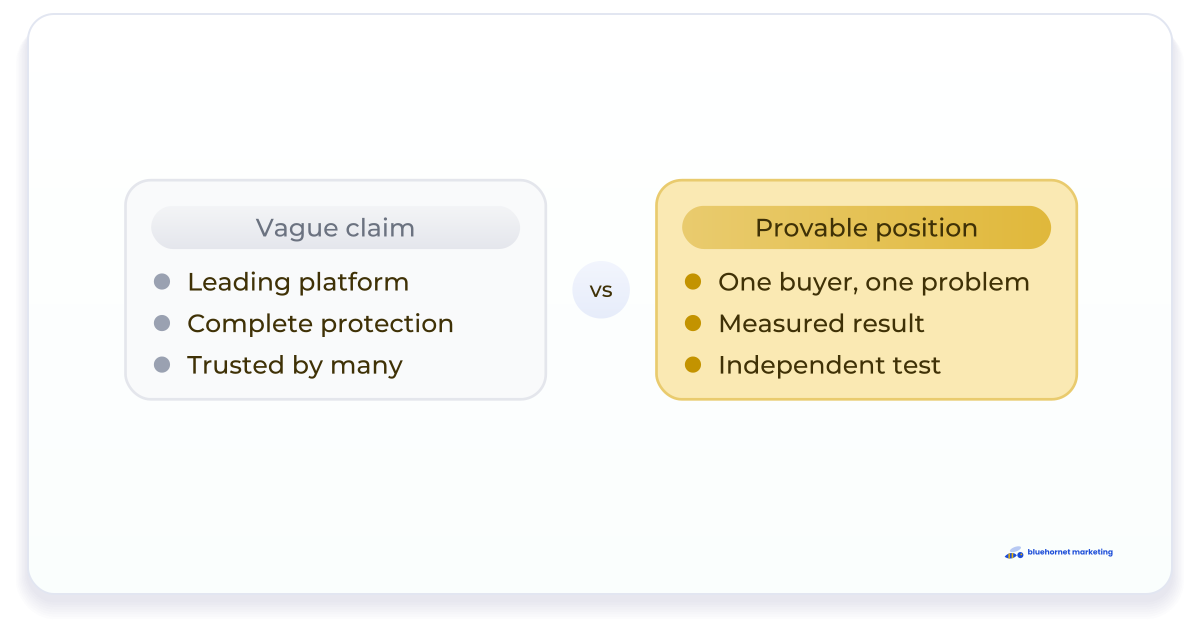
Start by naming the one thing you do better, for one kind of buyer. "Endpoint protection for mid-sized hospitals with small IT teams" is a position. "Next-generation cybersecurity" is not, and every buyer scrolls past it.
Collect three proof points: a measurable result, an independent test or certification and a customer who will speak. Keep claims narrow and accurate. A defensible claim helps with a skeptical buyer and with your own legal and product teams, who will read the page too.
Test the position with five recent buyers or prospects. Ask them to describe in their own words what you do and why they considered you. The gap between their words and yours is where your messaging needs work, and their phrases often make better headlines than anything written in a meeting room.
Phase 2: Map the Buying Committee
Gartner reports that B2B buyers spend only 17% of their purchase time meeting potential suppliers, and less than that with each one when they compare several. The rest is research and internal discussion, which means your content speaks for you while you are not in the room. Source: Gartner
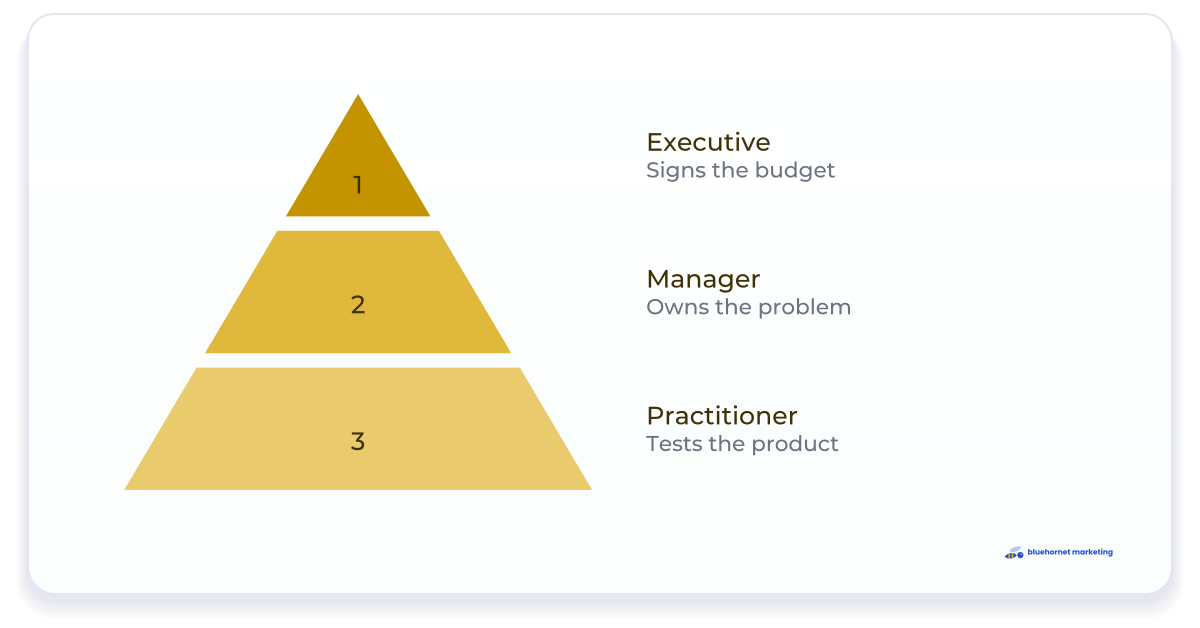
List the people involved: the practitioner who tests, the manager who owns the problem, the executive who funds it and often a finance, legal or procurement reviewer. Sales calls, support tickets and lost-deal notes tell you who really took part, which is often different from the org chart. For each person, write the question they ask and the objection they raise. A practitioner asks "does it integrate with my stack?", while a finance lead asks "what happens if we skip it?".
Phase 3: Build the Core Content Set
You do not need a hundred assets. In my projects, a core set of eight to twelve carries most of the weight: a clear product page, an honest comparison page, integration pages for your top partners, a security and compliance overview, two customer stories, a pricing explanation and a short demo video.
Write each for one role. A page that tries to please the practitioner and the executive tends to bore both. Link them to each other so a champion can forward the right one without writing a long email.
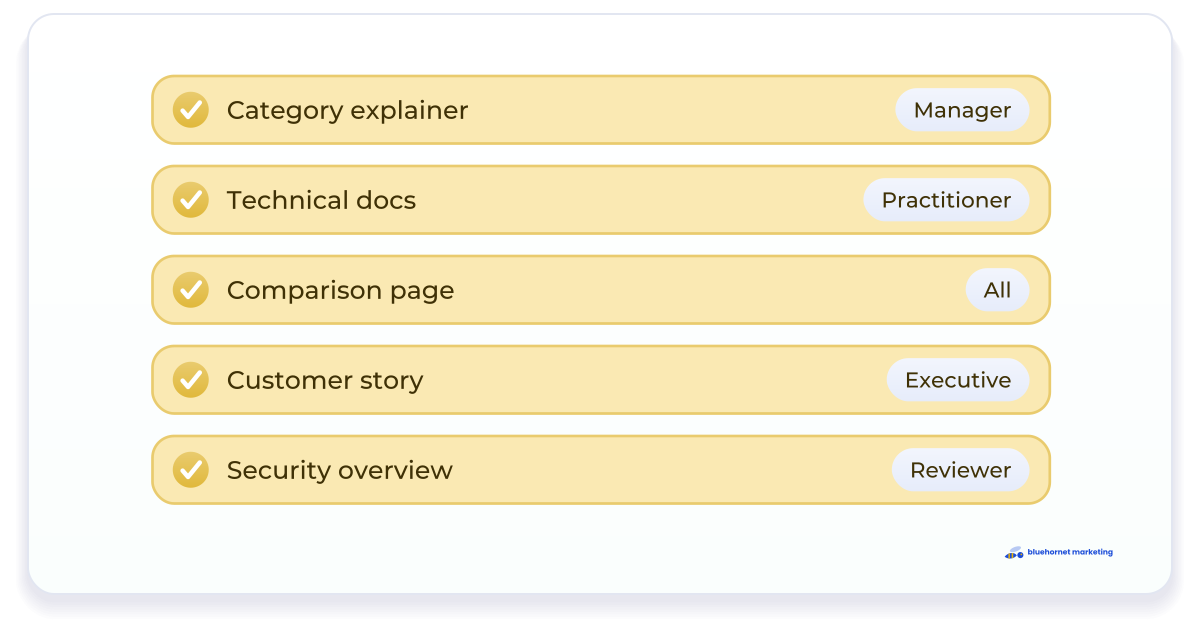
Sequence matters as well. Early-stage buyers need problem and category pages, middle-stage buyers need comparisons and integrations and late-stage buyers need security documents, pricing logic and references. Map each asset to a stage and fill the gaps in order of the deals you lose most often.
Write for scrutiny
Assume every sentence will be checked. State what the product does, what it does not do and where it fits in a larger stack. Buyers read candor as a signal of competence.
Phase 4: Choose Two Lead Channels
Match channels to deal size and sales motion. The table shows my usual starting points, which you should test and not treat as rules.
| Motion | Lead channels | Supporting channels |
|---|---|---|
| Product-led, low price | Search, comparison pages, trials | Email, review sites, communities |
| Mid-market sales-assisted | Search, LinkedIn, webinars | Email nurture, partners, content |
| Enterprise | Account-based outreach, events | LinkedIn, analyst relations, partners |
| MSSP and consultancy | Local search, referrals, content | LinkedIn, speaking, case stories |
Paid search in security is expensive, so give it tight keyword sets and negative lists, and judge it on cost per opportunity. For a view of where buyer behavior is going, I track the shifts in cybersecurity marketing trends.
Comparison pages deserve special care. Buyers search for "vendor A vs vendor B" while they are close to a decision, and a page that fairly states where you fit and where you do not earns trust you cannot buy with ads. Check every statement about a competitor, date the page and update it twice a year.
Phase 5: Turn Interest Into Pipeline
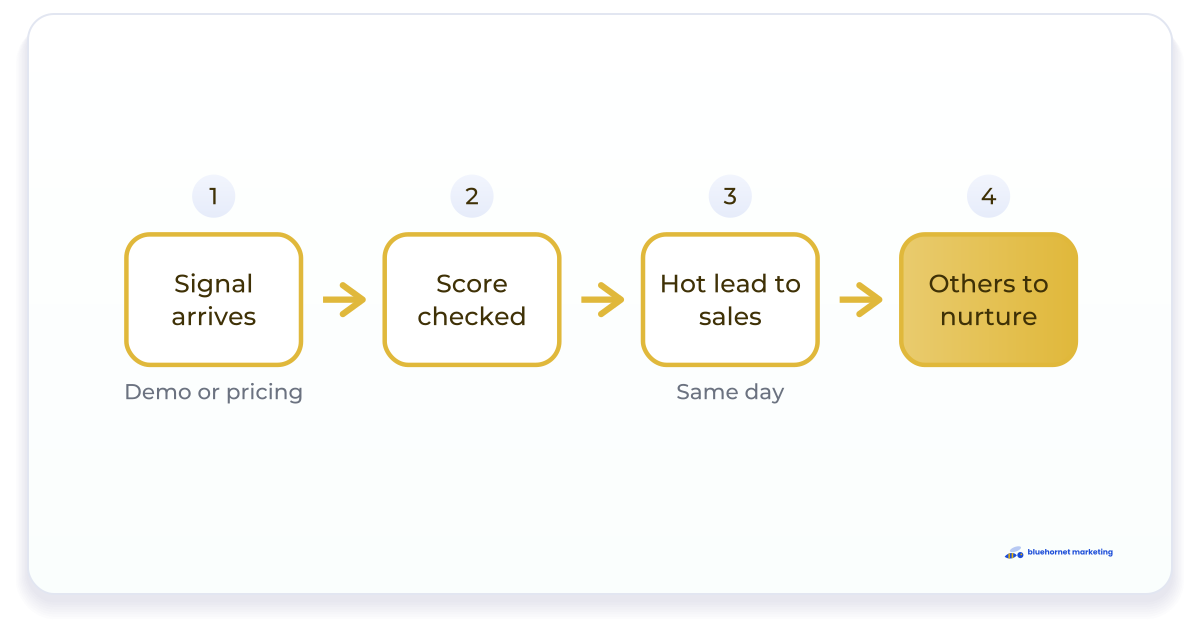
Agree on what counts as a marketing-qualified lead with sales, in writing. Score on role, company fit and behavior such as a pricing page visit or a trial start. Route hot leads to a person within the hour, with a note of what the buyer read.
For everyone else, use a short nurture sequence that teaches something. A buyer who reads three of your pages in a week is more valuable than one who downloaded a report once.
Agree on service levels with sales. A reasonable one is a reply to hot leads within an hour during business days, a follow-up sequence of four touches over two weeks and a written reason whenever a lead is returned to marketing. Review returned leads monthly, because they show you which campaigns are bringing the wrong people.
Phase 6: Measure Pipeline, Not Activity
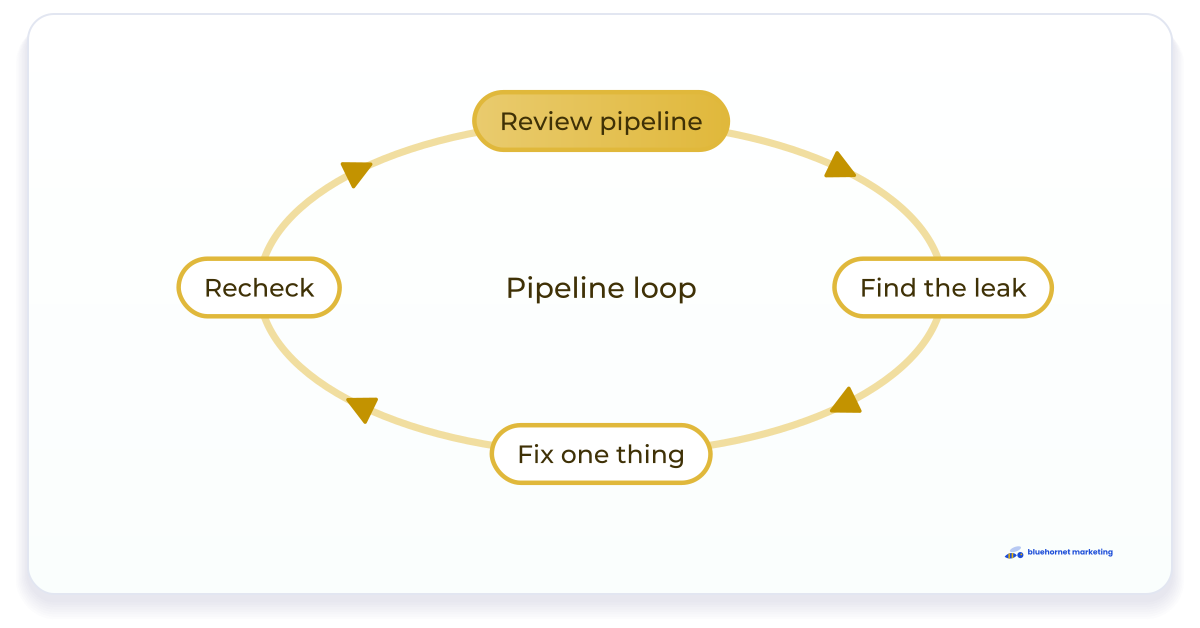
Report five numbers monthly: demos booked, opportunities created, pipeline by source, win rate and sales cycle length. Add engagement from your named accounts if you sell to a list.
Resist the pull toward easy vanity numbers. Traffic and downloads can rise while pipeline stays flat, and finance will notice. For a useful picture of how strong performers present their results, see my selection of cybersecurity marketing examples.
Mistakes That Undercut Security Marketing
The most common mistake is leading with fear. Breach statistics get attention for a day, and then buyers go back to the vendors they already trust. Calm, specific content on how you reduce a named risk holds attention longer and fits better with how a security team talks.
The second is gating everything behind a form. A practitioner who wants a technical answer will not fill in a form to get it, so keep documentation, integration guides and pricing logic open, and gate only the assets that justify the exchange.
The third is ignoring existing customers. Customer stories, reviews and references carry more weight in security than almost any other proof. Build a simple program to ask, record and publish them, with permission and a legal check.
Budget: Demand, Brand and Proof
Split spend into three buckets. Demand programs capture buyers who are looking now, such as search, comparison pages and outbound. Brand and content build recognition among the larger group who will look later. Proof covers customer stories, certifications, independent tests and reviews, which feed both.
A common starting point in my work is about 60% on demand, 25% on brand and content and 15% on proof, adjusted for stage. A young company with no references should push proof higher, because nothing else converts without it. A mature one with a strong name can lean on demand.
Whatever the split, protect the proof budget. Paid campaigns stop when the money stops, while a published customer story and a clear comparison page keep working for years. Review the split each quarter against cost per opportunity and the share of deals where buyers mentioned content in their notes.
Seasonality is mild in security, but budgets are not. Many buyers plan spend in the last quarter for the next year and loosen purchasing at the start of their fiscal year. Time your biggest campaigns and your outreach to named accounts ahead of those windows, and use the quiet months to build content and fix pages.
Events deserve a short rule: go only where your buyers are, bring a specific goal and follow up within a week. Count meetings booked and opportunities created, not badge scans. A small roundtable dinner with ten target accounts often beats a large booth.
A 90-Day Starting Plan
- Days 1 to 30: write the position, map the committee and fix your product and comparison pages.
- Days 31 to 60: publish integration and proof pages and set up scoring and handoff rules.
- Days 61 to 90: launch the first lead channel and review demos and opportunities.
How to Choose Between In-House and Outside Help
Keep position and product knowledge in-house, because nobody else knows your product as well. Bring outside help for audits, channel setup and the pieces your team lacks time for. A good partner shows a clear audit method, gives a fixed quote, reports on pipeline and leaves you with the accounts and documentation.
Be careful with agencies that promise leads in a fixed number of days. Security sales cycles do not bend to marketing calendars, and honest partners will tell you what is likely and when.
Questions About Cybersecurity Marketing Strategy
How Is a Cybersecurity Marketing Strategy Different from Other B2B Strategies?
Trust carries more weight, committees are bigger and buyers are quick to spot hype. Your strategy needs proof and plain language at every step, and it should serve technical and executive readers with different content. The structure is familiar, but the standard of evidence is higher.
Which Channels Work Best for Cybersecurity Companies?
Search on buyer-intent terms, comparison and integration pages, LinkedIn, email nurture and a few well-chosen events are the usual core. Enterprise sellers add account-based programs. Your mix depends on deal size, so rank channels by cost per opportunity once you have data.
How Long Does It Take to See Pipeline from Content?
Paid and outbound can create demo requests within weeks. Content and search normally need three to six months to show traction, and longer for large deals. Judge early progress by qualified demos and engagement from target accounts.
Should I Use Fear-Based Messaging?
I advise against it as a core message. Security buyers have seen it for years and tend to distrust it. Describe the problem accurately, show your approach and let the buyer decide. A calm tone often reads as more competent.
How Do I Market to Both Technical and Executive Buyers?
Build two tracks. Practitioners want docs, demos, integration details and honest limits. Executives want risk reduction, cost and proof from peers. Give each a path, and make sure your champion can hand the right page to the right person.
What Should I Measure?
Track qualified demos, opportunities created, pipeline by source, win rate and sales cycle length. Add engagement from named accounts if you sell to a list. Downloads and traffic are useful context, but they rarely persuade a finance team.
Do I Need a Separate Budget for Brand and Demand?
Think in two layers. Demand programs capture buyers who are looking now, and brand work builds recognition for the ones who will look later. Most firms I advise keep the larger share on demand and reserve a fixed slice for brand and content.
Disclaimer: This article is for general information only and isn’t legal, financial or tax advice. Treat figures as estimates from typical work and confirm details with your providers before you act.
Was this guide helpful?
Thanks for your feedback.
Warren Albright
Warren leads the Blue Hornet editorial team and works with the consultants to turn real client projects into practical guides on content, paid media, marketing automation, CRM and analytics. He comes from content and demand generation work, edits every article before a working marketing consultant reviews it, and draws on strategies, channel plans and audits from client projects to keep the advice grounded in real numbers.